

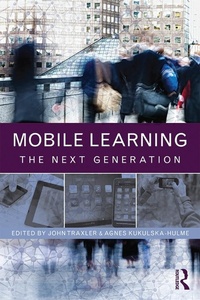
Mobile Learning
The Next Generation
Published on 6. November 2015
250 pages
978-1-135-12366-6 (ISBN)
Description

Mobile Learning: The Next Generation documents the most innovative projects in context-aware mobile learning in order to develop a richer theoretical understanding of learning in modern mobile-connected societies. Context-aware mobile learning takes advantage of cell phone, mobile, and pervasive personal technologies to design learning experiences that exploit the richness of both indoor and outdoor environments. These technologies detect a learner's presence in a particular place, the learner's history in that place or in relation to other people and objects nearby, and adapt learning experiences accordingly, enabling and encouraging learners to use personal and social technologies to capture aspects of the environment as learning resources, and to share their reactions to them.
Reviews / Votes
"Comprehensive and timely, this book is a must-read for any researchers interested in mobile learning. Traxler and Kukulska-Hulme have brought together an interesting and varied set of chapters that cover a wide range of issues and technologies. The future of context-aware mobile learning is challenging, as Mobile Learning: The Next Generation makes clear, but the chapters in this book go a long way towards unpacking many of these challenges."--Rose Luckin, Professor of Learner Centred Design at the London Knowledge Lab, University College London, UK
"Mobile Learning provides a rich, deep analysis and a wider understanding of learning with mobile technologies in connected societies. One of the greatest values and exciting strengths of the book is that it reflects existing terms, considering MOOCS, BYOD, flipped classrooms, learning analytics, big data, ethics, OER, and more, looking beyond these phenomena and 'seeing' that there is no clear separation any longer between acting online and being offline. This book pushes the reflective thinking and development of the field and lays the foundation for a third generation journey."
--Dr. Isa Jahnke, Director of Research for the Information Experience Lab and Associate Professor of Information Science and Learning Technologies at the University of Missouri, USA.
More details
Language
English
Place of publication
London
United Kingdom
Publishing group
Taylor & Francis Ltd
Target group
College/higher education
Professional and scholarly
Illustrations
28 s/w Abbildungen, 16 s/w Tabellen
16 Tables, black and white; 28 Illustrations, black and white
File size
5,24 MB
ISBN-13
978-1-135-12366-6 (9781135123666)
Copyright in bibliographic data and cover images is held by Nielsen Book Services Limited or by the publishers or by their respective licensors: all rights reserved.
Schweitzer Classification
Other editions
Additional editions
Book
11/2015
1st Edition
Routledge
€243.40
Shipment within 15-20 days
Book
11/2015
1st Edition
Routledge
€65.40
Shipment within 15-20 days
Persons
John Traxler was Professor of Mobile Learning (the world's first) and is now Professor of Digital Learning in the Institute of Education at the University of Wolverhampton, UK. He is a Founding Director and current Vice-President of the International Association for Mobile Learning, Associate Editor of the International Journal of Mobile and Blended Learning and of Interactive Learning Environments.
Agnes Kukulska-Hulme is Past-President of the International Association for Mobile Learning, Professor of Learning Technology and Communication in the Institute of Educational Technology at the Open University, UK, and Programme Manager for the Next Generation Distance Learning research programme in the institute.
Agnes Kukulska-Hulme is Past-President of the International Association for Mobile Learning, Professor of Learning Technology and Communication in the Institute of Educational Technology at the Open University, UK, and Programme Manager for the Next Generation Distance Learning research programme in the institute.
Content
Chapter 1: Introduction to the Next Generation of Mobile Learning by John Traxler & Agnes Kukulska-Hulme
Chapter 2: Technologies and Applications for Context-aware Mobile Learning by David Metcalf and Angela Hamilton
Chapter 3: Integrating Mobile Technologies in the Italian Educational Context by Marco Arrigo, Giovanni Fulantelli, Manuel Gentile, and Davide Taibi
Chapter 4: Mobile Informal Learning through Geocaching by Gill Clough
Chapter 5: Learning-through-Touring: A Methodology for Mobilising Learners by Juliet Sprake
Chapter 6: Technology Integration in Next Generation Mobile Learning by Teemu H. Laine and Eeva Nygren
Chapter 7: Exploring the potentials of mobile learning for stroke patients: RehabMaster Mobile by Ahreum Lee, Jieun Kim, and Hokyoung Ryu
Chapter 8: Analyzing Context for Mobile Augmented Reality Prototypes in Education by Brenda Bannan
Chapter 9: Making Sense of Context for Mobile Learning by Mike Sharples
Chapter 10: Beyond Innovation in Mobile Learning: Towards Sustainability in Schools by Teresa Cerratto-Pargman and Marcelo Milrad
Chapter 11: Challenges and Barriers for Mobile Learning in Security and Defense Organizations by Christian Glahn
Chapter 12: Context Reconsidered by John Traxler
Conclusion: Contextual Challenges for the Next Generation
Index
Chapter 2: Technologies and Applications for Context-aware Mobile Learning by David Metcalf and Angela Hamilton
Chapter 3: Integrating Mobile Technologies in the Italian Educational Context by Marco Arrigo, Giovanni Fulantelli, Manuel Gentile, and Davide Taibi
Chapter 4: Mobile Informal Learning through Geocaching by Gill Clough
Chapter 5: Learning-through-Touring: A Methodology for Mobilising Learners by Juliet Sprake
Chapter 6: Technology Integration in Next Generation Mobile Learning by Teemu H. Laine and Eeva Nygren
Chapter 7: Exploring the potentials of mobile learning for stroke patients: RehabMaster Mobile by Ahreum Lee, Jieun Kim, and Hokyoung Ryu
Chapter 8: Analyzing Context for Mobile Augmented Reality Prototypes in Education by Brenda Bannan
Chapter 9: Making Sense of Context for Mobile Learning by Mike Sharples
Chapter 10: Beyond Innovation in Mobile Learning: Towards Sustainability in Schools by Teresa Cerratto-Pargman and Marcelo Milrad
Chapter 11: Challenges and Barriers for Mobile Learning in Security and Defense Organizations by Christian Glahn
Chapter 12: Context Reconsidered by John Traxler
Conclusion: Contextual Challenges for the Next Generation
Index
