

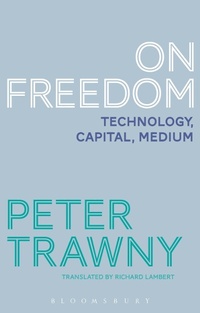
On Freedom
Technology, Capital, Medium
1st Edition
Published on 16. November 2017
208 pages
978-1-4742-7305-3 (ISBN)
Description

How do we challenge the structures of late capitalism if all possible media through which to do do is inescapably capitalist? This urgent political question is at the heart of Peter Trawny's major new work.
With searing precision Trawny demonstrates how our world has become wholly determined by technology, capital, and the medium. In this world of the 'TCM', we universal subjects remain in a state of apathy that is temporarily punctuated, but also reinforced, by the phantasmatic dream of difference offered us by the 'Hollywood machine.' Our sole motivation is to gain money and the power it brings. The only meaningful difference in the world of the TCM universal is the difference between wealth and poverty. Freedom is then only the freedom to dispose of things (particularly technological objects) and to gain pleasure. It makes our relation to our surroundings essentially 'touristic,' and our relation to the earth an essentially exploitative one.
The notion of personal or societal freedom has never been more controversial or, seemingly, more far from our grasp. While exploring in details the difficulties we face in our attempts to be free, Trawny builds a vision of how to break out of the mediums in which we operate and experience a new kind of freedom. Escape from the TCM universal is impossible. Yet philosophy itself is the impossible. So when Trawny writes that "escape-the other-is impossible," we can read this both as "escape is impossible" and as "escape is the impossible," that is, the only possible escape is through philosophy.
With searing precision Trawny demonstrates how our world has become wholly determined by technology, capital, and the medium. In this world of the 'TCM', we universal subjects remain in a state of apathy that is temporarily punctuated, but also reinforced, by the phantasmatic dream of difference offered us by the 'Hollywood machine.' Our sole motivation is to gain money and the power it brings. The only meaningful difference in the world of the TCM universal is the difference between wealth and poverty. Freedom is then only the freedom to dispose of things (particularly technological objects) and to gain pleasure. It makes our relation to our surroundings essentially 'touristic,' and our relation to the earth an essentially exploitative one.
The notion of personal or societal freedom has never been more controversial or, seemingly, more far from our grasp. While exploring in details the difficulties we face in our attempts to be free, Trawny builds a vision of how to break out of the mediums in which we operate and experience a new kind of freedom. Escape from the TCM universal is impossible. Yet philosophy itself is the impossible. So when Trawny writes that "escape-the other-is impossible," we can read this both as "escape is impossible" and as "escape is the impossible," that is, the only possible escape is through philosophy.
More details
Edition
1. Auflage
Language
English
Place of publication
London
United Kingdom
Publishing group
Bloomsbury Publishing PLC
Target group
College/higher education
ISBN-13
978-1-4742-7305-3 (9781474273053)
Copyright in bibliographic data and cover images is held by Nielsen Book Services Limited or by the publishers or by their respective licensors: all rights reserved.
Schweitzer Classification
Other editions
Additional editions
Book
11/2017
Bloomsbury Academic
€36.30
Shipment within 15-20 days
Persons
Peter Trawny is Professor of Philosophy at Bergische University, Wuppertal, Germany. A specialist in phenomenological and hermeneutical political philosophy and aesthetics, he is the author of books on Heidegger, Hegel, Arendt, and Plato, and a co-editor of Heidegger's Gesamtausgabe, or the complete works (vol. 35, 69.73, 90).
Richard Lambert is a translator based in Berlin. He gained his PhD in philosophy from the University of Warwick.
Richard Lambert is a translator based in Berlin. He gained his PhD in philosophy from the University of Warwick.
Content
Preface
1. The Double Topology
1.1 The Poetic Topology
1.2 The Mathematico-Technological Topology
2. The Idea-Matter-Matrix
3. What Is:
3.1 Technology
3.2 Capital
3.3 Medium
3.4 The TCM Universal
3.4.1 The Scientific Universal
3.4.2 The Human Universal
3.4.3 The Natural Universal
3.4.4 The First Universal Hierarchy
3.4.5 The Second Universal Hierarchy: Quantity ? Quality
3.4.51 Excursus: Quantity and Time
4. The Universal and the Universal Topology
5. The Universal Subject
5.1 The Subject before the TCM Universal: Solipsism and Intimacy
5.2 The Subject within the TCM Universal: Indifference and Normality
6. Pragma-Politics
7. The Final Revolution
8. Anachronisms
9. The Double Topology and the Museum
10. Patho-topo-logy
10.1 The Patho-topo-logy of the Subject in the TCM Universal I
10.2 The Patho-topo-logy of the Subject in the TCM Universal II: Loss
11. The Differentiated Subject/Violence
12. Intimacy and Freedom
13. Philosophy as Impossibility
Note on the Wittgenstein Citation
Notes
1. The Double Topology
1.1 The Poetic Topology
1.2 The Mathematico-Technological Topology
2. The Idea-Matter-Matrix
3. What Is:
3.1 Technology
3.2 Capital
3.3 Medium
3.4 The TCM Universal
3.4.1 The Scientific Universal
3.4.2 The Human Universal
3.4.3 The Natural Universal
3.4.4 The First Universal Hierarchy
3.4.5 The Second Universal Hierarchy: Quantity ? Quality
3.4.51 Excursus: Quantity and Time
4. The Universal and the Universal Topology
5. The Universal Subject
5.1 The Subject before the TCM Universal: Solipsism and Intimacy
5.2 The Subject within the TCM Universal: Indifference and Normality
6. Pragma-Politics
7. The Final Revolution
8. Anachronisms
9. The Double Topology and the Museum
10. Patho-topo-logy
10.1 The Patho-topo-logy of the Subject in the TCM Universal I
10.2 The Patho-topo-logy of the Subject in the TCM Universal II: Loss
11. The Differentiated Subject/Violence
12. Intimacy and Freedom
13. Philosophy as Impossibility
Note on the Wittgenstein Citation
Notes
