

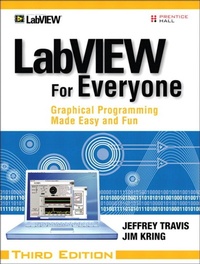
LabVIEW for Everyone, Third Edition
Graphical Programming Made Easy and Fun
3rd Edition
Published on 24. May 2011
1056 pages
978-0-13-241224-7 (ISBN)
Description

This is the eBook version of the printed book. If the print book includes a CD-ROM, this content is not included within the eBook version.
The #1 Step-by-Step Guide to LabVIEW-Now Completely Updated for LabVIEW 8!
Master LabVIEW 8 with the industry's friendliest, most intuitive tutorial: LabVIEW for Everyone, Third Edition. Top LabVIEW experts Jeffrey Travis and Jim Kring teach LabVIEW the easy way: through carefully explained, step-by-step examples that give you reusable code for your own projects!
This brand-new Third Edition has been fully revamped and expanded to reflect new features and techniques introduced in LabVIEW 8. You'll find two new chapters, plus dozens of new topics, including Project Explorer, AutoTool, XML, event-driven programming, error handling, regular expressions, polymorphic VIs, timed structures, advanced reporting, and much more. Certified LabVIEW Developer (CLD) candidates will find callouts linking to key objectives on NI's newest exam, making this book a more valuable study tool than ever.
Not just what to do: why to do it!
Use LabVIEW to build your own virtual workbench
Master LabVIEW's foundations: wiring, creating, editing, and debugging VIs; using controls and indicators; working with data structures; and much more
Learn the "art" and best practices of effective LabVIEW development
NEW: Streamline development with LabVIEW Express VIs
NEW: Acquire data with NI-DAQmx and the LabVIEW DAQmx VIs
NEW: Discover design patterns for error handling, control structures, state machines, queued messaging, and more
NEW: Create sophisticated user interfaces with tree and tab controls, drag and drop, subpanels, and more
Whatever your application, whatever your role, whether you've used LabVIEW or not, LabVIEW for Everyone, Third Edition is the fastest, easiest way to get the results you're after!
The #1 Step-by-Step Guide to LabVIEW-Now Completely Updated for LabVIEW 8!
Master LabVIEW 8 with the industry's friendliest, most intuitive tutorial: LabVIEW for Everyone, Third Edition. Top LabVIEW experts Jeffrey Travis and Jim Kring teach LabVIEW the easy way: through carefully explained, step-by-step examples that give you reusable code for your own projects!
This brand-new Third Edition has been fully revamped and expanded to reflect new features and techniques introduced in LabVIEW 8. You'll find two new chapters, plus dozens of new topics, including Project Explorer, AutoTool, XML, event-driven programming, error handling, regular expressions, polymorphic VIs, timed structures, advanced reporting, and much more. Certified LabVIEW Developer (CLD) candidates will find callouts linking to key objectives on NI's newest exam, making this book a more valuable study tool than ever.
Not just what to do: why to do it!
Use LabVIEW to build your own virtual workbench
Master LabVIEW's foundations: wiring, creating, editing, and debugging VIs; using controls and indicators; working with data structures; and much more
Learn the "art" and best practices of effective LabVIEW development
NEW: Streamline development with LabVIEW Express VIs
NEW: Acquire data with NI-DAQmx and the LabVIEW DAQmx VIs
NEW: Discover design patterns for error handling, control structures, state machines, queued messaging, and more
NEW: Create sophisticated user interfaces with tree and tab controls, drag and drop, subpanels, and more
Whatever your application, whatever your role, whether you've used LabVIEW or not, LabVIEW for Everyone, Third Edition is the fastest, easiest way to get the results you're after!
More details
Edition
3rd edition
Language
English
Place of publication
United States
Publishing group
Pearson Education (US)
Target group
Professional and scholarly
File size
19,77 MB
ISBN-13
978-0-13-241224-7 (9780132412247)
Copyright in bibliographic data and cover images is held by Nielsen Book Services Limited or by the publishers or by their respective licensors: all rights reserved.
Schweitzer Classification
Other editions
Additional editions
Book
08/2006
3rd Edition
Prentice Hall
€86.62
Article exhausted; check different version
Persons
Jeffrey Travis provides expert consulting and creates books, courses, and products for remote Internet controls and monitoring, virtual instrumentation, and Web applications through his company, Jeffrey Travis Studios. He has more than fifteen years of experience developing software, teaching, and consulting on LabVIEW and related technologies. He holds an M.S. in engineering from the University of Texas at Austin.
Jim Kring is president of James Kring, Inc., a leader in LabVIEW development, system integration consulting, and custom software design. He is founder of OpenG, a foundation promoting open-source LabVIEW tools, applications, frameworks, and documentation.
Jim Kring is president of James Kring, Inc., a leader in LabVIEW development, system integration consulting, and custom software design. He is founder of OpenG, a foundation promoting open-source LabVIEW tools, applications, frameworks, and documentation.
Content
About the Authors xxix
Preface xxxi
Acknowledgments xli
1 What in the World Is LabVIEW? 3
2 Virtual Instrumentation: Hooking Your Computer Up to the Real World 21
3 The LabVIEW Environment 41
4 LabVIEW Foundations 101
5 Yet More Foundations 147
6 Controlling Program Execution with Structures 185
7 LabVIEW's Composite Data: Arrays and Clusters 245
8 LabVIEW's Exciting Visual Displays: Charts and Graphs 301
9 Exploring Strings and File I/O 379
10 Signal Measurement and Generation: Data Acquisition 419
11 Data Acquisition in LabVIEW 465
12 Instrument Control in LabVIEW 523
13 Advanced LabVIEW Structures and Functions 553
14 Advanced LabVIEW Data Concepts 673
15 Advanced LabVIEW Features 721
16 Connectivity in LabVIEW 799
17 The Art of LabVIEW Programming 853
Appendix A CD Contents 891
Appendix B Add-on Toolkits for LabVIEW 893
Appendix C Open Source Tools for LabVIEW: OpenG 897
Appendix D LabVIEW Object-Oriented Programming 901
Appendix E Resources for LabVIEW 921
Appendix F LabVIEW Certification Exams 925
Glossary 931
Index 959
Preface xxxi
Acknowledgments xli
1 What in the World Is LabVIEW? 3
2 Virtual Instrumentation: Hooking Your Computer Up to the Real World 21
3 The LabVIEW Environment 41
4 LabVIEW Foundations 101
5 Yet More Foundations 147
6 Controlling Program Execution with Structures 185
7 LabVIEW's Composite Data: Arrays and Clusters 245
8 LabVIEW's Exciting Visual Displays: Charts and Graphs 301
9 Exploring Strings and File I/O 379
10 Signal Measurement and Generation: Data Acquisition 419
11 Data Acquisition in LabVIEW 465
12 Instrument Control in LabVIEW 523
13 Advanced LabVIEW Structures and Functions 553
14 Advanced LabVIEW Data Concepts 673
15 Advanced LabVIEW Features 721
16 Connectivity in LabVIEW 799
17 The Art of LabVIEW Programming 853
Appendix A CD Contents 891
Appendix B Add-on Toolkits for LabVIEW 893
Appendix C Open Source Tools for LabVIEW: OpenG 897
Appendix D LabVIEW Object-Oriented Programming 901
Appendix E Resources for LabVIEW 921
Appendix F LabVIEW Certification Exams 925
Glossary 931
Index 959
