

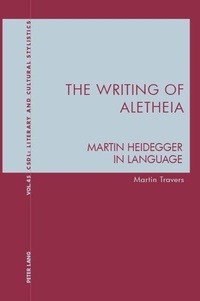
The Writing of Aletheia
Description

Martin Heidegger was engaged in a continual struggle to find words - new words, both descriptive and analytical - for his radical form of philosophy. This tendency can be traced from Being and Time, where he elaborated an entirely new vocabulary for his ontological enquiry; to Contributions to Philosophy, which saw him committed to a transformation of language; to later essays on poets such as Rilke and Trakl in On the Way to Language.
The Writing of Aletheia is the first study to appear in either English or German that provides a full account of Heidegger's language and writing style. Focusing not only on his major philsophical works but also on his lectures, public talks and poetry, this book explores the complex textuality of Heidegger's writing: the elaborate chains of wordplay and neologistic formations; the often oblique, circuitous and regressive exposition of his ideas; the infamous tautologies; the startling modification of grammatical rules and syntax; the idiosyncratic typography of his texts; the rhetorical devices, imagery and symbolism; and the tone and voice of his writing. All of these aspects betray not only his will to structure and his assertiveness but also his ongoing self-questioning and reflectiveness about the ultimate goal of his philosophical quest.
More details
Other editions
Additional editions
Person
Content
CONTENTS: Language: Housing Being - The Language of Ontology: Being and Time - The Performative Text: Contributions to Philosophy (from Ereignis) - Re-calling the Originary: Parmenides - What Thinking Is Given to Think: On the Way to Language - The Triumph of Ratio: "The Question Concerning Technology"
