

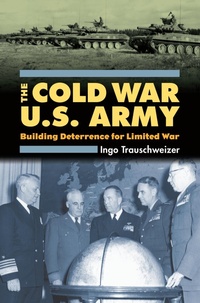
The Cold War U.S. Army
Description

Winner: Army Historical Foundation Distinguished Book Award
Winner: Society for Military History Book Award
Choice Outstanding Title
The Cold War marked a new era for America's military, one dominated by nuclear weapons and air power that seemed to diminish the need for conventional forces. Ingo Trauschweizer chronicles the U.S. Army's struggles with its identity, structure, and mission in the face of those challenges, showing how it evolved, redefined its mission more than once, and ultimately transformed itself.
Trauschweizer describes how, beginning in the 1950s, the army faced an unprecedented problem: how to maintain a combat-ready fighting force that could operate on both conventional and nuclear battlefields. Faced with shifting threats to national security, budgetary battles, and unstable political developments around the globe, the army also had to keep abreast of new weaponry while navigating changes in its own top brass and the presidency.
Trauschweizer particularly considers the army's organizational and doctrinal response to problems posed by deterrence in Europe, focusing on the evolving role of the Seventh Army in West Germany?the largest and best-prepared field army the U.S. had ever deployed in peacetime. He explores the roles of Generals Matthew Ridgway, Maxwell Taylor, and others, as well as the use role of tactical nuclear weapons, as he traces the army's transformation through the New Look policy, pentomic reorganization, and the adoption of the ROAD concept.
Ultimately, Trauschweizer contends, the army found it impossible to prepare for limited war in the Third World while pursuing its primary mission of deterrence in Europe. His revisionist argument about the army's objectives in the 1960s and early 1970s places the Vietnam War in the context of the wider Cold War, offering new lines of inquiry into both. He also shows how, after the debacle of Vietnam, the army's sense of mission, technological evolution, organizational structure, and operational doctrine matured to produce the AirLand Battle doctrine of 1982, the cornerstone of our defense of Europe until the Cold War finally ended.
The U.S. Army's evolution during the 1950s and its role in Europe throughout the Cold War have remained two of the most neglected subjects in American military history. By covering the interaction of strategy, organization, doctrine, and technology in the army during this era?as well as the relationship between army doctrine and U.S./NATO defense strategy?The Cold War U.S. Army marks a major contribution to our understanding of both subjects.
More details
Other editions
Additional editions
Person
Ingo Trauschweizer is visiting assistant professor of history at New Mexico Tech. He has also taught at Norwich University and the University of Maryland.
Content
Preface
List of Abbreviations
Maps
Introduction
1. The U.S. Army in National and Alliance Strategy
2. Atomic Weapons and Limited War
3. The Pentomic Army in Germany
4. The ROAD Army and Flexible Response
5. The ROAD Army in Germany and Vietnam
6. The Cold War Army
Conclusion
Appendixes
Notes
Bibliography
Index
