

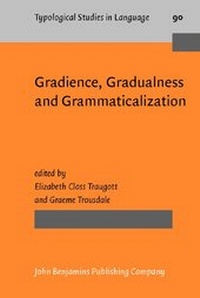
Gradience, Gradualness and Grammaticalization
1st Edition
Published on 24. February 2010
IX, 306 pages
978-90-272-8844-8 (ISBN)
Description

This volume, which emerged from a workshop at the New Reflections on Grammaticalization 4 conference held at KU Leuven in July 2008, contains a collection of papers which investigate the relationship between synchronic gradience and the apparent gradualness of linguistic change, largely from the perspective of grammaticalization. In addition to versions of the papers presented at the workshop, the volume contains specially commissioned contributions, some of which offer commentaries on a subset of the other articles. The articles address a number of themes central to grammaticalization studies, such as the role of reanalysis and analogy in grammaticalization, the formal modelling of grammaticalization, and the relationship between formal and functional change, using data from a range of languages, and (in some cases) from particular electronic corpora. The volume will be of specific interest to historical linguists working on grammaticalization, and general linguists working on the interface between synchrony and diachrony.
More details
Other editions
Additional editions
Elizabeth Closs Traugott | Graeme Trousdale
Gradience, Gradualness and Grammaticalization
Book
02/2010
John Benjamins Publishing Co
€104.94
Shipment within 10-15 days
Persons
Content
- Gradience, Gradualness and Grammaticalization
- Editorial page
- Title page
- LCC data
- Table of contents
- Contributors
- Acknowledgements
- Preface
- 1. Introduction
- 2. The questions
- 3. The papers
- 4. Themes in the papers
- 5. Conclusion
- References
- Gradience, gradualness and grammaticalization
- 1. Introduction
- 2. Some background
- 2.1 Gradience
- 2.2 Gradualness
- 3. How are we to understand the intersection between synchronic gradience and grammaticalization?
- 3.1 How does grammaticalization intersect with gradience?
- 4. What does the intersection between synchronic gradience and grammaticalization tell us about whether work on grammaticalization needs reanalysis and analogy/extension, or some other mechanism?
- 4.1 Reanalysis
- 4.2 Analogy
- 4.3 Distinguishing mechanisms from motivations
- 5. Conclusion
- References
- Grammaticalization, the clausal hierarchy and semantic bleaching
- 1. Introduction
- 2. The formal approach to grammaticalization
- 3. The Cinque hierarchy
- 4. Grammaticalization and the Cinque hierarchy
- 4.1 Romance futures/conditionals
- 4.2 Perfects to preterits
- 4.3 Modals
- 4.4 Some less well-known cases
- 4.5 Conclusion
- 5. Semantic bleaching and grammaticalization
- 6. Conclusion
- References
- Grammatical interference
- 1. Introduction
- 2. For and the for...to-infinitive
- 2.1 The emergence of the for...to-infinitive
- 2.2 The survival of the for...to-infinitive
- 2.3 The diffusion of the for...to-infinitive
- 3. The phrasal verb particles out and forth
- 3.1 Main semantic and collocational developments in out
- 3.2 Semantic and collocational overlap between out and forth
- 3.3 Inter-particle interference
- 4. Implications
- 4.1 Gradience and the structure of grammar
- 4.2 Grammaticalization
- 5. Conclusions
- Digital data sources
- References
- Category change in English with and without structural change
- 1. Introduction
- 2. Category change without structural change
- 2.1 N~A
- 2.2 Constructions
- 2.3 Gradience
- 2.4 A~D
- 3. Category change with structural change
- 3.1 on behalf of
- 3.2 Non-gradient accounts
- 4. New category
- 5. Conclusion
- References
- Features in reanalysis and grammaticalization
- 1. Introduction
- 2. Where have parameters gone?
- 3. Features
- 4. From P to C
- 4.1 De Smet
- 4.2 From PP to C
- 4.3 For as subject marker
- 5. Small changes or gradient ones?
- 6. Directionality and renewal
- 7. Conclusion
- References
- How synchronic gradience makes sense in the light of language change (and vice versa)
- 1. Introduction
- 2. Modifying Aarts's assumptions on syntactic gradience
- 3. Gradience between constructions with determiner genitives and noun modifiers
- 3.1 Synchronic gradience between constructions with determiner genitives and noun modifiers: Mismatch(es) and bridging constructions
- 3.2 The diachronic emergence of a synchronically gradient construction: Determiner noun modifiers in the making
- 4. On the relation between synchronic gradience and language change: Synopsis and outlook
- 4.1 Synopsis: Synchronic gradience and language change
- 4.2 A semantic account of gradience
- 4.3 The emergence of a new construction and the distinction between analogy and reanalysis
- 4.4 Beyond English - a (brief) look at typology
- References
- What can synchronic gradience tell us about reanalysis?
- 1. Introduction
- 2. Verb-first conditionals in German and Swedish
- 3. Data and analysis
- 4. Conclusions
- References
- A paradigmatic approach to language and language change
- 1. Introduction
- 2. Synchronic gradience and gradual language change
- 3. Reanalysis and analogy
- 4. The relation between constructional paradigms
- 5. Conclusion
- References
- Grammaticalization and the it-cleft construction
- 1. Introduction
- 2. The development of non-NP focus it-clefts
- 2.1 Ball (1991, 1994) and the AdvP/PP it-cleft
- 2.2 A grammaticalization story for the development of non-NP it-clefts
- 3. The development of the 'informative-presupposition' (IP) it-cleft
- 3.1 Ball (1991, 1994) and the IP it-cleft
- 3.2 A grammaticalization story for the development of the IP it-cleft
- 4. Grammaticalization, mismatch and synchronic gradience/variation
- 5. Conclusions
- References
- Grammaticalization in Chinese
- 1. Setting the stage: A constructional approach to grammaticalization
- 2. Basic assumptions about constructions
- 3. Two basic typological properties of Late Archaic Chinese: Precategoriality and hidden complexity
- 3.1 Precategoriality and the argument structure construction
- 3.2 Hidden complexity and the lack of obligatory grammatical markers
- 4. Problems with subsective gradience vs. intersective gradience (Aarts 2004, 2007)
- 5. Continuity in synchrony: Reanalysis, analogy, gradience and gradualness
- 6. Continuity in diachrony: The emergence of the resultative construction
- 6.1 Preliminaries
- 6.2 How to account for the resultative construction in Modern Standard Chinese
- 6.3 The historical development of the resultative construction
- 7. Conclusion
- References
- Grammaticalization and models of language
- 1. Scene setting
- 2. Theory and pre-theory
- 3. Formal vs. functional
- 4. Directionality and degrammaticalization
- 5. Reanalysis and the generative enterprise
- 6. Formal semantics
- 7. LFG, gradience and stochastic OT
- 8. Dynamic syntax
- 9. Conclusions
- References
- Language index
- Subject index
- The series Typological Studies in Language
