

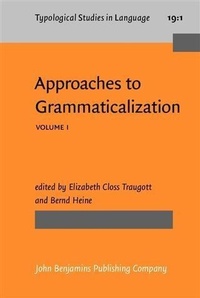
Approaches to Grammaticalization
Volume I. Theoretical and methodological issues
1st Edition
Published on 15. October 1991
XII, 360 pages
978-90-272-7762-6 (ISBN)
Description

The study of grammaticalization raises a number of fundamental theoretical issues pertaining to the relation of langue and parole, creativity and automatic coding, synchrony and diachrony, categoriality and continua, typological characteristics and language-specific forms, etc., and therefore challenges some of the basic tenets of twentieth century linguistics.This two-volume work presents a number of diverse theoretical viewpoints on grammaticalization and gives insights into the genesis, development, and organization of grammatical categories in a number of language world-wide, with particular attention to morphosyntactic and semantic-pragmatic issues.
The papers in Volume I are divided into two sections, the first concerned with general method, and the second with issues of directionality. Those in Volume II are divided into five sections: verbal structure, argument structure, subordination, modality, and multiple paths of grammaticalization.
The papers in Volume I are divided into two sections, the first concerned with general method, and the second with issues of directionality. Those in Volume II are divided into five sections: verbal structure, argument structure, subordination, modality, and multiple paths of grammaticalization.
More details
Other editions
Additional editions
Elizabeth Closs Traugott | Bernd Heine
Approaches to Grammaticalization
Volume I. Theoretical and methodological issues
Book
10/1991
John Benjamins Publishing Co
€157.94
Shipment within 10-15 days
Content
- APPROACHES TO GRAMMATICALIZATION
- Editorial page
- Title page
- Copyright page
- Table of contents
- ABBREVIATIONS
- Foreword
- Introduction
- 1. INTRODUCTION
- 2. THE LEXICAL ITEM& MORPHEME MODEL
- 3. THE DISCOURSE & MORPHOSYNTAX PERSPECTIVE
- 4. THE GRAMMATICAL CODING PERSPECTIVE ON GRAMMATICALIZATION
- 5. THE RELATION OF DIACHRONIC GRAMMATICALIZATION TO LANGUAGE CHANGE
- 6. THE UNIDIRECTIONALITY OF GRAMMATICALIZATION
- 7. COUNTEREXAMPLES TO UNIDIRECTIONALITY
- 8. MECHANISMS OF LANGUAGE CHANGE RELEVANT TO GRAMMATICALIZATION
- 9. CONDITIONS LICENSING GRAMMATICALIZATION
- 10. SOME QUESTIONS FOR THE FURTHER STUDY OF GRAMMATICALIZATION
- 11. ORGANIZATION OF THE VOLUMES
- ACKNOWLEDGMENTS
- REFERENCES
- SECTION A: GENERAL METHOD
- On Some Principles of Grammaticization
- 1. INTRODUCTION1
- 2. GRAMMAR: SOME WORKING ASSUMPTIONS
- 3. THE PRINCIPLES
- 3.1. Layering
- 3.2. Divergence
- 3.3. Specialization
- 3.4. Persistence
- 3.5. De-categorialization
- 4. CONCLUSIONS
- NOTES
- REFERENCES
- On the Gradualness of Grammaticalization
- 1. INTRODUCTION
- 2. VERB-LIKE PREPOSITIONS
- 2.1. Indexing of direct objects
- 2.2. Verb-like prepositions: Similarities to transitive verbs
- 2.3. Other prepositions
- 2.4. Reduced variants of the verb-like prepositions
- 2.5. Frequencies of use of the innovative variants
- 2.6. Emergence of a new syntactic subcategory
- 3. A VERB-LIKE PREPOSITION AND A CONJUNCTION
- 4. VERB-LIKE COMPLEMENTIZERS
- 4.1. Pairings of prepositional and complementizer functions
- 4.2. Variant forms of the complementizers
- 4.3. Pairing of the ablative and the purpose functions
- 4.4. Functional shifts among the complementizers
- 5. SUMMARY AND DISCUSSION
- NOTES
- REFERENCES
- SerialVerbs and the Mental Reality of 'Event': Grammatical vs. Cognitive Packaging
- 1. THE PHENOMENON
- 2. THEORETICAL ISSUES: GRAMMAR VS. COGNITION
- 3. EMPIRICAL ISSUES: GRAMMAR VS. BEHAVIOR
- 4. METHODOLOGY
- 4.1. Languages
- 4.2. Textelicitation
- 4.2.1. The 'chicken story' movie
- 4.2.2.Elicitation procedures and speakers
- 4.3. Transcription of texts
- 4.4. Phonetic processing of tapes
- 4.5. Pause measurement
- 5. RESULTS OF QUANTITATIVE ANALYSIS
- 5.1. Preamble
- 5.2.Tok Pisin
- 5.2.1. Verb serialization in Tok Pisin
- 5.2.2. Quantitative results: Tok Pisin
- 5.2.2.1. On-line text
- 5.2.2.2. Post-view text
- 5.3. Kalam
- 5.3.1. Verb serialization in Kalam
- 5.3.2. Quantitative results: Kalam
- 5.3.2.1. On-line text
- 5.3.2.2. Post-view text
- 5.4. Tairora
- 5.4.1. Verb serialization in Tairora
- 5.4.2. Quantitative results: Tairora
- 5.4.2.1. On-line text
- 5.4.2.2. Post-view text
- 6. OVERALL COMPARISON
- 6.1. Serial-verb density
- 6.2. Pause distribution
- 6.3. The effect of the on-line text-elicitation technique on pause distribution
- 6.4. Adjacency to another verb-stem and the potential for co-lexicalization or co-grammaticalization
- 6.5. Adjacency to object or instrument nouns: Potential for grammaticalization as case-markers
- 7. SOME TENTATIVE CONCLUSIONS
- 7.1. Empirical methodology
- 7.2. Grammar and culture: Typological vs. cognitive variability
- 8. POSSIBLE EXTENSIONS
- 8.1. Other types of verb serialization
- 8.2. The clause-type continuum
- 8.3. Gradual vs. instantaneous grammaticalization
- ACKNOWLEDGEMENTS
- NOTES
- REFERENCES
- Grammaticalization as Retextualization
- 1. INTRODUCTION
- 2. DESCRIPTIVE NOTIONS
- 3. OLD RUSSIAN PREDICATIVE INSTRUMENTAL
- 4. PREHISTORY OF THE PREDICATIVE INSTRUMENTAL
- 5. MIDDLE RUSSIAN PREDICATIVE INSTRUMENTAL
- 6. CONCLUSIONS
- ABBREVIATIONS
- Notes
- REFERENCES
- SECTION B: DIRECTIONALITY
- From Cognition to Grammar - Evidence from African Languages
- 1. INTRODUCTION1
- 2. THE COGNITIVE SETTING
- 2.1. An underlying principle
- 2.2. Source structures
- 2.2.1. Concepts
- 2.2.2. Propositions
- 2.2.3. Source structures and target structures
- 2.3. Transfer
- 2.3.1. Some prerequisite notions: "Bleaching" and "abstraction
- 2.3.2. Metaphor
- 2.3.3. Chaining
- 2.4. Context-induced reinterpretation (CIR)
- 3. GRAMMAR
- 3.1. Reanalysis
- 3.2. Dependency
- 3.3. Grammaticalization chains
- 3.4. Grammaticalization and discourse role
- 3.5. Problems of grammatical description
- 3.5.1. 'Back' in So
- 3.5.2. Some conclusions
- 4. Summary
- NOTES
- REFERENCES
- The Semantics-Pragmatics of Grammaticalization Revisited
- 1. INTRODUCTION
- 2. SOME THEORETICAL AND METHODOLOGICAL ASSUMPTIONS
- 3. THE CONVENTIONALIZING OF CONVERSATIONAL IMPLICATURES
- 3.1. Inferred causation
- 3.2. From concomitance to concessivity
- 3.3. From temporals to preference to denial markers
- 4. STRENGTHENING OF INFORMATIVENESS VS. METAPHORIC PROCESSES
- 5. CONCLUSION
- NOTES
- REFERENCES
- The De Dicto Domain in Language
- 1. PURPOSE AND SCOPE OF THE PAPER
- 2. FROM DEMONSTRATIVE TO COMPLEMENTIZER
- 2.1. What needs to be explained
- 2.2. Hypothesis
- 2.3. Evidence
- 2.3.1. Demonstrative and propositional anaphora
- 2.3.2. Definite article
- 2.3.2. Complements of the verba dicendi
- 2.4. Complements of verba dicendi as complements of other verbs
- 2.5. A case study: Complementizer in Mupun
- 2.5.1. The f orm of the complementizer
- 2.5.2. Anaphora n? as complementizer
- 2.5.3. Complementizer n? as the sole marker of de dicto
- 2.5.4. Epistemic modality after verba dicendi
- 2.5.5. De dicto and the hypothetical: Complements of verbs of perception
- 3. RELATIVE CLAUSES
- 4. DE DICTO REFERENCE SYSTEMS
- 4.1. Two properties
- 4.2. Locative anaphora
- 4.3. Formal distinctions in the de dicto referential systems
- 4.3.1. Addressees in the de dicto and de re domains
- 4.3.2. Interrogative pronouns
- 4.3.3. Plural verb in an interrogative clause
- 4.3.4. Quantifiers and de dicto referents
- 4.3.5. Gender in the de dicto domain in English
- 5. CONCLUSIONS
- ABBREVIATIONS
- ACKNOWLEDGEMENTS
- NOTES
- REFERENCES
- The Grammaticalization of Rhetorical Questionsin Tamil
- 1. INTRODUCTION
- 2. RHETORICAL QUESTIONS: THE THREE TAMIL TYPES
- 2.1. CRQs
- 2.2. TRQs
- 2.3. RTags
- 3. THE INTERACTIVE BASIS OF RHETORICAL QUESTIONS
- 3.1. Rhetorical questions in traditional performance narrative
- 4. FROM "EXPRESSIVE" TO "TEXTUAL" FUNCTIONS
- 4.1. Expressive functions of CRQs
- 4.2. Expressive functions of TRQs
- 4.3. Expressive functions of RTags
- 5. THE GRAMMATICALIZED STATUS OF RQ ELEMENTS
- 5.1. From TRQ to conjunction
- 5.2. From RTag to relativizer
- 6. FROM MORE OR LESS PRAGMATIC: IMPLICATIONS FOR ATHEORY OF GRAMMATICALIZATION
- ABBREVIATIONS
- ACKNOWLEDGEMENTS
- NOTES
- REFERENCES
- Some Grammaticalization Changes in Estonian and their Implications
- 1. INTRODUCTION
- 2. MODUS OBLIQUUS
- 3. EXPLANATIONS
- 4. QUESTION PARTICLES
- 5. IMPLICATIONS
- 6. CONCLUSIONS
- ACKNOWLEDGEMENTS
- NOTES
- REFERENCES
- The Last Stages of Grammatical Elements: Contractive and Expansive Desemanticization
- NOTES
- REFERENCES
- Substrates, Calquing and Grammaticalization in Melanesian Pidgin
- 1. INTRODUCTION1
- 2. TRANSITIVE MARKING
- 3. PREPOSITIONAL VERBS
- 4. THE CALQUING PROCESS: THE CASE OF KAM AND GO
- 5. PREVERBAL PARTICLES MARKING ASPECT/MOOD/ MODALITY
- 6. POSTVERBAL PERFECT-MARKING PARTICLES
- 7. KAM AND GO AS AUXILIARIES
- 8. CONCLUSIONS
- ABBREVIATIONS
- NOTES
- REFERENCES
- Volume I. Index of languages
- Volume I. Index of names
- Volume I. Index of subjects
