

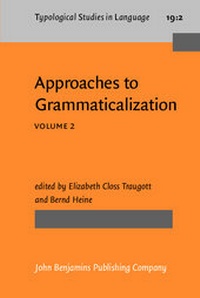
Approaches to Grammaticalization
Volume II. Types of grammatical markers
1st Edition
Published on 15. October 1991
XII, 558 pages
978-90-272-7761-9 (ISBN)
Description

The study of grammaticalization raises a number of fundamental theoretical issues pertaining to the relation of langue and parole, creativity and automatic coding, synchrony and diachrony, categoriality and continua, typological characteristics and language-specific forms, etc., and therefore challenges some of the basic tenets of twentieth century linguistics.This two-volume work presents a number of diverse theoretical viewpoints on grammaticalization and gives insights into the genesis, development, and organization of grammatical categories in a number of language world-wide, with particular attention to morphosyntactic and semantic-pragmatic issues.
The papers in Volume I are divided into two sections, the first concerned with general method, and the second with issues of directionality. Those in Volume II are divided into five sections: verbal structure, argument structure, subordination, modality, and multiple paths of grammaticalization.
The papers in Volume I are divided into two sections, the first concerned with general method, and the second with issues of directionality. Those in Volume II are divided into five sections: verbal structure, argument structure, subordination, modality, and multiple paths of grammaticalization.
More details
Other editions
Additional editions
Elizabeth Closs Traugott | Bernd Heine
Approaches to Grammaticalization
Volume II. Types of grammatical markers
Book
10/1991
John Benjamins Publishing Co
€206.70
Shipment within 10-15 days
Content
- APPROACHES TO GRAMMATICALIZATION II
- Editorial page
- Title page
- Copyright page
- Table of contents
- ABBREVIATIONS
- Foreword
- Introduction
- 1. INTRODUCTION
- 2. THE LEXICAL ITEM & MORPHEME MODEL
- 3. THE DISCOURSE & MORPHOSYNTAX PERSPECTIVE
- 4. THE GRAMMATICAL CODING PERSPECTIVE ON GRAMMATICALIZATION
- 5. THE RELATION OF DIACHRONIC GRAMMATICALIZATION TO LANGUAGE CHANGE
- 6. THE UNIDIRECTIONALITY OF GRAMMATICALIZATION
- 7. COUNTEREXAMPLES TO UNIDIRECTIONALITY
- 8. MECHANISMS OF LANGUAGE CHANGE RELEVANT TO GRAMMATICALIZATION
- 9. CONDITIONS LICENSING GRAMMATICALIZATION
- 10. SOME QUESTIONS FOR THE FURTHER STUDY OF GRAMMATICALIZATION
- 11. ORGANIZATIONOF THE VOLUMES
- ACKNOWLEDGMENTS
- REFERENCES
- SECTION A: VERBAL STRUCTURE
- Back to the Future
- 1. INTRODUCTION
- 2. WHAT IS FUTURE?
- 3. ASPECTUAL GRAMS USED FOR FUTURE
- 4. MODALITY
- 5. SEMANTIC AGE FOR FUTURES BASED ON MODALITY USES
- 6. FUTURE GRAMS FROM MOVEMENT VERBS
- 7. FORM/MEANING COVARIATION
- 8. DEGREE OF FORMAL GRAMMATICIZATION
- 8.1. Fusion with the verb
- 8.2. Dependence
- 8.3. Shortness
- 9. CORRELATIONS
- 10. THE ROLE OF LANGUAGE TYPOLOGY
- 11. ASPECTUAL FUTURES
- 12. CONCLUSION
- NOTES
- REFERENCES
- APPENDIX 1: GRAMCATS Meaning Components
- APPENDIX 2: Future grams in the GRAMCATS database grouped by assigned semantic age (FUTAGE).
- The Emergence of Perfective Aspect in Indo-Aryan Languages
- 1. INTRODUCTION
- 2. GENERAL PROPERTIES OF THE INDO-ARYAN COMPOUND VERB
- 3. THE ARYAVARTAN COMPOUND VERB AND PERFECTIVE ASPECT
- 4. GRAMMATICIZATION AND ASPECTOGENESIS
- 4.1. Text frequency
- 4.2. Internal privileges of co-occurrence
- 4.3. External privileges of co-occurrence
- 5. OTHER POSSIBLE CONCOMITANTS OF GRAMMATICIZATION
- 5.1. Specialization
- 5.2. Morphological processes
- 6. SUMMARY OF FINDINGS
- 7. IMPLICATIONS FOR THE GENERAL STUDY OF GRAMMATICIZATION
- ABBREVIATIONS
- ACKNOWLEDGEMENTS
- NOTES
- APPENDIX: CV DATA
- REFERENCES
- SECTION B: ARGUMENT STRUCTURE
- Grammaticization of Topic into Subject
- 1. INTRODUCTION
- 2. SUBJECT AND TOPIC
- 2.1. On the nature of a grammatical topic
- 2.2. On the nature of a grammatical subject
- 3. FROM TOPIC TO SUBJECT
- 3.1. Philippine topics as grammatical topics
- 3.2. Philippine topics as subjects
- 4. TOPIC SELECTION PATTERNS
- 5. GRAMMATICIZATION PATTERNS AND THE RISE OF SPLIT SYNTAX
- 6. SPLIT SYNTAX IN ERGATIVE LANGUAGES
- 7. SUMMARY
- ABBREVIATIONS
- ACKNOWLEDGEMENTS
- NOTES
- REFERENCES
- From V/2 to Subject Clitics: Evidence from Northern Italian
- INTRODUCTION
- 1. THE CLITIC STATUS OF OBLIGATORY SUBJECT PRONOUNS
- 2. STAGES ON THE PATH OF GRAMMATICALIZATION
- 2.1. The status of the 2sg.
- 2.2 Some dialects have doubling only in inverted word order
- 3. CONCLUSIONS
- REFERENCES
- The Role of Motivation in the Emergence of Grammatical Categories: the Grammaticization of Subjects
- INTRODUCTION
- 1. CODING
- 2. BEHAVIOR
- 2.1. Commands
- 2.2. Coordination
- 2.3. Nominalized clauses
- 2.4. Complex constructions
- 2.5. Relativization
- 3. WHY CAYUGA AND SELAYARESE NEED NOTGRAMMATICIZE A SUBJECT CATEGORY
- 3.2. Discourse-level topicality: Point of view
- 4. CONCLUSION
- ABBREVIATIONS
- REFERENCES
- Verbsto Promotional Suffixes in Sahaptian and Klamath
- INTRODUCTION
- 1. BENEFACTIVE/GENITIVE OBJECTS
- 1.1. The Sahaptian benefactive -'eni
- 1.2. The Sahaptian/Klamath benefactive ~*'eyl-*oy.
- 2. LOCATIVE GOALS
- 2.1. The Sahaptian directive -*éwe
- 2.2. The Klamath directive -otan
- 2.3. The Nez Perce locative -c'aa
- 2.4. The Sahaptian locative -*éce
- 2.5. The Nez Perce locative -'aatk
- 2.6. The Nez Perce locative -úukini
- 3. ABLATIVE OBJECTS
- 4. ASSOCIATIVE OBJECTS
- 5. COMPETITOR OBJECTS
- 6. CONCATENATED VERBS
- 7. CONCLUSION
- NOTES
- REFERENCES
- Grammaticalization of Postpositions and Word Order in Senufo Languages
- 1. INTRODUCTION
- 1.1. Word order in the Senufo languages
- 1.2. The origin of the S AUX O V order
- 1.3. The place of postpositional phrases
- 2. VERBAL ETYMOLOGIES FOR SENUFO POSTPOSITIONS
- 2.1. na/la 'at, on, to'
- 2.2.niin, at, to'
- 2.3. m/pan [pã] 'to'
- 2.4. tán [tãnl/táán [tã:]/táánná [tã:na] 'beside'
- 2.5. fùn 'without'
- 2.6 kan 'for'
- 2.7. kurugo/kunu?? 'along, through, because of, after'
- 3. POSTPOSITIONS AND AUXILIARIES IN MANDE
- 4. FROM SERIAL VERB TO POSTPOSITION
- ABBREVIATIONS
- NOTES
- REFERENCES
- SECTION C: SUBORDINATION
- From Postposition to Subordinator in Newari
- 1. INTRODUCTION
- 1.1. The Typological Study Revisited
- 1.2. Newari
- 2. POSTPOSITIONS AND SUBORDINATORS IN CLASSICAL AND KATHMANDU NEWARI
- 2.1. Background
- 2.2. Subordinators
- 3. MORPHOLOGICAL REANALYSIS AND SYNTACTIC CHANGE
- 4. CONCLUSION
- ABBREVIATIONS
- NOTES
- REFERENCES
- The Evolution of Dependent Clause Morpho-syntax in Biblical Hebrew
- 1. INTRODUCTION
- 2. THE PRE-HISTORY OF BIBLICAL HEBREW RELATIVE CLAUSES
- 2.1. The use of the noun 'place' as REL-subordinator: A general typological perspective
- 2.2. Relativization patterns in Early Biblical Hebrew
- 2.2.1. The finite 'asher-marked pattern
- 2.2.2. The participial relativization pattern
- 2.2.3. Lexical nominalizations
- 2.2.4. Infinitival syntactic nominalizations
- 2.3. The numerical distribution of the various relativization patterns in Early Biblical Hebrew
- 2.4. Because-ADV-clauses in Early Biblical Hebrew
- 3. COMPLEMENTS OF COGNITION-UTTERANCE VERBS IN EARLY BIBLICAL HEBREW
- 3.1. Indirect-quote complements
- 3.2. Direct-quote complements
- 3.3. The accusative blend indirect-quote pattern
- 4. THE BIBLICAL HEBREW DIALECT CONTINUUM
- 4.1. Main variables used to identify continuum-points
- 4.2. Adverbial clauses and the BH dialect continuum
- 5. THE DYNAMICS OF TRANSFER OF REL-CLAUSEMORPHOLOGY INTO THE V-COMPLEMENT PARADIGM IN BIBLICAL HEBREW
- 5.1. The shift of frequency distributions
- 5.2. Analogical pathways
- 5.2.1. Preamble
- 5.2.2. The accusative-propositional blend
- 5.2.3. The purpose-subjunctive blend
- 6. DISCUSSION
- 6.1. Multiple causation in grammatical evolution
- 6.2. The scope of analogy
- 6.4. The because-factive analogical pathway: Second time around?
- 6.3. Contact as an alternative explanation
- 6.5. The Biblical Hebrew dialect continuum
- 6.6. Syntactic change and secondary grammaticalization
- ACKNOWLEDGEMENTS
- NOTES
- REFERENCES
- SECTION D: MODALITY
- A Quantitative Perspective on the Grammaticization of Epistemic Parentheticals in English
- 1. INTRODUCTION AND BACKGROUND
- 2. METHODOLOGY
- 3. TERMINOLOGY
- 4. HYPOTHESIS
- 5. RESULTS
- 5.1 Verbs
- 5.2 Subjects
- 5.3 I think
- 6. ARE EPS AN EXAMPLE OF GRAMMATICIZATION?
- 7. CONCLUSIONS
- NOTES
- REFERENCES
- The Grammaticization of the German ModalParticles
- 1. INTRODUCTION
- 2. PHENOMENA AND QUESTIONS
- 3. SYNTACTIC CONSTRAINTS FOR MPS
- 3.1. Structural positions and linearity
- 3.2. Results and implications
- 4. TYPOLOGICAL CORRELATION: MP-LANGUAGES AND MIDDLE FIELD-LANGUAGES
- 5. PRAGMATIC CHARACTERISTICS OF MPS: FROM LEXICAL OR FUNCTIONAL BLEACHING TO ILLOCUTIVE FORCE
- 6. PRAGMATIC CHARACTERISTICS OF MPS: THEIR SCOPE AND THE DISCOURSE FUNCTION OF RHEME.
- 7. DIACHRONIC EVIDENCE
- 7.1. The NHG MP doch
- 7.1.1. Gothic.
- 7.1.2. Old high German thoh
- 7.1 3. MHG doch
- 7.2. The MP NHG eben and its diachronic development
- 7.3. The MP NHG halt
- 7.4. The MP NHG ja
- 7.5. Summary
- 8. CONCLUSIONS: TOWARD A THEORY OF GRAMMATICIZATION
- 8.1. Grammaticization vs. language change
- 8.2. Towards a typology of stages of grammaticization
- 8.3. Motivation and teleology of grammaticization
- NOTES
- REFERENCES
- SECTION E: SPECTRA OF GRAMMATICALIZATION PATTERNS
- Areal and UniversalDimensions of Grammatization in Lahu
- 1. INTRODUCTION
- 1.1. The Southeast Asian linguistic area
- 2. "PARTICULIZATION" IN LAHU
- 2.1. In the noun-phrase: A noun becomes a noun-particle
- 2.1.1. thà? 'uppersurface'& OBJECT MARKER (direct or indirect)
- efficacy/agentivity depressant
- 2.1.2. lo 'road/way' & locative particle
- 2.1.3.'object/possession' genitive marker
- 2.1.4. 'female proprietary spirit' & feminine agentive nominalizer
- 2.2. Verb & noun-particle: 'Copula' & pluralizer
- 2.3. In the verb-phrase: From verb to verb-particle
- 2.3.1. 'think / desire' & desiderative particle
- 2.3.2. 'come'& cisative particle and marker of non-3rd person beneficiary
- 2.3.3. 'place/put down'&perfective, durative, permanent action
- 2.4. Verb becomes a clause-particle (complementizer)
- 2.4.1. 'say ' & quotative/ topicalizer/conditional
- 2.4.1.1. Thai wâs, 'say
- quotative complementizer'
- 2.4.1.2. Khmer thaa 'say
- quotative complementizer'
- 2.4.1.3. Lahu qô? 'say' & qo 'if, qô? qo ("if one says") 'topicalizer.'
- 2.4.1.4. Tamang 3pi-sam and Mandarin de huà
- 2.4.2. 'come' & purpose marker
- 3. VERBLEACHING: FROM CONCRETE VERB TO ABSTRACTER VERB
- 3.1. Verb concatenation in Lahu
- 3.1.1 Subclasses of post-head versatile verbs.
- 3.1.1.1 The juxtacapital Vv's
- 3.1.1.2 The caudal Vv's.
- 3.1.1.3 The medial Vv's.
- 3.1.1.4 The variable Vv's.
- 3.1.2 Pre- vs. post-headedness and the continuum of abstractness.
- 3.1.2.1 Where both verbs can function as pre-head versatiles.
- 3.1.2.2 Where both verbs can function as post-head versatiles:
- 3.1.2.3 Where the first verb is a vV and the second is a Vv:
- 3.1.2.4 The constituent structure and semantic hierarchization of multiversatile concatenations.
- 3.1.3 Other types of multiverbal constructions in Lahu
- 3.1.3.1 Fortuitous concatenations
- 3.1.3.2 Resultative complements
- 3.1.3.3 Lexical compounds
- 3.1.3.4 Borderline cases.
- 3.1.4 Polysemy and grammatization.
- 3.1.4. phê 'send forth' & violent action
- 3.1.4.2 pò(n) 'pass by
- be spared' & ago
- except
- 3.2 Areal and universal patterns of verbleaching
- 3.2.1 'dwell/be at' & continuative¡progressive in ¡at
- 3.2.1.1 Lahu che
- 3.2.1.2 Burmese nei
- 3.2.1.3 Thai jùu
- 3.2.1.4 Chinese zài
- 3.2.1.5 Vietnamese
- 3.2.1.6 Yao Samsao yi?m
- 3.2.1.7 Hmong nyob
- 3.2.2 'get/ obtain' MANAGE/GET TO
- HAVE TO/MUST
- ABLE TO
- 3.2.2.1 Lahu ga
- 3.2.2.2 Thai dâj
- 3.2.2.3 Yao (Mien) Samsao tú?
- 3.2.2.4 Hmong tau
- 3.2.2.5 Vietnamese duoc and its analogues (especially Thai thúk and Chinese *tek)
- 3.2.2.6 Khmer baan
- 3.2.2.7 English 'get'
- 3.2.3. 'give' & causative/benefactive
- 3.2.3.1. Lahu pî and its competitors.
- 3.2.3.2. Yao Samsao pun
- 3.2.3.3. Vietnamese cho
- 3.2.3.4. Khmer qaoy
- 3.2.3.5. Mandarin gei
- 3.2.4. Excursus on Lahu te 'do'
- 4.0 CONTINUA OF GRAMMATICO-SEMANTIC CATEGORIES
- 4.1 "Verpositions" in SVO languages
- 4.2. Verbs as postpositions in SVO languages
- 4.2.1 'finish'& perfective
- 4.2.1.1 Lahu p?
- 4.2.1.2. Thai l?ew
- 4.2.2. GIVE/TAKE' outer-directed/'inner-directed
- 4.2.3. COME/GO toward/away from the deictic center (Postposition)
- 4.2.3.1. Thai maa, 'come' and paj 'go
- 4.2.3.2. Yao Samsao tâay 'come' and mîing 'go'
- 4.3 Verb-compounds vs. verb concatenations
- 4.3.1. "Idiomatic" concatenations
- 4.3.2. Productive compound-formations
- 4.4 Versatile verbs vs. verb-particles
- 4.4.1. Lahu pi 'be able'
- 4.4.2. Lahu 'perfective' ta revisited
- 4.5 The syntagmatic continuum: loss of syllable/morpheme boundary
- 4.5.1. Lahu qay 'go' & *qa + e
- 4.5.2. Thai kháp 'polite particle' & ráp
- 4.6. Cheshirization
- 4.6.1. PTB *sya 'meat
- flesh' & *S?- 'body-part prefix' & HIGH TONE
- 4.6.2. Atsi and Mpi: citation-particle on verb special tone on verb
- 5. Concluding remarks
- 5.1. Areal and typological differences in grammatizational tendencies.
- 5.2. Predictability and controllability of grammatization
- SYMBOLS AND ABBREVIATIONS
- NOTES
- REFERENCES
- Ways to go in Rama: A Case Study in Polygrammaticalization
- 1. INTRODUCTION
- 2. THE RAMA LANGUAGE: A TYPLOGICAL OVERVIEW
- 3. FROM POSTPOSITION TO RELATIONAL PREVERB
- 3.1. The nature of the conditions under which they occur
- 3.2. Their degree of productivity
- 3.3. The semantic relation that holds between each type of relational preverb and its postposition of origin
- 4. FROM POSTPOSITIONS TO SUBORDINATING MARKERS
- 5. ON THE VERBAL ORIGIN OF SOME TENSE/ASPECT/ MODALITY MARKERS
- 5.1. The inventory of Rama aspect and mood markers
- 5.2. Deverbal origin of aspect and modality markers
- 6. POLYGRAMMATICALIZATION: OVERVIEW OFINTERCONNECTED RAMA GRAMMATICALIZATION CHAINS
- 6.1. Argument marking domain
- 6.2. Aspect/modality domain
- 6.3.Polygrammaticalization
- NOTES
- REFERENCES
- Grammaticalizationand Related Changes in Contemporary German
- 1. INTRODUCTION
- 2. NOMINAL CATEGORIES
- 2.1. Gender and number
- 2.2. Case relations
- 2.2.1. The possessive attribute relation
- 2.2.2. The dative relation
- 2.2.3. Loss by grammaticalization
- 2.3. Complex prepositions
- 2.4. von ... her and other limitative constructions
- 3. VERBAL CATEGORIES
- 3.1. Modal verbs
- 3.2. Progressive aspect
- 3.3. Andative and venitive
- 3.4. The addressee passive
- 3.5. Function verbs
- 4. INTENSIFICATION
- 4.1.mehrals
- 4.2.zunehmend
- 5. SENTENCE-LEVEL SYNTAX
- 5.1. Verb-second position in subordinate clauses
- 5.2. Verb-first position in main clauses
- 6. GRAMMATICALIZATION IN CONTEMPORARY GERMAN
- NOTES
- REFERENCES
- Volume II. Index of languages
- Volume II. Index of names
- Volume II. Index of Subjects
