

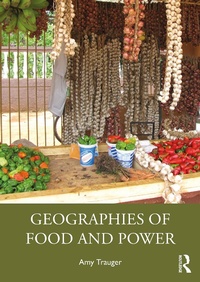
Geographies of Food and Power
1st Edition
Published on 17. August 2022
210 pages
978-1-000-61961-4 (ISBN)
Description

This book provides a comprehensive overview of the production and consumption of food, suitable for use in undergraduate classrooms, either at the intermediate or advanced level.
It takes an intersectional approach to difference and power and approaches standard subjects in the geography of food with a fresh perspective focusing on inequality, uneven production and legacies of colonialism. The book also focuses on places and regions often overlooked in conventional narratives, such as the Americas in the domestication of plants. The topics covered in the textbook include:
descriptions and analyses of food systems
histories of agricultural development with a focus on the roles of different regions
major commodities such as meat, grains and produce with a focus on the place of production
contemporary challenges in the food system, including labor, disasters/conflict and climate change
recent and emerging trends in food and agriculture such as lab-grown meat and vertical urban farms
Geographies of Food and Power takes a synthetic approach by discussing food as something produced within an interconnected system, in which labor, food quality and the environment are considered together. It will be a valuable resource for students of human geography, environmental geography, economic geography, food studies and development.
It takes an intersectional approach to difference and power and approaches standard subjects in the geography of food with a fresh perspective focusing on inequality, uneven production and legacies of colonialism. The book also focuses on places and regions often overlooked in conventional narratives, such as the Americas in the domestication of plants. The topics covered in the textbook include:
descriptions and analyses of food systems
histories of agricultural development with a focus on the roles of different regions
major commodities such as meat, grains and produce with a focus on the place of production
contemporary challenges in the food system, including labor, disasters/conflict and climate change
recent and emerging trends in food and agriculture such as lab-grown meat and vertical urban farms
Geographies of Food and Power takes a synthetic approach by discussing food as something produced within an interconnected system, in which labor, food quality and the environment are considered together. It will be a valuable resource for students of human geography, environmental geography, economic geography, food studies and development.
Reviews / Votes
"This is the geography textbook for the class I always wished I'd taken, progressing from introductory concepts to sophisticated analysis over the arc of a semester. With terrific suggestions for supplementary reading, watching, and discussion, Amy Trauger's Geographies of Food and Power is set to become a classic foundation for generations of geographers."Raj Patel, Research Professor, Lyndon B. Johnson School of Public Affairs, The University of Texas at Austin, USA.
"Geographies of Food and Power makes a critical contribution to ongoing debates about the historical and contemporary structures of our food system along with the social and environmental implications. Using an intersectional lens, Trauger introduces several concepts and theoretical perspectives to reveal challenges and point to promising pathways forward. This is an essential text for students of geography and food studies along with anyone interested in just and sustainable food futures."
Charles Z. Levkoe, Canada Research Chair in Equitable and Sustainable Food Systems, Lakehead University, Canada.
More details
Edition
1. Auflage
Language
English
Place of publication
London
United Kingdom
Publishing group
Taylor & Francis Ltd
Target group
College/higher education
Illustrations
15 Line drawings, black and white; 56 Halftones, color; 56 Illustrations, color; 15 Illustrations, black and white
ISBN-13
978-1-000-61961-4 (9781000619614)
Copyright in bibliographic data and cover images is held by Nielsen Book Services Limited or by the publishers or by their respective licensors: all rights reserved.
Schweitzer Classification
Other editions
Additional editions
Amy Trauger
Geographies of Food and Power
Book
08/2022
1st Edition
Routledge
€221.80
Shipment within 15-20 days
Amy Trauger
Geographies of Food and Power
Book
08/2022
1st Edition
Routledge
€73.70
Shipment within 15-20 days
Person
Amy Trauger is Professor of Geography in the Department of Geography at the University of Georgia. She is Affiliate Faculty with UGA's Institute for Women's Studies, the Latin American and Caribbean Studies Institute and the Center for Integrative Conservation Research. Her research interests include: food sovereignty, sustainable and alternative agriculture, human-environment interactions, gender and agriculture, and indigenous political struggle. She's taught the Geography of Food and the Athens Urban Food Collective courses at UGA nearly every year since she arrived in 2008. Before that, she taught the Geography of Sustainability at Penn State University. She has written, edited and collaborated on four books on the topics of food, agriculture and the environment. Her book, We Want Land to Live, (2017) is used in graduate and advanced undergraduate classes in the US. Her work is widely used by professors teaching courses on the geography of food and agriculture, including Iowa State University, West Virginia University, Tufts University, Cornell and Washington State.
Content
Part 1: Food and Power Chapter 1 - The Geographies of Food Chapter 2 - Geography and Power Part 2: Food for Thought Chapter 3 - The Origins of Food Chapter 4 - The Nexus of Production and Consumption Chapter 5 - Food System Contradictions Chapter 6 - The Right to Food Part 3: What We Eat Chapter 7 - Produce: Fruits and Vegetables Chapter 8 - Seeds: Grains, Pulses and Nuts Chapter 9 - Protein: Meat, Fish, Dairy and Eggs Chapter 10 - Tropical Commodities: Beverages, Fruits, Sugar and Spices Chapter 11 - Not Food: Ingredients and Additives Part 4: Challenges in the Global Food System Chapter 12 - Labor Chapter 13 - Conflict and Disasters Chapter 14 - Climate Change Chapter 15 - The Future of Food
