

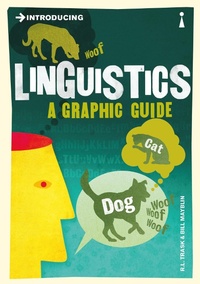
Introducing Linguistics
A Graphic Guide
Published on 5. June 2014
176 pages
978-1-84831-771-0 (ISBN)
Description

Covering thinkers from Aristotle to Saussure and Chomsky, "Introducing Linguistics" reveals the rules and beauty that underlie language, our most human skill.
More details
Other editions
Additional editions
Book
09/2009
2nd Edition
Icon Books
€11.50
Shipment within 3-4 weeks
Persons
R.L. Trask was a professor of Linguistics at the University of Sussex. A hugely acclaimed specialist in historical linguistics, his work on the Basque language made him among the world's foremost authorities on the subject. He died in 2004. Bill Mayblin trained as a graphic designer at the Royal College of Art in London. He is also the illustrator for Introducing Logic, Derrida and Empiricism.
Content
- Intro
- Cover
- Title Page
- Copyright
- Contents
- A Brief History of Linguistics
- An Indian Linguist
- The Greek Origins of Linguistics
- Grammar or Parts of Speech
- Latin Grammar
- Traditional Grammar
- The Port-Royal Grammar
- Historical Linguistics
- Ferdinand de Saussure
- Saussure's Lectures on General Linguistics
- Saussure's Structuralism
- An Example from English
- An Example from Spanish
- Synchronic and Diachronic Structures
- Trubetzkoy's Phonology
- Jakobson's Work on Linguistics
- Jakobson and Semiotics
- The Origins of American Linguistics
- Sapir's General Linguistics
- The Sapir-Whorf Hypothesis
- Example of the Sapir-Whorf Hypothesis
- A Pioneer of American Structuralism
- Post-Bloomfieldian Structruralists
- The Formalism of Zellig Harris
- Chomsky's Generative Grammar
- Transformational Grammar
- Chomsky's Programme
- Paradox of the TG Programme
- The Functional Approach
- What Does "Function" Communicate?
- Systemic Functional Linguistics: Texts
- Cognitive Linguistics
- Gendering Nouns
- Dyirbal Noun Genders
- Language Perception Differences
- Greek Perception of Time
- Metaphor
- What is Language?
- Natural Language
- Our Language Faculty
- What's Special About Human Languages?
- What do all Languages Have in Common?
- Linguistic Abilities
- Language Media
- Units of Writing
- Duality of Patterning
- Sign Languages
- Nicaraguan Sign Language
- Grammar and Word Order
- Different Examples of Word Order and Location
- Tense and Time
- Grammatical Differences
- Sign Language Grammar
- The Written Record of Language
- And Further Back .
- . to Old English
- The Never-ending Story
- Conservative Prescriptivism
- Historical Perspectives
- Explaining Systemic Correspondence
- The Indo-European Family and PIE
- The Remote Origins of English
- Eastern Ancestors of PIE
- The Saussurean Paradox
- Sociolinguistic Studies of Variation
- Male-versus-Female Speech
- Variation and Social Context
- Semantics
- Meanings Occur in Connections
- Pragmatics
- Pragmatic Issues
- Extending Pragmatics
- Where Does Language Come From?
- Skinner's Thesis Attacked by Chomsky
- Children Construct Rules
- Example of Active Construction
- Creating a Language
- Pidgin
- Creoles
- Chomsky's Universal Grammar
- What is the Rule?
- Linguistic Nativism
- Obstacles to Confirming UG
- Respectively, with Respect
- Innate or Acquired?
- Language Planning
- Engineering Basque
- Standard English
- Sexism in Language
- Sexist Attitudes
- Descriptivism
- Disordered Language
- Wernicke's Aphasia
- Neurolinguistics
- Specific Language Impairment
- Williams Syndrome
- A Psycholinguistic View of Language
- A Problem of Faulty Genes
- How Did Language Originate?
- What Do We Know Today?
- When Did Language Begin?
- The Gradualist Theory
- The Catastrophic Theory
- Criticism of the Gradualist View
- Bickerton's Conclusion
- Another Cognitive Example
- Differences of Metaphor
- Conflicting Speculations
- The Purposes of Language
- Further Reading
- Index
- Biographies
