

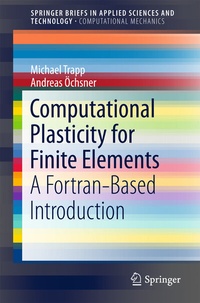
Computational Plasticity for Finite Elements
Description

This volume demonstrates the use of FORTRAN for numerical computing in the context of the finite element method. FORTRAN is still an important programming language for computational mechanics and all classical finite element codes are written in this language, some of them even offer an interface to link user-code to the main program. This feature is especially important for the development and investigation of new engineering structures or materials. Thus, this volume gives a simple introduction to programming of elasto-plastic material behavior, which is, for example, the prerequisite for implementing new constitutive laws into a commercial finite element program.
More details
Other editions
Additional editions
Persons
Andreas Öchsner is a Full Professor for lightweight design and structural simulation at the Esslingen University of Applied Sciences, Germany. Having obtained a Dipl.-Ing. degree in Aeronautical Engineering at the University of Stuttgart (1997), Germany, he served as a research and teaching assistant at the University of Erlangen-Nuremberg from 1997 to 2003 while working to complete his Doctor of Engineering Sciences (Dr.-Ing.) degree. From 2003 to 2006, he was an Assistant Professor at the Department of Mechanical Engineering and Head of the Cellular Metals Group affiliated with the University of Aveiro, Portugal. He spent seven years (2007-2013) as a Full Professor at the Department of Applied Mechanics, Technical University of Malaysia, where he was also Head of the Advanced Materials and Structure Lab. From 2014-2017 he was a Full Professor at the School of Engineering, Griffith University, Australia and Leader of the Mechanical Engineering Program (Head of Discipline and Program Director).
Content
Theoretical Introduction.- One-Dimensional Continuum Approach.- One-Dimensional Finite Element Approach.- Three-Dimensional Finite Element Approach.- Summary and Outlook.- FORTRAN Source Codes.
