

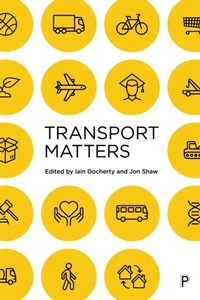
Transport Matters
Why transport matters and how we can make it better
Policy Press
1st Edition
Published on 16. October 2019
452 pages
978-1-4473-2957-2 (ISBN)
Description

This book shows that transport matters. Comprising a series of highly accessible chapters written by respected experts, it reviews key transport issues and explains how and why effective and efficient transport is fundamental to successfully addressing all manner of public policy goals.
Contributors explore how we 'do' transport, as a result of the technologies available to us and the cultures surrounding how we use them, and examine how this has significant social, economic and environmental consequences. They also provide key recommendations for how we could do things differently to bring about a happier, healthier and more economically secure future for all of us.
Contributors explore how we 'do' transport, as a result of the technologies available to us and the cultures surrounding how we use them, and examine how this has significant social, economic and environmental consequences. They also provide key recommendations for how we could do things differently to bring about a happier, healthier and more economically secure future for all of us.
Reviews / Votes
"A well-thumbed copy of this book should be on every transport minister's desk. It shows why transport is such a key policy tool of government and explains why it is so rarely used well." Christian Wolmar, Transport writer and broadcaster "This lively collection of essays, by some of the key thinkers in the field, will be of central interest to all those concerned with the role that transport plays in modern social and economic life." Ron Martin, University of Cambridge "Essential reading for students and practitioners who will be thankful for this well-written, comprehensive and delightful coverage of the transport policy space." Jim Steer, Director of Steergroup "This book examines the unprecedented challenges and opportunities of the 'transport question' in a time of vast technological and social change, and is rightly focused on societal ends, not means. It could not be more essential reading for every planner and decision-maker involved in choosing the future we want for our communities." Lord Taylor, Chair of UK government policy reviews of Planning Practice Guidance and Rural Economy and HousingMore details
Edition
First Edition
Language
English
Place of publication
Bristol
United Kingdom
Publishing group
Bristol University Press
Target group
Professional and scholarly
Illustrations
20 s/w Tabellen, 37 s/w Abbildungen
20 Tables, black and white; 37 Illustrations, black and white
ISBN-13
978-1-4473-2957-2 (9781447329572)
DOI
https://doi.org/10.51952/9781447329572
Copyright in bibliographic data and cover images is held by Nielsen Book Services Limited or by the publishers or by their respective licensors: all rights reserved.
Schweitzer Classification
Other editions
Additional editions
Transport Matters
Why transport matters and how we can make it better
E-Book
10/2019
1st Edition
Policy Press
€60.49
Available for download
Persons
Iain Docherty is Dean of the Institute for Advanced Studies at the University of Stirling.
Jon Shaw is Professor of Geography at the University of Plymouth.
Jon Shaw is Professor of Geography at the University of Plymouth.
Content
Foreword by John McTernan
Part I: Setting the scene
Transport matters ~ Jon Shaw and Iain Docherty
The political economy of transport and travel ~ Iain Docherty, Jon Shaw and David Waite
Energy, pollution and climate change ~ Jillian Anable and Christian Brand
Social inclusion, accessibility and emotional work ~ Jennie Middleton and Justin Spinney
Part II: Dealing with policy inheritance
Influencing travel behaviour ~ Stewart Barr and John Preston
The gentle tyranny of cost-benefit analysis in transport appraisal ~ Robin Hickman
Forecasting road traffic and its significance for transport policy ~ Phil Goodwin
Health, wellbeing and quality of life ~ Angela Curl and Julie Clark
Connecting places: towards a participatory, ordinary urbanism ~ Geoff Vigar and Georgiana Varna
The journey experience ~ Juliet Jain and William Clayton
Public engagement and consultation: decide, announce and defend? ~ Tom Cohen and Dan Durrant
Remote, rural and island communities ~ David Gray
Part III: New policy imperatives
Disruption and resiliene: new realities? ~ David Dawson and Greg Marsden
Changing demographics ~ Charles Musselwhite and Kiron Chatterjee
Will the 'smart mobility' revolution matter? ~ Graham Parkhurst and Andrew Seedhouse
Future mobility ~ Glenn Lyons
Part I: Setting the scene
Transport matters ~ Jon Shaw and Iain Docherty
The political economy of transport and travel ~ Iain Docherty, Jon Shaw and David Waite
Energy, pollution and climate change ~ Jillian Anable and Christian Brand
Social inclusion, accessibility and emotional work ~ Jennie Middleton and Justin Spinney
Part II: Dealing with policy inheritance
Influencing travel behaviour ~ Stewart Barr and John Preston
The gentle tyranny of cost-benefit analysis in transport appraisal ~ Robin Hickman
Forecasting road traffic and its significance for transport policy ~ Phil Goodwin
Health, wellbeing and quality of life ~ Angela Curl and Julie Clark
Connecting places: towards a participatory, ordinary urbanism ~ Geoff Vigar and Georgiana Varna
The journey experience ~ Juliet Jain and William Clayton
Public engagement and consultation: decide, announce and defend? ~ Tom Cohen and Dan Durrant
Remote, rural and island communities ~ David Gray
Part III: New policy imperatives
Disruption and resiliene: new realities? ~ David Dawson and Greg Marsden
Changing demographics ~ Charles Musselwhite and Kiron Chatterjee
Will the 'smart mobility' revolution matter? ~ Graham Parkhurst and Andrew Seedhouse
Future mobility ~ Glenn Lyons
