
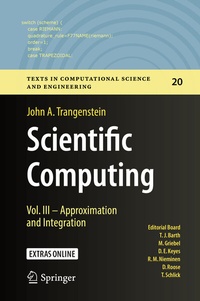
Scientific Computing
Description
Alles über E-Books | Antworten auf Fragen rund um E-Books, Kopierschutz und Dateiformate finden Sie in unserem Info- & Hilfebereich.
This is the third of three volumes providing a comprehensive presentation of the fundamentals of scientific computing. This volume discusses topics that depend more on calculus than linear algebra, in order to prepare the reader for solving differential equations. This book and its companions show how to determine the quality of computational results, and how to measure the relative efficiency of competing methods. Readers learn how to determine the maximum attainable accuracy of algorithms, and how to select the best method for computing problems. This book also discusses programming in several languages, including C++, Fortran and MATLAB. There are 90 examples, 200 exercises, 36 algorithms, 40 interactive JavaScript programs, 91 references to software programs and 1 case study.
Topics are introduced with goals, literature references and links to public software. There are descriptions of the current algorithms in GSLIB and MATLAB.This book could be usedfor a second course in numerical methods, for either upper level undergraduates or first year graduate students. Parts of the text could be used for specialized courses, such as nonlinear optimization or iterative linear algebra.
More details
Other editions
Additional editions

Person
Content
System requirements
File format: PDF
Copy protection: Watermark-DRM (Digital Rights Management)
System requirements:
- Computer (Windows; MacOS X; Linux): Use the free software Adobe Reader, Adobe Digital Editions, or any other PDF viewer of your choice (see eBook Help).
- Tablet/Smartphone (Android; iOS): Install the free app Adobe Digital Editions or another reading app for eBooks, e.g., PocketBook (see eBook Help).
- E-reader: Bookeen, Kobo, Pocketbook, Sony, Tolino and many more (only limited: Kindle).
The file format PDF always displays a book page identically on any hardware. This makes PDF suitable for complex layouts such as those used in textbooks and reference books (images, tables, columns, footnotes). Unfortunately, on the small screens of e-readers or smartphones, PDFs are rather annoying, requiring too much scrolling.
This eBook uses Watermark-DRM, a „soft” copy protection. This means that there are no technical restrictions to prevent illegal distribution. However, there is a personalised watermark embedded in the eBook that can be used to identify the purchaser of the eBook in the event of misuse and to provide evidence for legal purposes.
For more information, see our eBook Help page.