

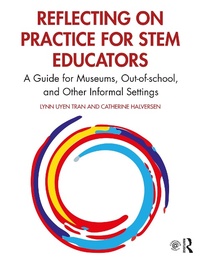
Reflecting on Practice for STEM Educators
A Guide for Museums, Out-of-school, and Other Informal Settings
1st Edition
Published on 30. May 2021
356 pages
978-1-000-37236-6 (ISBN)
Description

Reflecting on Practice for STEM Educators is a guidebook to lead a professional learning program for educators working in STEM learning environments.
Making research on the science of human learning accessible to educational professionals around the world, this book shows educators how to relate this research to their own practice. Educators' collective work broadens the scope of an organization's reach, and through this effort, the organization grows its social capital in its local community and beyond. This book offers opportunities to engage in processes that lead toward organizational learning by attending to the professional growth of the educators. Tran and Halversen show how learning together can shape the language and meanings by which educators do and talk about their work to support visitors' experiences. The book provides guidance on how teams of educators can build community as they engage in reflective practice.
Reflecting on Practice for STEM Educators will be essential reading for leaders of any organization that aims to educate and engage the public in science, technology, engineering, and mathematics. It will be particularly useful to educators who work in museums, zoos, aquariums, botanical gardens, youth organizations, after-school programs, and nature, science, and conservation centres.
Making research on the science of human learning accessible to educational professionals around the world, this book shows educators how to relate this research to their own practice. Educators' collective work broadens the scope of an organization's reach, and through this effort, the organization grows its social capital in its local community and beyond. This book offers opportunities to engage in processes that lead toward organizational learning by attending to the professional growth of the educators. Tran and Halversen show how learning together can shape the language and meanings by which educators do and talk about their work to support visitors' experiences. The book provides guidance on how teams of educators can build community as they engage in reflective practice.
Reflecting on Practice for STEM Educators will be essential reading for leaders of any organization that aims to educate and engage the public in science, technology, engineering, and mathematics. It will be particularly useful to educators who work in museums, zoos, aquariums, botanical gardens, youth organizations, after-school programs, and nature, science, and conservation centres.
Reviews / Votes
"Reflecting on Practice is an incredibly well-designed, well-tested and effective set of materials and practices for museum professionals. It's a course of study and application that can transform and deepen staff understandings of themselves and their visitors."Laura W. Martin, Ph.D., Senior Advisor, Arizona Science Center
"The Reflecting on Practice curriculum is a welcome, practical guide for advancing the informal STEM education field. It provides a detailed, research-based approach to build shared language, develop a culture of reflection, and cultivate a connected professional learning community. The timely release of this volume will help forge a post-pandemic era for our field."
Jamie Bell, Project Director, Center for Advancement of Informal Science Education (CAISE)
"This curriculum has the potential to transform an organization's approach to supporting each other as staff, make structured and systematic considerations on how to deepen effective pedagogical approaches used by the staff in working with audiences. Grounded in the latest understandings of how people learn, I highly recommend this book for any leader who is authentically interested in developing a sustainable professional learning program within their organization."
Preeti Gupta, Ph.D., Director of Youth Learning and Research, American Museum of Natural History
"The structure and content of the Reflecting on Practice guidebook and workshop really helped us understand how to improve our practice and to be confident of conducting such sessions ourselves as facilitators for our colleagues. The guide was detailed, well organised and planned as bite sized modules to plan our internal sessions to fit our schedules. Our staff are from diverse fields and all were able to benefit from Reflecting on Practice. I would recommend it for museum educators."
Anne Dhanaraj, Senior Director, Education Programmes, Science Centre Singapore
More details
Edition
1. Auflage
Language
English
Place of publication
London
United Kingdom
Publishing group
Taylor & Francis Ltd
Target group
College/higher education
Professional and scholarly
Illustrations
4 Line drawings, black and white; 4 Illustrations, black and white
ISBN-13
978-1-000-37236-6 (9781000372366)
Copyright in bibliographic data and cover images is held by Nielsen Book Services Limited or by the publishers or by their respective licensors: all rights reserved.
Schweitzer Classification
Other editions
Additional editions
Lynn Uyen Tran
Reflecting on Practice for Stem Educators
A Guide for Museums, Out-Of-School, and Other Informal Settings
Book
07/2021
Routledge
Unfortunately, price unknown
Available (delivery time upon request)
Lynn Uyen Tran | Catherine Halversen
Reflecting on Practice for STEM Educators
A Guide for Museums, Out-of-school, and Other Informal Settings
Book
05/2021
1st Edition
Routledge
€206.30
Shipment within 15-20 days
Lynn Uyen Tran | Catherine Halversen
Reflecting on Practice for STEM Educators
A Guide for Museums, Out-of-school, and Other Informal Settings
Book
05/2021
1st Edition
Routledge
€53.90
Shipment within 15-20 days
Persons
Lynn Uyen Tran is Research Director in the Learning and Teaching Group at the Lawrence Hall of Science, University of California Berkeley, USA. Her work focuses on relating the science of learning to teaching practices of informal educators and university faculty, and cultivating reflective practice and professional learning among these communities.
Catherine Halversen is Senior Program Director in the Learning and Teaching Group at the Lawrence Hall of Science, University of California Berkeley, USA. Her work focuses on developing and disseminating inperson and online professional learning programs and instructional materials for STEM university/college faculty, informal educators, and K-12 teachers.
Catherine Halversen is Senior Program Director in the Learning and Teaching Group at the Lawrence Hall of Science, University of California Berkeley, USA. Her work focuses on developing and disseminating inperson and online professional learning programs and instructional materials for STEM university/college faculty, informal educators, and K-12 teachers.
Content
Introduction Module 1: Learning, Reflections, and Science Module 2: How People Learn Module 3: Learning Conversations Module 4: Objects and Design Appendix A: Tools for Reflective Practice Appendix B: Design and Teaching Tool
