

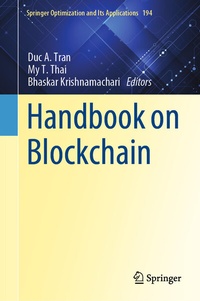
Handbook on Blockchain
Description

This handbook aims to serve as a one-stop, reliable source of reference, with curations of survey and expository contributions on the state-of-the-art in Blockchain technology. It covers a comprehensive range of topics, providing the technical and non-technical reader with fundamentals, applications, and deep details on a variety of topics. The readership is expected to span broadly from technologically-minded business professionals and entrepreneurs, to students, instructors, novices and seasoned researchers, in computer science, engineering, software engineering, finance, and data science. Though Blockchain technology is relatively young, its evolution as a field and a practice is booming in growth and its importance to society had never been more important than it is today. Blockchain solutions enable a decentralization of a digital society where people can contribute, collaborate, and transact without having to second-guess the trust and transparency factors with many geographical, financial, and political barriers removed. It is the distributed ledger technology behind the success of Bitcoin, Ethereum, and many emerging applications.
The resource is divided into 5 parts. Part 1 (Foundation) walks the reader through a comprehensive set of essential concepts, protocols, and algorithms that lay the foundation for Blockchain. Part 2 (Scalability) focuses on the most pressing challenges of today's blockchain networks in how to keep pace with real-world expectations. Part 3 (Trust and Security) provides detailed coverage on the issues of trust, reputation, and security in Blockchain. Part 4 (Decentralized Finance) is devoted to a high-impact application of Blockchain to finance, the sector that has most benefitted from this technology. Part 5 (Application and Policy) includes several cases where Blockchain applies to the real world.
More details
Other editions
Additional editions
Persons
My T. Thai is a UF Research Foundation Professor of Computer & Information Science & Engineering and Associate Director of the Nelms Institute for the Connected World at the University of Florida. She has extensive expertise in billion-scale data mining, machine learning, and optimization, especially for complex graph data with applications to blockchain, social media, critical networking infrastructure, cybersecucurity, and healthcare.
Bhaskar Krishnamachari is Professor, Ming Hsieh Faculty Fellow, Department of Electrical and Computer Engineering witha joint appointment at the Department of Computer Science, Viterbi School of Engineering, University of Southern California. His research interests are in the design and analysis of algorithms, protocols, and applications for next-generation networks and distributed systems including the internet of things, connected vehicles, dispersed computing, and blockchain systems.
