

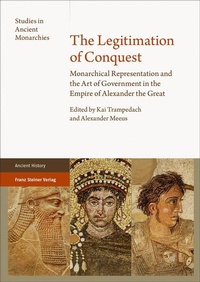
The Legitimation of Conquest
Description

Within a single decade (334-325 BC) Alexander III of Macedon conquered much of the known world of his time, creating an empire that stretched from the Balkans to India and southern Egypt. His clear intention of establishing permanent dominion over this huge and culturally diverse territory raises questions about whether and how he tried to legitimate his position and about the reactions of various groups subject to his rule: Macedonians, Greeks, the army, indigenous elites. Starting from Max Weber's "Herrschaftssoziologie", the 15 authors discuss Alexander's strategies of legitimation as well as the motives his subjects may have had for offering him obedience. The analysis of monarchical representation and political communication in these case-studies on symbolic performances and economic, administrative and religious measures sheds new light on the reasons for the swift Macedonian conquest: It appears that Alexander and his staff owed their success not only to their military talent but also to their communication skills and their capacity to cater to the expectations of their audiences.
More details
Other editions
Additional editions
Persons
Content
- Intro
- CONTENTS
- PREFACE
- Introduction: Understanding Alexander's Relations with His Subjects (Kai Trampedach / Alexander Meeus)
- I: SELF-PRESENTATION AND ROYAL PERSONA
- 1 From Early On To Become A Hero ('Held'): Mythical Models of Alexander's Image and Biography (Tonio Hölscher)
- 2 Staging Charisma: Alexander and Divination (Kai Trampedach)
- 3 Alexander and Athletics or How (Not) To Use a Traditional Field of Monarchic Legitimation (Christian Mann)
- 4 Violence and Legitimation: The Social Logic of Alexander the Great's Acts of Violence between the Danube and the Indus - A Conceptual Outline and a Case Study (Matthias Haake)
- II: LOCAL PERSPECTIVES AND INTERACTIONS
- 5 Alexander's Dedications to the Gods: Sacred Space, Pious Practice and Public Legitimation (Ralf von den Hoff)
- 6 Communication and Legitimation: Knowledge of Alexander's Asian Conquests in the Greek World (Shane Wallace)
- 7 Legitimation - Unwitting and Unrequested: Alexander of Macedon's Portrayal as Devine Tool in Zechariah 9 (Wilhelm Köhler)
- 8 Wooing the Victor with Words: Babylonian Priestly Literature as a Response to the Macedonian Conquest (Michael Jursa)
- 9 Shaping the New World: Once More On the Cities of Alexander (Maurizio Giangiulio)
- III: ADMINISTRATION AND INSTITUTIONS
- 10 Alexander, the King of the Macedonians (Manuela Mari)
- 11 On the Titulature of Alexander the Great: The Title basileus (Maxim M. Kholod)
- 12 Alexander the Great and Asia Minor: Conquest and Strategies of Legitimation (Michele Faraguna)
- 13 Alexander's Tributary Empire (Andrew Monson)
- IV: EPILOGUES
- 14 The Strategies of Legitimation of Alexander and the Diadochoi: Continuities and Discontinuities (Alexander Meeus)
- 15 Concluding Remarks (Hans-Joachim Gehrke)
- ABBREVIATIONS
- BIBLIOGRAPHY
- CONTRIBUTORS
