

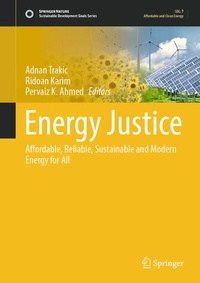
Energy Justice
Description

This book delves into the pressing issue of energy justice as it relates to SDG 7 and its far-reaching implications for society. With a comprehensive exploration of various aspects, from reducing energy burdens to political considerations, environmental justice, and human rights, this thought-provoking collection of chapters offers a profound understanding of the challenges and potential solutions surrounding energy justice.
Starting with an introduction to the concept of energy justice and its significance, the editors lay the groundwork for an engaging discourse. The book then delves into the disproportionate energy burdens faced by low-income communities, shedding light on the difficult choices they must make to meet their basic needs. It further examines the intricate interplay between energy justice, politics, and environmental concerns, striving to find a harmonious balance.
Drawing from a diverse range of perspectives, the chapters explore the intersection of energy justice with human rights, analyzing its implications for countries worldwide. The book also investigates the influence of disruptive events on renewable energy programs, presents an Islamic perspective on energy justice, and highlights the roles of the financial sector, fossil fuel industry, nuclear energy sector, and energy technology innovation in mitigating energy injustice.
Chapter 'The Role of the Financial Sector in Energy Justice' is available open access under a Creative Commons Attribution 4.0 International License via link.springer.com.
More details
Other editions
Additional editions
Persons
Adnan Trakic is an associate professor with the Department of Business Law and Taxation, School of Business, Monash University Malaysia. He has taught and researched in the fields of conventional and Islamic finance law, business law, and dispute resolution. He has published numerous articles, book chapters, and monographs.
Ridoan Karim is a lecturer at the Department of Business Law & Taxation, School of Business, Monash University Malaysia. He has taught and researched in the fields of business and international trade law. He holds a Doctor of Philosophy (Ph.D.) from the University of Malaya, Malaysia. He also obtained a Master of Business Administration (MBA) from the University of Chichester, UK, a Master of Comparative Laws (MCL) from International Islamic University Malaysia (IIUM), and a Bachelor of Laws (LLB) from BRAC University, Bangladesh.
Pervaiz K Ahmed is a management scholar exploring innovation and strategic dynamics of entrepreneurial change. His outlook on management is colored by moral responsibility, particularly ethics of care and sustainability. He has held several senior positions in the UK before coming to Malaysia. He has published extensively in international journals and is a regular keynote speaker with a number of academic awards for his research. In addition, he has served as an editor and sits on the editorial boards of several international journals. He has extensive experience working with and advising blue-chip companies and public sector organizations, such as Unilever, Ford, AT&T, NCR, British Telecommunications, and the NHS in Europe. He has also been involved with corporate clients in Asia, as well as government agencies, such as the Singapore National Productivity Council.
Content
What is Energy Justice and Why It Matters.- Energy Justice Reducing Energy Burdens.- Energy Justice and Political Considerations.- Does Energy Justice Trump Environmental Justice.- Energy Justice and Human Rights.
