

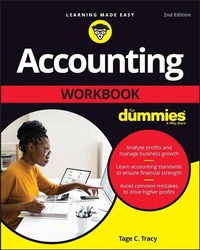
Accounting Workbook For Dummies
Description

The numbers are clear: the need for accountants is not only strong, but on the rise. With job growth projected to increase by 7% over the next 10 years, there's no time like the present to join this growing--and profitable--profession. Accounting Workbook For Dummies, 2nd Edition gives you the hands-on instruction you need to understand complicated concepts through demonstration problems, practice worksheets. and spreadsheets.
* Understand the role of accountants versus bookkeepers
* Develop knowledge to establish and maintain high quality accounting systems
* Dip your toes into accounting in the digital age
* Learn to properly interpret financial statements and reports
* Generate income statements, balance sheets, and cash flow statements
* Expand your knowledge on sources of business capital
* Learn how to improve profits and manage costs
Understanding the intricacies of accounting has never been easier as in today's rapid-fire global economy, accountants have never been more important--it's all in your hands with this plain-English workbook!
More details
Other editions
Additional editions
Person
Content
Part 1: Business Accounting Basics. 5
Chapter 1: Business Accounting Fundamentals. 7
Chapter 2: Financial Effects of Transactions 27
Chapter 3: Getting Started in the Bookkeeping Cycle 51
Chapter 4: The Bookkeeping Cycle: Adjusting and Closing Entries. 81
Chapter 5: Accounting in the Digital Age 105
Part 2: Preparing Financial Statements. 123
Chapter 6: Understanding Basic Accounting Concepts and Methods. 125
Chapter 7: The Effects and Reporting of Profit. 155
Chapter 8: Reporting Financial Condition in the Balance Sheet. 179
Chapter 9: Coupling the Income Statement and Balance Sheet 205
Chapter 10: Reporting Cash Flows and Changes in Owners' Equity 223
Part 3: Managerial, Manufacturing, and Capital Accounting 245
Chapter 11: Analyzing Profit Behavior 247
Chapter 12: Tackling Managerial Cost Accounting. 275
Chapter 13: Business Planning and Raising Capital. 309
Part 4: The Part of Tens 337
Chapter 14: Ten Things You Should Know About Business Financial Statements 339
Chapter 15: A Ten-Point Checklist for Management Accountants. 347
Index. 355
Introduction
First of all, I have to admit that accounting has an image problem. Be honest: What's the first thing that pops into your mind when you see the word "accountant"? You probably think of a nerd wearing a green eyeshade who has the personality of an undertaker (no offense meant to undertakers, of course). Well, I've never worn green eyeshades in my life, and I can assure you that I'm not a nerd (but a bit geeky from time to time). I do own the latest technology gadgets, generally have a good sense of humor (which will be on display throughout this book) and have extensive accounting experience both from the classroom perspective (through my dad, John Tracy, who taught for more than 35 years and was the author of the first edition of this book) as well as from the "street" (I have been operating a financial and accounting consulting business for more than 25 years).
Explaining accounting for nonaccountants is one of mine and my late dad's passions in life, and we've written several books on the topic. In the mid-1990s, our journey started with John Tracy having the opportunity to write Accounting For Dummies (Wiley), which is now in its seventh edition. One of our other books is How To Read A Financial Report (Wiley), which has been in print for more than 40 years and now is in its ninth edition. This book, Accounting Workbook For Dummies, 2nd Edition, fills a gap with our books: That is, they don't incorporate questions and exercises. This book offers plenty of questions to test and improve your understanding of accounting.
Accounting Workbook for Dummies, 2nd Edition, offers a different take on accounting - one that offers new insights and perspectives including covering important recent developments and trends, such as accounting in the digital age. Through my experiences, I have a pretty good idea of how the subject is taught and understood. I don't go out of my way to be contrary or confrontational, but it is important to remember that accounting isn't an exact science and often a bit of an art form. Accounting is full of controversy and differences of opinion. In this book, I state my opinions forcefully and (I hope) clearly.
The spirit of this book is illustrated in two common-told stories. The first concerns the young and eager musician on her first trip to New York City, who gets off the train at Grand Central Terminal and asks the first person she meets on the street: "How do you get to Carnegie Hall?" The answer is: "Practice, practice, practice!" The second story concerns the legendary UCLA basketball coach John Wooden. At the first practice of each year, he taught the players how to tie their shoes so that they wouldn't come loose during a game.
About This Book
Whether it's a small mom-and-pop business or the gargantuan Apple, Inc., every business keeps track of its financial activities and its financial condition. You can't run a business without an accounting system that tells you whether you're making a profit or suffering a loss, whether you have enough cash (or access to capital) to support on-going operations, or your bank account balance is approaching zero, and whether you're in good financial shape or are on the edge of bankruptcy.
Accounting Workbook For Dummies, 2nd Edition, is largely about business accounting. It explains how business transactions are recorded in the accounts of a business and the financial statements that are prepared for a business to report its profit and loss (the income statement), financial condition (the balance sheet), and cash flows (the statement of cash flows). It also explains how business managers, executives, and analysts use accounting information for decision making. (The book doesn't delve into business income taxation, which is the province of professional accountants.)
Most business managers have limited accounting backgrounds, and most have their enthusiasm for learning more about accounting well under control. But, down deep, they're likely to think that they should know more about accounting. Business managers should find this book quite helpful even if they just dip their toes in.
If you're a business bookkeeper or accountant, you can use this book to review the topics you need to know well. It can help you upgrade your accounting skills and savvy and lay the foundation for further advancement. One great thing about Accounting Workbook For Dummies, 2nd Edition, is that it offers alternative explanations of accounting topics that are different from the explanations in standard accounting textbooks. The many questions and problems (with clearly explained answers) offer an excellent way to test your knowledge, and nobody knows your exam scores but you.
If you're a student presently enrolled in a beginning accounting course, you can use this book as a supplementary study guide to your textbook, one that offers many supplementary questions and exercises. Perhaps you took an accounting course a few years ago and need to brush up on the subject. This book can help you refresh your understanding of accounting and help you recall things forgotten.
Note: In Part 2, a fictious business is used as the base for the financial examples provided in Chapters 7 through 10 (for consistency purposes). To start Part 3 of the book, Chapters 11 and 12 do not use the same fictious business but rather simpler and more compact fictious business examples are provided to assist you with understanding the concepts more efficiently. I wanted to call this out to avoid any confusion as it relates to carrying forward the financial information presented in Part 2 of the book.
Foolish Assumptions
Mastering accounting is like mastering many other subjects: First, you must understand the basic terminology (the lingo) and the fundamentals. In accounting, you have to work problems to really get a grasp of the topic and technique. Passive reading just isn't enough. In writing this book, I assume that you aren't a complete accounting neophyte. I designed the book as a second step that builds on your basic accounting knowledge and experience. If you have no previous exposure to accounting, you may want to consider first reading Accounting For Dummies, 7th Edition (Wiley).
You don't have to be a math wizard to understand accounting; basic high school algebra is more than enough. However, you do have to pay attention to details, just as you have to pay close attention to the words when you study Shakespeare. Accounting involves calculations and using a business/financial calculator is very helpful. In my experience, many people don't take the time to learn how to use their calculators. But that's time well spent. In many of the questions and problems posed throughout the book, I explain how to use a business calculator for the solution.
Icons Used in This Book
Throughout this book, you can find useful "pointers" that save you the trouble of buying a yellow highlighter pen and using sticky notes. These icons draw your attention to certain parts of the text. Think of them as road signs on your journey through accounting.
This icon marks the spot of an example question that explains and illustrates an important point. The answer follows the question. It's a good idea to make sure that you understand the answer before attempting the additional questions on the topic on your own. To get the most out of the example questions, don't read the answer right away. First, try to answer the question and then compare my answer with yours and how you got it.
This icon points out information that you probably would have underlined or highlighted while reading. These points are worth remembering. When reviewing each chapter, read everything with this icon attached in order to get the essentials.
I use this icon to indicate that I'm building on your background in accounting. Instead of starting at ground zero, I assume that you already know basic points about the topic. If this book were an elevator, this marker would mean that you're ascending from the first floor to the second floor.
Simply put, this icon is a red flag that means "watch out." This warning sign means that the topic being explained is a serious and troublesome issue in accounting, so you should pay close attention and handle it with care.
Beyond the Book
In addition to the content in this book, an online Cheat Sheet is provided for quick access to important information on topics from formulas and functions for financial statements to knowing your debits from your credits to choosing the right accounting method for your business. The Cheat Sheet can be found at www.dummies.com - type Accounting Workbook For Dummies Cheat Sheet in the search bar.
But, wait, there's more! For those readers who are interested, I have created an online Excel workbook file containing all the figures given in this book plus some extras that you are able to work through. Go to: www.dummies.com/go/accountingwbfd2e to connect with them.
Where to Go from Here
Accounting Workbook For Dummies, 2nd Edition, is designed to maximize modularity. Each chapter stands on its own feet to the fullest extent possible. Of course, it makes sense to read the chapters in order, but you...
