

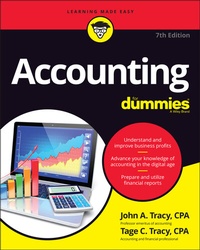
Accounting For Dummies
Description

Few skills are as useful as a basic understanding of accounting language. And with the right resources, learning the language of business can be intuitive, empowering, and fun.
Accounting For Dummies is the perfect place to start, whether you're operating a small business, just need help managing the family budget, or you're a rising star in corporate America. It's a financial blueprint for the everyday person, easy-to-understand, and full of practical advice.
You'll learn the basic ABC's of accounting, how to read and understand financial statements, create best in class budgets & forecasts, craft profitable business plans, take control of your own finances, gain insight on how companies get money from investors and banks, and avoid common money mistakes that trip up even the best of us. You'll also find out how to:
* Diagnose the financial health of your business and make a realistic plan to grow your company
* Improve your own or your family's money situation with sound financial planning and understanding
* Understand each of the three basic financial statements and what they say about a company's past, present, and future
* Enhance your knowledge of how accounting functions and operates in today's digital age and cloud-based world
As a useful tool for business or as a guide to your personal finances, nothing compares to accounting mastery. And once you've nailed the basics, you'll wonder how you ever lived without this universal and beautiful language.
More details
Other editions
Additional editions
Persons
Tage C. Tracy, CPA, operates a financial consulting firm focused on offering CFO support and planning services to private companies. He is the author of Business Financial Information Secrets and has coauthored several For Dummies titles.
Content
Part 1: Opening the Books on Accounting 5
Chapter 1: Accounting in Today's New Economy 7
Chapter 2: Introducing Financial Statements 29
Chapter 3: Safeguarding Company Assets 53
Chapter 4: Accounting in the Digital Age 75
Chapter 5: Recognizing the Legal and Accounting Entity 89
Part 2: Exploring Financial Statements 109
Chapter 6: Reporting Profit or Loss in the Income Statement 111
Chapter 7: Reporting Financial Condition in the Balance Sheet 137
Chapter 8: Reporting Cash Sources and Uses in the Statement of Cash Flows 161
Chapter 9: Financial Accounting Issues 183
Part 3: Understanding Financial Reports, Financial Statements, and Financial Information 207
Chapter 10: Producing Financial Reports 209
Chapter 11: Deciphering a Financial Report 231
Chapter 12: Analyzing Financial Information with Ratios 245
Chapter 13: Generating Internal Financial Information for Management Use 267
Chapter 14: Applying Wall Street's Tricks and Treats to Engineer Financial Results 289
Part 4: Leveraging Accounting in Managing a Business 301
Chapter 15: Analyzing Profit 303
Chapter 16: Accounting for Costs 325
Chapter 17: Preparing Best-in-Class Forecasts, Projections, and Budgets 347
Chapter 18: Capitalizing a Business: How, When, Why, and What 369
Part 5: The Part of Tens 397
Chapter 19: Ten Tips for Managers 399
Chapter 20: Ten Tips for Reading a Financial Report 409
Index 419
Chapter 1
Accounting in Today's New Economy
IN THIS CHAPTER
Appreciating how accounting is relevant to you
Grasping how all economic activity requires accounting
Understanding the accounting function's primary roles
Watching an accounting department in action
Shaking hands with business financial statements
Realizing accounting is both an art form and science
There was a captive audience present when I (coauthor John) taught Accounting 101 because, then as well as now, all business school students have to take this course. In contrast, very few arts and science students elect the course, which is unfortunate. Accounting 101 teaches about business, including the nature of profit (which most people don't fully understand) and the fundamentals of capitalism.
The course is a very good training ground for becoming financially literate. Accounting is the language of business, finance, investing, and taxes. To be financially literate, you need to know basic accounting. These days, there's a big push to improve financial literacy, and a basic accounting course offers a useful framework for understanding and thinking about financial issues. Financial literacy is important to help ensure financial security for you and your family as you go through life and eventually enter into retirement.
In one sense, this book is the accounting course you never took. For business grads, the book presents an opportune review of topics you've gotten rusty on. We dare say that even accounting majors can glean many insights from this book. You don't need a college education to gain from this book, however. Like all the For Dummies books, this book delivers useful information in a plain-talking manner, with a light touch to keep it interesting.
As you go through life, you come face to face with a flood of accounting-generated information - more than you would ever imagine. Regrettably, much of this information isn't intuitive, and it doesn't come with a user's manual. In short, most of the accounting information you encounter isn't readily clear.
One main reason for learning some accounting is to understand its vocabulary and valuation methods so you can make more intelligent use of the information. Accountants are financial scorekeepers. In playing or watching any game, you need to know how the score is kept. The purpose of this book is to make you a knowledgeable spectator of and sometimes a participant in the accounting game.
Let us point out another reason you should know accounting basics - the defensive reason. Many people in the cold, cruel financial world are on the prowl to take advantage of your lack of savvy about accounting. These unscrupulous characters treat you as a lamb waiting to be fleeced. An important defense against such tactics is to know some accounting, which helps you ask the right questions and understand the crucial points on which con artists want to keep you in the dark.
Checking Your Preconceptions about Accounting
You probably fall in with the majority of people who have preconceptions about accounting - which in fact may be way off the mark. For instance, most people think that you have to be good at math to understand accounting. Accounting deals with numbers, that's for sure, but by no means does it require calculus or other math - just arithmetic. Accountants make calculations and compare numbers. That's about it. We've never heard of an accountant taking the first derivative of an accounting equation or doing any other calculus computation.
The problem is that many people - perhaps even you - are number-phobic. They avoid anything to do with digits. They wouldn't think of doing their annual income tax return. Accountants deal in numbers. But be aware that every accounting number has a name or label attached. There are no naked numbers in accounting. The basic unit of information in accounting is the account, which consists of both
- A name
- Its amount or value
The vocabulary of accounting consists of accounts. Accountants communicate in terms of accounts.
Another preconception is that accountants have their heads buried in a torrent of details. Accountants have no choice; they have to be detail-oriented. At the same time, they have to see how the details fit into the overall scheme of things. The avalanche of details is condensed into accounting reports that disclose relatively few aggregate accounts. One reason for learning accounting is to understand what these collective accounts include.
Thinking about where assets come from
We explain later that accountants decide how to record transactions, which are economic exchanges (see the later section "Focusing on Transactions"). Many people aren't aware of the double duty of accountants in recording transactions. Accountants look at things from two points of view - the give and the take of the transaction. This is called double-entry accounting, which we explain in Chapter 3. The following example illustrates the two-sided nature of accounting.
Suppose a business reports $1,000,000 in total assets at the end of its most recent year. Most people, quite naturally, focus on the makeup of its assets (how much cash, for example). But the composition of its assets is only half the financial picture of a business. You've heard the expression that there are two sides to every story. Well, in accounting, there are two sides to the financial condition of a business.
Accounting deals with assets, of course. Accountants are equally concerned with the sources of the assets. In this example, the $1,000,000 in assets comes from three sources: $300,000 liabilities; $500,000 capital; and $200,000 surplus. You probably have a good idea of what liabilities are. Capital is money invested in the business by the owners. Surplus is profit that has been earned and not distributed to the owners. The sum of all three sources taken together equals the total assets of the business. The books are in balance.
Asking about profit
Businesses are profit motivated, so a natural question is "How much profit did the business earn over the last year?" Suppose the business had $120,000 surplus at the beginning of the year, and the business didn't distribute any of its profit to its owners during the year. Therefore, the business earned $80,000 profit for the year: $120,000 surplus at start of year $200,000 surplus at end of year = $80,000 gain in surplus, which is the profit for the year.
One popular misconception is that earning profit increases cash by the same amount. Unfortunately, it's not as simple as that. Earning profit involves many assets and several liabilities. Cash is the main asset but not the only one affected by earning profit. One purpose of learning accounting is to understand the financial "fallout" from making profit. Profit consists of changes in assets and liabilities that, taken all together, increase the surplus of the business. The cash result from making profit is either higher or lower than the amount of profit. Isn't this interesting?
Sorting out stereotypes of accountants
We recently saw a cartoon in which the young son of clowns is standing in a circus tent and is dressed as a clown, but he's holding a briefcase. He's telling his clown parents that he's running away to join a CPA firm. This cartoon plays off the stereotype of a CPA (certified public accountant) as a boring "bean counter" who wears a green eyeshade, has no sense of humor, and possesses the personality of an undertaker (no offense to morticians). Maybe you've heard the joke that an accountant with a personality is one who looks at your shoes when he's talking to you instead his own shoes.
Like most stereotypes, there's an element of truth in this image of accountants. As a CPA and accounting professor for more than 40 years (coauthor John) and a financial and accounting consultant for more than 36 years (coauthor Tage), we've met and known a large number of accountants. Most accountants are not as gregarious as used-car salespeople (though some are). Accountants certainly are more detail-oriented than your average person, and they're a little more comfortable with complex calculations. Accountants are very good at one thing: Examining both sides of financial transactions - the give and the take, what was gotten and what was given. Accountants know better than anyone that, as economists are fond of saying, there's no such thing as a free lunch.
Because accountants work with numbers and details, you hear references to accountants as bean counters, digit heads, number nerds, and other names we don't dare mention here. Accountants take these snide references in stride and with good humor. Actually, accountants rank among the most respected professionals in many polls. Many people and businesses rely on their accountants for business, financial, and even investment advice. Accountants are much more than preparers of your tax returns.
If you walked down a busy street in Chicago, Denver, New York, or Los Angeles, we doubt that you could pick out the accountants. We have no idea whether accountants have higher or lower divorce rates, whether they go to church...
