

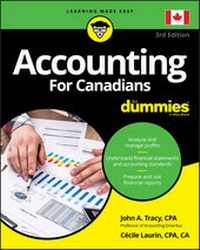
Accounting For Canadians For Dummies
Description

Get it right with this accessible guide to Canadian accounting practices
As the demand for on-the-money accounting expertise grows in Canada's increasingly complex public and private business landscape, current and future accounting professionals need a comprehensive resource that's tailored specifically to their financial world. This revised edition takes you through what you need to know in straightforward language, from the basics to advanced issues such as income statements and balance sheets, budgets and budgeting, and the ins and outs of the GAAP.
In addition to advice on general accounting procedures, Accounting For Canadians For Dummies includes coverage of the latest regulations in all areas of the Canadian economy, keeping you on the right side of the law as it applies to government, public, and private sectors. The book is also a must-have for salary accountants working for accounting, tax preparation, bookkeeping, and payroll services firms.
- Align with the most recent International Financial Reporting Standards
- Comply with the latest need-to-know regulations for private enterprise
- Use guidelines on common procedures such as tracking inventory, profit and cash flow, and evaluating profit margins
- Get expert advice on budgeting and payroll best practices
Whether you're a professional or studying for your future career, Accounting For Canadians For Dummies gives you an authoritative, easy-to-follow path to success!
More details
Other editions
New editions
Additional editions
Content
- Intro
- Title Page
- Copyright Page
- Table of Contents
- Introduction
- About This Book
- Foolish Assumptions
- Icons Used in This Book
- Beyond the Book
- Where to Go from Here
- Part 1 Opening the Books on Accounting
- Chapter 1 Accounting: The Language of Business, Investing, Finance, and Taxes
- Accounting Is Not Just for Accountants
- Affecting both insiders and outsiders
- Overcoming the stereotypes of accountants
- Relating accounting to your personal financial life
- Looking for Accounting in All the Right Places
- Taking a Peek behind the Scenes
- Focusing on Transactions
- Separating basic types of transactions
- Knowing who's on the other side of transactions
- Taking the Pulse of a Business: Financial Statements
- Meeting the balance sheet and the accounting equation
- Reporting profit and loss, and cash flows
- Respecting the importance of this trio
- Exploring Careers in Accounting
- Professional accounting designations
- The controller: The chief accountant in an organization
- A springboard to other careers
- Chapter 2 Financial Statements and Accounting Standards
- Introducing the Information Content of Financial Statements
- Setting up the business example
- The income statement
- The balance sheet
- The statement of cash flows
- How Profit and Cash Flow from Profit Differ
- Gleaning Key Information from Financial Statements
- How's profit performance?
- Is there enough cash?
- Can you trust the financial statement numbers?
- Why no cash distribution from profit?
- Keeping in Step with Accounting and Financial Reporting Standards
- Recognizing Canadian and international standards
- Getting to know the Canadian, U.S., and international standard setters
- Going worldwide
- Noting a divide between public and private companies
- Recognizing how income tax methods influence accounting methods
- Following the rules and bending the rules
- Chapter 3 Bookkeeping and Accounting Systems
- Bookkeeping and Beyond
- Pedalling Through the Bookkeeping Cycle
- Managing the Bookkeeping and Accounting System
- Categorize your financial information: The chart of accounts
- Standardize source document forms and procedures
- Hire competent, trained personnel
- Enforce strong - we mean strong! - internal controls
- Complete the process with end-of-period procedures
- Leave good audit trails
- Look out for unusual events and developments
- Design truly useful reports for managers
- Double-Entry Accounting for Single-Entry Folks
- Juggling the Books to Conceal Embezzlement and Fraud
- Using Accounting Software in the Cloud and on the Ground
- Part 2 Exploring Financial Statements
- Chapter 4 Reporting Revenue, Expenses, and the Bottom Line
- Presenting a Typical Income Statement
- Looking at businesses that sell services
- Taking care of some housekeeping details
- Your job: Asking questions!
- Deconstructing Profit
- Revenue and expense effects on assets and liabilities
- Folding profit into retained earnings
- Pinpointing the Assets and Liabilities Used to Record Revenue and Expenses
- Making sales: Accounts receivable and unearned revenue
- Selling products: Inventory
- Prepaying operating costs: Prepaid expenses
- Fixed assets: Depreciation expense
- Unpaid expenses: Accounts payable, accrued expenses payable, and income tax payable
- Summarizing the Financial Effects of Profit
- Reporting Gains and Losses
- Unusual gains and losses
- Discontinued operations
- Statement of Retained Earnings
- Closing Comments
- Chapter 5 Reporting Assets, Liabilities, and Owners' Equity
- Understanding That Transactions Drive the Balance Sheet
- Presenting a Proper Balance Sheet
- Kicking balance sheets out into the real world
- Judging liquidity and solvency
- Sizing up assets and liabilities
- Sales revenue and accounts receivable
- Cost of goods sold expense and inventory
- Fixed assets and depreciation expense
- SG&A expenses and their three balance sheet accounts
- Intangible assets, goodwill, and amortization expense
- Debt and interest expense
- Income tax expense and income tax payable
- Net income and cash dividends (if any)
- Financing a Business
- Costs and Other Balance Sheet Values
- Chapter 6 Reporting Cash Flows
- Meeting the Statement of Cash Flows
- Presenting the direct method
- Opting for the indirect method
- Dissecting the Difference between Cash Flow and Net Income
- Accounts receivable change
- Inventory change
- Prepaid expenses change
- The depreciation factor
- Changes in operating liabilities
- Putting the cash flow pieces together
- Sailing Through the Rest of the Statement of Cash Flows
- Investing activities
- Financing activities
- Trying to Pin Down "Free Cash Flow"
- Being an Active Reader
- Chapter 7 Choosing Accounting Methods: Different Strokes for Different Folks
- Reporting Changes in Shareholders' Equity
- Recognizing Reasons for Accounting Differences
- Looking at a More Conservative Version of the Company's Income Statement
- Presenting an alternative income statement
- Spotting significant differences
- Explaining the Differences
- Accounts receivable and sales revenue
- Inventory and cost of goods sold expense
- Cost of fixed assets and depreciation expense
- Accrued expenses payable, income tax payable, and expenses
- Wrapping things up
- Calculating Cost of Goods Sold Expense and Inventory Cost
- The FIFO (first-in, first-out) method
- The average cost method
- The specific identification method
- Recording Inventory Losses under the Lower of Cost and Net Realizable Value (LCNRV) Rule
- Appreciating Depreciation Methods
- Scanning the Revenue and Expense Horizon
- Part 3 Preparing and Using Financial Reports
- Chapter 8 Deciding the Legal Structure for a Business
- Studying the Sources of Business Capital
- Tapping two sources of owners' equity
- Leveraging equity capital with debt
- Recognizing the Legal Roots of Business Entities
- Incorporating a Business
- Issuing shares
- Offering different classes of shares
- Determining the market value of shares
- Keeping alert for dilution of share value
- Recognizing conflicts between shareholders and managers
- Partnerships
- Going It Alone: Sole Proprietorships
- Choosing the Best Structure for Income Tax
- Chapter 9 Getting a Financial Report Ready for Release
- Quickly Reviewing the Theory of Financial Reporting
- Starting with financial statements
- Keeping in mind the reasons for financial reports
- Recognizing Management's Role
- Staying on Top of Accounting and Financial Reporting Standards
- Making Sure Disclosure Is Adequate
- Notes: Nettlesome but needed
- Other disclosures in financial reports
- Putting a Spin on the Numbers (But Not Cooking the Books)
- Window dressing for fluffing up cash balance and cash flow
- Comparing Public and Private Companies
- Reports from publicly owned companies
- Reports from private businesses
- Dealing with Information Overload
- Browsing based on your interests
- Recognizing condensed versions
- Using other sources of business information
- Chapter 10 How Lenders and Investors Read a Financial Report
- Knowing the Rules of the Game
- Becoming a More Savvy Investor
- Comparing Private and Public Business Financial Reports
- Analyzing Financial Statements with Ratios
- Gross margin ratio
- Profit ratio
- Earnings per share (EPS), basic and diluted
- Price/earnings (P/E) ratio
- Dividend yield
- Market value, book value, and book value per share
- Return on equity (ROE) ratio
- Current ratio
- Acid-test ratio
- Return on assets (ROA) ratio and financial leverage gain
- Cash flow ratios - not
- More ratios?
- Frolicking through the Notes
- Checking Out the Auditor's Report
- Why audits?
- What's in an auditor's report?
- Discovering fraud, or not
- Chapter 11 How Business Managers Use a Financial Report
- Building on the Foundation of External Financial Statements
- Seeking out problems and opportunities
- Avoiding information overload
- Gathering Financial Condition Information
- Cash
- Accounts receivable
- Inventory
- Prepaid expenses
- Fixed assets less accumulated depreciation
- Intangible assets
- Accounts payable
- Accrued expenses payable
- Income tax payable
- Interest-bearing debt
- Owners' equity
- Culling Profit Information
- Presenting an income statement for managers
- Calculating cash flow on the back of an envelope
- Managing operating cash flows
- Scrutinizing sales revenue and expenses
- Digging deeper into ROE (return on equity)
- Part 4 Accounting in Business Management
- Chapter 12 Analyzing and Managing Profit
- Helping Managers: The Fourth Pillar of Accounting
- Branching out in the field of management accounting
- Centering on profit centres
- Internal Profit Reporting
- Designing internal profit and loss (P&L) reports
- Reporting operating expenses
- Looking at Strategic Profit Analysis
- Presenting a profit analysis template
- Separating variable and fixed expenses
- Stopping at operating earnings
- Focusing on margin - the catalyst of profit
- Using the template to explain profit
- Taking a Closer Look at the Lines in the Profit Template
- Sales revenue
- Cost of goods sold
- Variable operating expenses
- Fixed operating expenses
- Using the Profit Template for Decision-Making Analysis
- Tucking Away Some Valuable Lessons
- Recognize the leverage effect caused by fixed operating expenses
- Don't underestimate the effect of small changes in sales price
- Know your options for improving profit
- Closing with an Auto Example
- Chapter 13 Accounting for Costs
- Looking Down the Road to the Destination of Costs
- Are Costs Really That Important?
- Becoming More Familiar with Costs
- Direct versus indirect costs
- Fixed versus variable costs
- Relevant versus irrelevant costs
- Actual, budgeted, and standard costs
- Product versus period costs
- Assembling the Product Cost of Manufacturers
- Minding manufacturing costs
- Classifying costs properly
- Calculating product cost
- Examining fixed manufacturing costs and production capacity
- Puffing Profit by Excessive Production
- Shifting fixed manufacturing costs to the future
- Cranking up production output
- Being careful when production output is out of kilter with sales volume
- Chapter 14 Budgeting
- Putting Budgeting in Its Place
- Planning reasons for budgeting
- Control reasons for budgeting
- Exploring Budgeting
- Words to the wise
- Budgets as financial models
- Looking at Profit Budgeting in Action
- Setting goals
- Developing the profit improvement plan
- Additional Benefits of Budgeting
- Is Budgeting Worth the Cost?
- Realizing Not Every Business Budgets
- Avoiding budgeting
- Relying on internal accounting reports
- Budgeting Cash Flow
- Considering Capital Expenditures and Other Cash Needs
- Part 5 The Part of Tens
- Chapter 15 Ten Tips for Managers
- Reach Breakeven, and Then Rake in Profit
- Set Sales Prices Right
- Distinguish Profit from Cash Flow
- Call the Shots on Accounting Policies
- Budget Wisely
- Get the Accounting Information You Need
- Tap into Your Accountant's Expertise
- Critically Review Your Fraud Controls
- Lend a Hand in Preparing Your Financial Reports
- Sound Like a Pro in Talking about Your Financial Statements
- Chapter 16 Ten Tips for Reading a Financial Report
- Get in the Right Frame of Mind
- Decide What to Read
- Improve Your Accounting Savvy
- Judge Profit Performance
- Test Earnings per Share (EPS) Against Change in the Bottom Line
- Confront Unusual Gains and Losses
- Compare Cash Flow and Profit
- Look for Signs of Financial Distress
- Recognize the Risks of Restatement and Fraud
- Remember the Limits of Financial Reports
- Glossary
- Index
- EULA
