

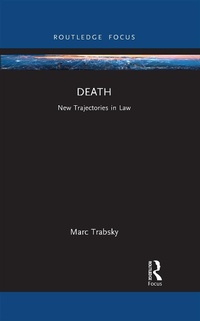
Death
New Trajectories in Law
1st Edition
Published on 20. July 2023
78 pages
978-1-000-95624-5 (ISBN)
Description

This book examines how legal institutions reify the value of death in the twenty-first century.
Its starting point is that bio-technological innovations have extended life to such an extent that death has become an epistemological problem for legal institutions. It explores how legal definitions of death are subject to the governing logic of economisation, how legal technologies for registering a death reshape what kind of deaths are counted during a pandemic, and how technologies for recycling cadaveric tissue problematise the legal status of the corpse. The question that unites each chapter is how legal institutions respond to technologies that bring death before their laws. The book argues for an interdisciplinary approach, informed by the writings of Georges Bataille, Wendy Brown, Georges Canguilhem and Michel Foucault, to understand how legal epistemologies are increasingly disrupted, challenged, and countered by technologies that repurpose death to extend, nourish and foster human life. It contends that legal theorists and social scientists need to rethink doctrinal perspectives of law when theorising how law defines the moment of death, shapes what kind of deaths count, and recycles the debris of the dead.
This book will appeal to a broad international readership with research interests in critical theory, political theory, legal theory or death studies; and it will be particularly useful for teachers and students who are searching for an accessible entry point to the study of the intersections between law and death.
Its starting point is that bio-technological innovations have extended life to such an extent that death has become an epistemological problem for legal institutions. It explores how legal definitions of death are subject to the governing logic of economisation, how legal technologies for registering a death reshape what kind of deaths are counted during a pandemic, and how technologies for recycling cadaveric tissue problematise the legal status of the corpse. The question that unites each chapter is how legal institutions respond to technologies that bring death before their laws. The book argues for an interdisciplinary approach, informed by the writings of Georges Bataille, Wendy Brown, Georges Canguilhem and Michel Foucault, to understand how legal epistemologies are increasingly disrupted, challenged, and countered by technologies that repurpose death to extend, nourish and foster human life. It contends that legal theorists and social scientists need to rethink doctrinal perspectives of law when theorising how law defines the moment of death, shapes what kind of deaths count, and recycles the debris of the dead.
This book will appeal to a broad international readership with research interests in critical theory, political theory, legal theory or death studies; and it will be particularly useful for teachers and students who are searching for an accessible entry point to the study of the intersections between law and death.
More details
Series
Edition
1. Auflage
Language
English
Place of publication
London
United Kingdom
Publishing group
Taylor & Francis Ltd
Target group
College/higher education
ISBN-13
978-1-000-95624-5 (9781000956245)
Copyright in bibliographic data and cover images is held by Nielsen Book Services Limited or by the publishers or by their respective licensors: all rights reserved.
Schweitzer Classification
Other editions
Person
Dr Marc Trabsky is an Associate Professor in Law at La Trobe University, Australia.
Content
1. Legal Epistemologies of Death 2. The Economisation of Death 3. Counting the Dead 4. Recycling the Corpse
