

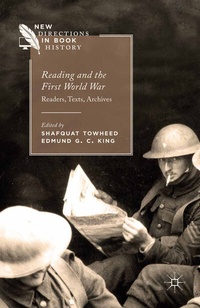
Reading and the First World War
Description

Reviews / Votes
"This collection of 13 essays focuses on readership, representing the democratizing shift in literary research that is now a standard approach to the teaching of literary culture. . This book should be used by researchers working on the study of this war, as well as those working on book and publishing history, since the essays discuss little-known archival possibilities that established researchers may not know, and newcomers should certainly be made aware of." (Kate Macdonald, First World War Studies, July, 2017)
"As Reading and the First World War demonstrates, a vast number of those involved in World War I-not only soldiers but also civilians-read avidly. . comprises a range of essays addressing topics as varied as the reading practices of war artists behind the line; of conscientious objectors; and of Australian prisoners of war. . the nurses and ambulance drivers who must have read, if only occasionally-ultimately Reading and the First World War contains somethingfor everyone." (Kabi Hartman, English Literature in Transition, Vol. 60 (1), 2017)
"The history of reading in the First World War is an area of particular significance in this commemorative period. It has benefited from a conjunction of archival and digital projects that makes new accounts and resources available to scholars across the world. . This complex intermingling of experience and imagination animates the collection as a whole, making this not just a gathering of scholarly perspectives, but a testament to the interdependence of all acts of wartime reading, politically and culturally." (Lucy Collins, SHARP News, sharpweb.org, August, 2016)
"Reading and the First World War participates in the recent digital turn and transnational turn in book history, which are also central to modernist studies. . Reading and the First World War includes some particularly strong essays based on work in neglected archives and collections. It will be of interest not only to book historians (its explicit audience), but also to scholars of modernism." (Lise Jaillant, Modernism, modernity, Vol. 23 (2), April, 2016)
More details
Other editions
Additional editions
Persons
Content
List of Tables
Acknowledgements
Notes on Contributors
Introduction; Edmund G.C. King and Shafquat Towheed
PART I: READING AND THE FORMATION OF THE LITERARY CANON
1. Khaki and Kisses: Reading the romance novel in the Great War; Jane Potter
2. Towards a popular canon: Education, war and authorial identity in Europe, 1914-1929; Alisa Miller
PART II: WRITERS' READING AND RESPONSES: FORD MADOX FORD AND EDITH WHARTON
3. Ford Madox Ford, reading, and Parade's End; Max Saunders
4. Reading the Great War: an examination of Edith Wharton's reading and responses, 1914-18; Shafquat Towheed
PART III: READING AND THE MASSES: AMERICA AND ITALY
5. 'Please send me Tess of the Dr Rbyvilles (Harding)': the reading preferences of American soldiers; Jonathan Arnold
6. 'Today they read even those who did not read': Reading in Italy during the First World War; Sara Mori
PART IV: READING AND NATIONAL IDENTITY: AUSTRALIAN SOLDIERS' READING AT THE FRONT
7. William Albert Amiet, Barrister-At-Law, M.A., reads his way through the Great War; Jim Cleary
8. A captive audience? The reading lives of Australian prisoners of wars, 1914-18; Edmund G.C. King
PART V: READING AND GROUP IDENTITY: WAR ARTISTS AND CONSCIENTIOUS OBJECTORS
9. Reading behind the lines: War artists, war poets, reading and letter writing, 1917-19; Jonathan Black
10. Only a scrap of paper: the prison reading of British conscientious objectors, 1916-19; Catherine Feely
PART VI: READING THE NEWS: NEWSPAPERS IN BELGIUM, FRANCE AND GERMANY
11. German soldier newspapers and their Allied counterparts; Robert L. Nelson
12. Forbidden reading in occupied countries: Belgium and France, 1914-18; Emmanuel Debruyne
Bibliography
Index
