

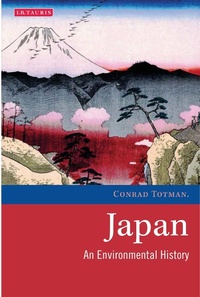
Japan
An Environmental History
1st Edition
Published on 30. January 2014
384 pages
978-1-78673-152-4 (ISBN)
Description

From the outset, society in Japan has been shaped by its environmental context. The lush green mountainous archipelago of today, with its highly productive lowlands, supports a population of more than 127 million people and one of the most advanced economies in the world. How has this come about and at what environmental cost? Conrad Totman, one of the world's foremost scholars on Japanese, here provides a comprehensive and detailed account of the country's environmental history, from its beginnings to the present day. Professor Totman traces the country's development through successive historical phases, as early agricultural society based on non-intensive forms of cultivation gave way to more intensified forms. With each stage came greater utilisation of natural resources but a steady reduction in the richness of the indigenous biosystem. By the late seventeenth century the country was well on the way to ecological disaster.
Yet Japan's isolation in the seventeenth and eighteenth centuries led to an unusually enlightened set of environmental policies, and the system of regenerative forestry brought in during the Tokugawa period prevented certain devastation of the country's forests. At the end of the nineteenth century, however, the country began to go to the opposite extreme, as industrialisation brought with it a period of unprecedented change. Growth and diversification led to a surge in environmental pollution as it became necessary to look beyond the country's domestic natural resources to meet the demand for foodstuffs, fossil fuels and the raw materials necessary to an advanced industrial economy. The population was particularly badly affected, and some of the problems that emerged, especially from the 1960s onwards, provided important test cases not just for Japan but worldwide. What makes the Japanese story particularly instructive is that the country's boundaries are uncommonly clear and the nature, timing, and extent of external influences on its history are unusually identifiable.
The Japanese experience, therefore, not only yields important insights into the processes of environmental history, it offers important lessons for the wider environmental history of the planet and for our understanding of current global ecological problems. A work of immense erudition and reflecting a lifetime of scholarship, Japan: an Environmental History will be welcomed by all with an interest in environmental history and the historical development of Japan.
Yet Japan's isolation in the seventeenth and eighteenth centuries led to an unusually enlightened set of environmental policies, and the system of regenerative forestry brought in during the Tokugawa period prevented certain devastation of the country's forests. At the end of the nineteenth century, however, the country began to go to the opposite extreme, as industrialisation brought with it a period of unprecedented change. Growth and diversification led to a surge in environmental pollution as it became necessary to look beyond the country's domestic natural resources to meet the demand for foodstuffs, fossil fuels and the raw materials necessary to an advanced industrial economy. The population was particularly badly affected, and some of the problems that emerged, especially from the 1960s onwards, provided important test cases not just for Japan but worldwide. What makes the Japanese story particularly instructive is that the country's boundaries are uncommonly clear and the nature, timing, and extent of external influences on its history are unusually identifiable.
The Japanese experience, therefore, not only yields important insights into the processes of environmental history, it offers important lessons for the wider environmental history of the planet and for our understanding of current global ecological problems. A work of immense erudition and reflecting a lifetime of scholarship, Japan: an Environmental History will be welcomed by all with an interest in environmental history and the historical development of Japan.
More details
Edition
1. Auflage
Language
English
Place of publication
United Kingdom
Publishing group
Bloomsbury Publishing PLC
Target group
Professional and scholarly
Illustrations
38 bw, 47 tables integrated
ISBN-13
978-1-78673-152-4 (9781786731524)
Copyright in bibliographic data and cover images is held by Nielsen Book Services Limited or by the publishers or by their respective licensors: all rights reserved.
Schweitzer Classification
Other editions
Additional editions
Book
01/2014
I.B. Tauris
€133.92
Article exhausted; check different version
Person
Conrad Totman is Professor Emeritus in Japanese History, Yale University, USA. Acknowledged as the leading western authority on Japanese environmental history, his books include Japan before Perry , The Green Archipelago , Early Modern Japan , and A History of Japan (3rd edition, 2010)
Content
Preface
Illustrations
Maps
Introduction
Chapter 1 Japan the Place
Japan today; Geological process: geological pre-history, archipelagic history; Global
Location: Japan's position in Eurasia, ambient ocean currents, north-south length, some
human consequences
Chapter 2 Forager Society
Environmental context: sea level, temperature and precipitation; Early arrivals
(pre-pottery); Jomon culture (pottery): perplexities of the onset, Jomon overall,
regarding ambiguities of society and culture; Recapitulation
Chapter 3 Early agricultural society to 600 CE
Regarding agriculture: forager-agriculture comparison, early-later agriculture comparison, paddy culture - the technique, paddy culture - its extent; Agriculture: Early manifestations: general
observations, Jomon agricultural practices; Yayoi: the beginning of fully developed agriculture in
Japan: background and beginnings, some socio-cultural conundrums: Yayoi and beyond c. 200-
600CE: Later Yayoi society, Kofun, environmental ramifications to 600 CE; Recapitulation:
Chapter 4 Early agricultural society, 600-1250
Regarding deforestation: logging, agricultural land clearance; Formation of a central elite, 600-
850: capital cities, the new architecture, control and exploitation of the hinterland; consolidation
of the margins; Environmental ramifications of the Ritsuryo order: regarding the center,
regarding the realm; The later Ritsuryo centuries, 850-1250: intra-elite changes, changes in elite-
producer relations, changes in producer organization and practice; Environmental ramifications
of later Ritsuryo developments: renewal of agricultural growth, changing center periphery
relations, urbanism - two lesser examples; Recapitulation
Chapter 5 Intensive agricultural society, 1250-1650
Geography; The elite: politics of disorder and reconsolidation, 1250-1650: the final decades of
diarchy (1250-1330), the era of disarray and disorder (1330-1550), the period of reconsolidation
(1550-1650); The producer populace: growth in scale and complexity: human-pathogen relations,
elite-producer relations, producer organization and practice; Trends in agricultural technique:
regarding fertilizer, water management, noteworthy new crops; Social and environmental effects
of technological change: effects of deforestation, effects of agricultural intensification, other
matters; Recapitulation
Chapter 6 Intensive agricultural society, 1650-1890
The elite: politics of stability, rupture and reorientation: Bakuhan structure and limitations, the
foreign menace (1790-1860), political restructuring (1860-90): The producer-populace:
growth, stasis and change: human pathogen relations, elite-producer relations, producer
organization and practice; Trends in technology: mining, forestry, fisheries, agriculture;
Recapitulation
Chapter 7 Imperial industrialism, 1890-1945
Some preliminaries: on the global resource, on 'packing and stacking', on 1890 as starting date,
on 'imperial industrialism' as a temporary category, on 'state' vs. 'elite'; Affairs of state:
domestic politics, foreign relations; Society and economy: demographics, co
Illustrations
Maps
Introduction
Chapter 1 Japan the Place
Japan today; Geological process: geological pre-history, archipelagic history; Global
Location: Japan's position in Eurasia, ambient ocean currents, north-south length, some
human consequences
Chapter 2 Forager Society
Environmental context: sea level, temperature and precipitation; Early arrivals
(pre-pottery); Jomon culture (pottery): perplexities of the onset, Jomon overall,
regarding ambiguities of society and culture; Recapitulation
Chapter 3 Early agricultural society to 600 CE
Regarding agriculture: forager-agriculture comparison, early-later agriculture comparison, paddy culture - the technique, paddy culture - its extent; Agriculture: Early manifestations: general
observations, Jomon agricultural practices; Yayoi: the beginning of fully developed agriculture in
Japan: background and beginnings, some socio-cultural conundrums: Yayoi and beyond c. 200-
600CE: Later Yayoi society, Kofun, environmental ramifications to 600 CE; Recapitulation:
Chapter 4 Early agricultural society, 600-1250
Regarding deforestation: logging, agricultural land clearance; Formation of a central elite, 600-
850: capital cities, the new architecture, control and exploitation of the hinterland; consolidation
of the margins; Environmental ramifications of the Ritsuryo order: regarding the center,
regarding the realm; The later Ritsuryo centuries, 850-1250: intra-elite changes, changes in elite-
producer relations, changes in producer organization and practice; Environmental ramifications
of later Ritsuryo developments: renewal of agricultural growth, changing center periphery
relations, urbanism - two lesser examples; Recapitulation
Chapter 5 Intensive agricultural society, 1250-1650
Geography; The elite: politics of disorder and reconsolidation, 1250-1650: the final decades of
diarchy (1250-1330), the era of disarray and disorder (1330-1550), the period of reconsolidation
(1550-1650); The producer populace: growth in scale and complexity: human-pathogen relations,
elite-producer relations, producer organization and practice; Trends in agricultural technique:
regarding fertilizer, water management, noteworthy new crops; Social and environmental effects
of technological change: effects of deforestation, effects of agricultural intensification, other
matters; Recapitulation
Chapter 6 Intensive agricultural society, 1650-1890
The elite: politics of stability, rupture and reorientation: Bakuhan structure and limitations, the
foreign menace (1790-1860), political restructuring (1860-90): The producer-populace:
growth, stasis and change: human pathogen relations, elite-producer relations, producer
organization and practice; Trends in technology: mining, forestry, fisheries, agriculture;
Recapitulation
Chapter 7 Imperial industrialism, 1890-1945
Some preliminaries: on the global resource, on 'packing and stacking', on 1890 as starting date,
on 'imperial industrialism' as a temporary category, on 'state' vs. 'elite'; Affairs of state:
domestic politics, foreign relations; Society and economy: demographics, co
