

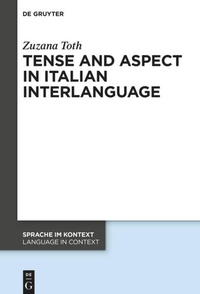
Tense and Aspect in Italian Interlanguage
1st Edition
Published on 23. November 2020
XII, 266 pages
978-3-11-062649-0 (ISBN)
Description

The expression of time is fundamental in communication and languages have developed a variety of means to encode temporal relations. When learning a new language, learners are often faced with the challenging task of discovering a new system of temporal relations.
The present study investigates the development of tense and aspect marking in the interlanguage of L3 Italian learners enrolled in university language courses. It examines how the tense-aspect system develops in the interlanguage and how the acquisition process is shaped by factors such as the lexical aspectual value of the predicates and discourse grounding. The data indicate that both lexical aspect and discourse grounding influence the distribution of verbal morphology in the interlanguage. Semantically congruent pairings of lexical aspect, verbal morphology and discourse grounding are used more frequently and appropriately than less prototypical combinations. The acquisition process is also influenced by the learner's L1, which was mostly German in the context of the present study.
The study can be used as a guide for curricular decisions in language teaching, and for projecting further research on the development of tense-aspect marking in multilingual learners.
The present study investigates the development of tense and aspect marking in the interlanguage of L3 Italian learners enrolled in university language courses. It examines how the tense-aspect system develops in the interlanguage and how the acquisition process is shaped by factors such as the lexical aspectual value of the predicates and discourse grounding. The data indicate that both lexical aspect and discourse grounding influence the distribution of verbal morphology in the interlanguage. Semantically congruent pairings of lexical aspect, verbal morphology and discourse grounding are used more frequently and appropriately than less prototypical combinations. The acquisition process is also influenced by the learner's L1, which was mostly German in the context of the present study.
The study can be used as a guide for curricular decisions in language teaching, and for projecting further research on the development of tense-aspect marking in multilingual learners.
More details
Other editions
Additional editions
Zuzana Toth
Tense and Aspect in Italian Interlanguage
Book
04/2025
1st Edition
De Gruyter
€149.95
Shipment within 7-9 days
Zuzana Toth
Tense and Aspect in Italian Interlanguage
E-Book
11/2020
1st Edition
De Gruyter
€149.95
Available for download
Person
Zuzana Toth
, Comenius University in Bratislava, Slovakia.
Content
- Intro
- Acknowledgments
- Contents
- 1 Introduction
- 2 Key concepts of language acquisition research
- 3 Tense, aspect and grounding
- 4 The acquisition of tense and aspect in Romance languages
- 5 The acquisition of tense and aspect in Italian
- 6 Methodology
- 7 Results of the obligatory occasion analysis
- 8 Results of the frequency analysis
- 9 The effect of lexical aspect on the distribution of past tense morphology
- 10 Discussion
- Bibliography
- Index
