
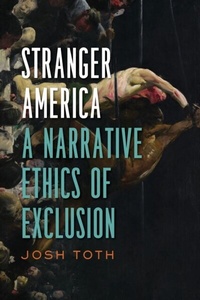
Stranger America
Description
Alles über E-Books | Antworten auf Fragen rund um E-Books, Kopierschutz und Dateiformate finden Sie in unserem Info- & Hilfebereich.
Contradictory ideals of egalitarianism and self-reliance haunt America's democratic state. We need look no further than Donald Trump's 2016 presidential campaign and victory for proof that early twentieth-century anxieties about individualism, race, and the foreign or intrusive "other" persist today. In Stranger America, Josh Toth tracks and delineates these anxieties in America's aesthetic production, finally locating a potential narrative strategy for circumnavigating them.
Toth's central focus is, simply, strangeness-or those characters who adamantly resist being fixed in any given category of identity. As with the theorists employed (Nancy, ¿i¿ek, Derrida, Freud, Hegel), the subjects and literature considered are as encompassing as possible: from the work of Herman Melville, William Faulkner, James Weldon Johnson, and Nella Larsen to that of Philip K. Dick, Woody Allen, Larry David, and Bob Dylan; from the rise of nativism in the early twentieth century to object-oriented ontology and the twenty-first-century zombie craze; from ragtime and the introduction of sound in American cinema to the exhaustion of postmodern metafiction.
Toth argues that American literature, music, film, and television can show us the path toward a new ethic, one in which we organize identity around the stranger rather than resorting to tactics of pure exclusion or inclusion. Ultimately, he provides a new narrative approach to otherness that seeks to realize a truly democratic form of community.
All prices
More details
Other editions
Additional editions
Person
Josh Toth is Associate Professor of English at MacEwan University.
Content
- Intro
- TITLE PAGE
- CONTENTS
- ACKNOWLEDGMENTS
- Introduction: Both Members of This Club
- PART I BEING WITHDRAWN
- 1 /Melancholics and Specters: Between James Weldon Johnson and Alan Crosland
- 2 /Promising Intrusion in Nella Larsen's Passing
- 3 / Articulations of Ambiguity: William Faulkner, Toni Morrison, and James McBride
- PART II BEING EATEN
- 4 /Touching Herman Melville's "Bartleby" (and Other Zombie Narratives)
- 5 /Consuming Androids in the Work of Philip K. Dick
- 6 / The Chameleon and the Dictator in Woody Allen's Zelig
- PART III BEING GIVEN
- 7 / The Autonarratives of Ernest Hemingway (and Others)
- 8 / The Divinely Unshareable Self: From Edward Albee to Larry David
- 9 / Bob Dylan's Autoplasticity
- NOTES
- WORKS CITED
- INDEX

System requirements
File format: ePUB
Copy protection: Adobe-DRM (Digital Rights Management)
System requirements:
- Computer (Windows; MacOS X; Linux): Install the free reader Adobe Digital Editions prior to download (see eBook Help).
- Tablet/smartphone (Android; iOS): Install the free app Adobe Digital Editions or the app PocketBook before downloading (see eBook Help).
- E-reader: Bookeen, Kobo, Pocketbook, Sony, Tolino and many more (not Kindle).
The file format ePub works well for novels and non-fiction books – i.e., „flowing” text without complex layout. On an e-reader or smartphone, line and page breaks automatically adjust to fit the small displays.
This eBook uses Adobe-DRM, a „hard” copy protection. If the necessary requirements are not met, unfortunately you will not be able to open the eBook. You will therefore need to prepare your reading hardware before downloading.
Please note: We strongly recommend that you authorise using your personal Adobe ID after installation of any reading software.
For more information, see our ebook Help page.
File format: PDF
Copy-Protection: Adobe-DRM (Digital Rights Management)
System requirements:
- Computer (Windows; MacOS X; Linux): Install the free reader Adobe Digital Editions prior to download (see eBook Help).
- Tablet/smartphone (Android; iOS): Install the free app Adobe Digital Editions or the app PocketBook before downloading (see eBook Help).
- E-reader: Bookeen, Kobo, Pocketbook, Sony, Tolino and many more (only limited: Kindle).
The file format PDF always displays a book page identically on any hardware. This makes PDF suitable for complex layouts such as those used in textbooks and reference books (images, tables, columns, footnotes). Unfortunately, on the small screens of e-readers or smartphones, PDFs are rather annoying, requiring too much scrolling.
This eBook uses Adobe-DRM, a „hard” copy protection. If the necessary requirements are not met, unfortunately you will not be able to open the eBook. You will therefore need to prepare your reading hardware before downloading.
Please note: We strongly recommend that you authorise using your personal Adobe ID after installation of any reading software.
For more information, see our eBook Help page.
File format: ePUB
Copy protection: without DRM (Digital Rights Management)
System requirements:
- Computer (Windows; MacOS X; Linux): Use a reader that can handle the file format ePUB, such as Adobe Digital Editions or FBReader – both free (see eBook Help).
- Tablet/Smartphone (Android; iOS): Install the free app Adobe Digital Editions or the app PocketBook (see eBook Help).
- E-reader: Bookeen, Kobo, Pocketbook, Sony, Tolino and many more (not Kindle).
The file format ePUB works well for novels and non-fiction books – i.e., 'flowing' text without complex layout. On an e-reader or smartphone, line and page breaks automatically adjust to fit the small displays.
This eBook does not use copy protection or Digital Rights Management
For more information, see our eBook Help page.
