

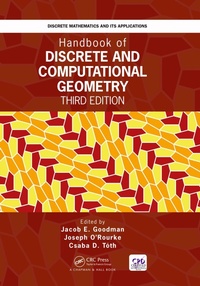
Handbook of Discrete and Computational Geometry
3rd Edition
Published on 22. November 2017
1950 pages
978-1-4987-1142-5 (ISBN)
Description

The Handbook of Discrete and Computational Geometry is intended as a reference book fully accessible to nonspecialists as well as specialists, covering all major aspects of both fields.
The book offers the most important results and methods in discrete and computational geometry to those who use them in their work, both in the academic world-as researchers in mathematics and computer science-and in the professional world-as practitioners in ?elds as diverse as operations research, molecular biology and robotics.
Discrete geometry has contributed signi?cantly to the growth of discrete mathematics in recent years. This has been fueled partly by the advent of powerful computers and by the recent explosion of activity in the relatively young ?eld of computational geometry. This synthesis between discrete and computational geometry lies at the heart of this Handbook.
A growing list of application fields includes combinatorial optimization, computer-aided design, computer graphics, crystallography, data analysis, error-correcting codes, geographic information systems, motion planning, operations research, pattern recognition, robotics, solid modeling, and tomography.
The book offers the most important results and methods in discrete and computational geometry to those who use them in their work, both in the academic world-as researchers in mathematics and computer science-and in the professional world-as practitioners in ?elds as diverse as operations research, molecular biology and robotics.
Discrete geometry has contributed signi?cantly to the growth of discrete mathematics in recent years. This has been fueled partly by the advent of powerful computers and by the recent explosion of activity in the relatively young ?eld of computational geometry. This synthesis between discrete and computational geometry lies at the heart of this Handbook.
A growing list of application fields includes combinatorial optimization, computer-aided design, computer graphics, crystallography, data analysis, error-correcting codes, geographic information systems, motion planning, operations research, pattern recognition, robotics, solid modeling, and tomography.
Reviews / Votes
"Discrete and computational geometry is a thriving ?eld, and the collective knowledge represented in this third edition of the Handbook is evidence of this. Twenty years have passed since the publication of the ?rst edition [Handbook of discrete and compu-tational geometry, CRC Press Ser. Discrete Math. Appl., CRC, Boca Raton, FL, 1997; MR1730156], and since then, the area has seen a tremendous growth due in part to the in?uence of both the ?rst and second editions [Handbook of discrete and computational geometry, Discrete Math. Appl. (Boca Raton), Chapman & Hall/CRC, Boca Raton, FL, 2004; MR2082993] of the Handbook. The new edition can be expected to serve a similar purpose for future generations of researchers and practitioners.The third edition has a new co-editor, Csaba D. T?oth, who joins the two editors of the previous editions, Jacob E. Goodman and Joseph O'Rourke.
The third edition of the Handbook has been substantially revised. The addition of almost 400 pages has resulted in a volume of well over 1900 pages. Fifty-eight out of the sixty-?ve chapters of the second edition have been updated (sometimes with a slightly revised title), many of them by the original authors, others in collaboration with new co-authors. Ten new chapters have been added, for an overall count of sixty-eight chapters.
Five new chapters on computational topology and its applications have been added, including four in a new section on "Combinatorial and Computational Topology". These deal with random simplicial complexes, computational topology of graphs on surfaces, persistent homology, high-dimensional topological data analysis, and geometry and topology of genomic, respectively. A new chapter on proximity algorithms, added to the section on "Algorithms and Complexity of Fundamental Geometric Objects", provides a comprehensive treatment of relative neighborhood graphs and geometric spanners. There also are two new chapters in the section on "Computational Techniques": on epsilon-approximations and epsilon-nets and on coresets and sketches, respectively. Finally, two more new chapters in the section on "Applications of Discrete and Compu-tational Geometry" describe recent advances in rigidity theory and concern rigidity of symmetric frameworks and global rigidity, respectively.
The new version remains an invaluable resource for anyone interested in discrete and computational geometry and in related areas, including specialists and non-specialists. The Handbook continues to be an attractive one-stop reference book."
- Egon Schulte - Mathematical Reviews Clippings - May 2019
More details
Series
Edition
3rd edition
Language
English
Place of publication
Philadelphia, PA
United States
Publishing group
Taylor & Francis Inc
Target group
College/higher education
Illustrations
314 s/w Abbildungen
314 Illustrations, black and white
File size
22,33 MB
ISBN-13
978-1-4987-1142-5 (9781498711425)
Copyright in bibliographic data and cover images is held by Nielsen Book Services Limited or by the publishers or by their respective licensors: all rights reserved.
Schweitzer Classification
Other editions
Additional editions
Csaba D. Toth | Joseph O'Rourke | Jacob E. Goodman
Handbook of Discrete and Computational Geometry
Book
11/2017
3rd Edition
Chapman & Hall/CRC
€386.26
Shipment within 15-20 days
Persons
Csaba D. Toth is a professor of mathematics at Cal State Northridge, located in the city of Los Angeles, and a visiting professor of computer science at Tufts University in the Boston metro area. He is the author of more than 90 papers in discrete and computational geometry. His main research interests are in hierarchical subdivisions in low-dimensional spaces, topological graph theory, and geometric optimization.
Joseph O'Rourke is professor of Computer Science and of Mathematics at Smith College, and director of the Statistical and Data Science program. His research is in computational geometry, developing algorithms for geometric computations. He has authored or coauthored five books besides this Handbook. His most recent book, "How To Fold It," is written for high-school students.
Jacob E. Goodman is, along with Richard Pollack, a Founding Editor of the journal "Discrete & Computational Geometry." He retired from City College, C.U.N.Y. in 2008. The author of over 60 papers in algebraic geometry, combinatorics, and discrete geometry, he has spent most of his time since his retirement composing music and working on a mystery novel. Goodman received the Lester R. Ford Award from the MAA in 1990, and is a Fellow of the AMS.
Joseph O'Rourke is professor of Computer Science and of Mathematics at Smith College, and director of the Statistical and Data Science program. His research is in computational geometry, developing algorithms for geometric computations. He has authored or coauthored five books besides this Handbook. His most recent book, "How To Fold It," is written for high-school students.
Jacob E. Goodman is, along with Richard Pollack, a Founding Editor of the journal "Discrete & Computational Geometry." He retired from City College, C.U.N.Y. in 2008. The author of over 60 papers in algebraic geometry, combinatorics, and discrete geometry, he has spent most of his time since his retirement composing music and working on a mystery novel. Goodman received the Lester R. Ford Award from the MAA in 1990, and is a Fellow of the AMS.
Content
Finite point configurations. Packing and covering. Tilings. Helly-type theorems and geometric transversals. Pseudoline arrangements. Oriented matroids.Lattice points and lattice polytopes. Low-distortion embeddings of finite metric spaces. Geometry and topology of polygonal linkages. Geometric graph theory. Euclidean Ramsey theory. Discrete aspects of stochastic geometry. Geometric discrepancy theory and uniform distribution. Polyominoes. Basic properties of convex polytopes. Subdivisions and triangulations of polytopes. Face numbers of polytopes and complexes. Symmetry of polytopes and polyhedra. Polytope skeletons and paths. Polyhedral maps.Topological methods in discrete geometry.Random simplicial complexes. Computational topology of graphs on surfaces. Persistent homology. High-dimensional topological data analysis. Convex hull computations. Voronoi diagrams and Delaunay triangulations. Arrangements.Triangulations and mesh generation. Polygons.Shortest paths and networks. Proximity algorithms. Visibility. Geometric reconstruction problems. Curve and surface reconstruction. Computational convexity. Computational and quantitative real algebraic geometry.Point location. Collision and proximity queries. Range searching. Ray shooting and lines in space. Geometric intersection. Nearest neighbors in high-dimensional spaces.Randomizaton and derandomization. Robust geometric computation. Parallel algorithms in geometry. Epsilon-nets and epsilon-approximations Coresets and sketches. Linear programming. Algorithmic motion planning. Robotics. Computer graphics. Modeling motion. Pattern recognition. Graph drawing.Splines and geometric modeling. Solid modeling. Computation of robust statistics: Depth, median, and related measures. Geographic information systems.Geometric applications of the Grassmann-Cayley algebra. Rigidity of symmetric frameworks. Global rigidity. Crystals, periodic and aperiodic..Applications to structural molecular biology. Geometry and topology of genomics. Software. Two computational geometry libraries: LEDA and CGAL
