

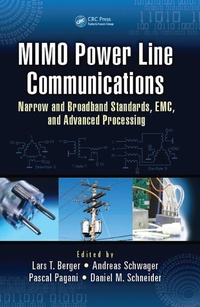
MIMO Power Line Communications
Narrow and Broadband Standards, EMC, and Advanced Processing
1st Edition
Published on 19. December 2017
710 pages
978-1-4665-5753-6 (ISBN)
Description

One of the first publications of its kind in the exciting field of multiple input multiple output (MIMO) power line communications (PLC), MIMO Power Line Communications: Narrow and Broadband Standards, EMC, and Advanced Processing contains contributions from experts in industry and academia, making it practical enough to provide a solid understanding of how PLC technologies work, yet scientific enough to form a base for ongoing R&D activities.
This book is subdivided into five thematic parts. Part I looks at narrow- and broadband channel characterization based on measurements from around the globe. Taking into account current regulations and electromagnetic compatibility (EMC), part II describes MIMO signal processing strategies and related capacity and throughput estimates. Current narrow- and broadband PLC standards and specifications are described in the various chapters of part III. Advanced PLC processing options are treated in part IV, drawing from a wide variety of research areas such as beamforming/precoding, time reversal, multi-user processing, and relaying. Lastly, part V contains case studies and field trials, where the advanced technologies of tomorrow are put into practice today.
Suitable as a reference or a handbook, MIMO Power Line Communications: Narrow and Broadband Standards, EMC, and Advanced Processing features self-contained chapters with extensive cross-referencing to allow for a flexible reading path.
This book is subdivided into five thematic parts. Part I looks at narrow- and broadband channel characterization based on measurements from around the globe. Taking into account current regulations and electromagnetic compatibility (EMC), part II describes MIMO signal processing strategies and related capacity and throughput estimates. Current narrow- and broadband PLC standards and specifications are described in the various chapters of part III. Advanced PLC processing options are treated in part IV, drawing from a wide variety of research areas such as beamforming/precoding, time reversal, multi-user processing, and relaying. Lastly, part V contains case studies and field trials, where the advanced technologies of tomorrow are put into practice today.
Suitable as a reference or a handbook, MIMO Power Line Communications: Narrow and Broadband Standards, EMC, and Advanced Processing features self-contained chapters with extensive cross-referencing to allow for a flexible reading path.
Reviews / Votes
"Stefano Galli and Erez Ben-Tovim, two experts I highly respect, contributed to this book regarding Smart Grid applications and ITU-T's work on powerline standardization, both G.hn's powerline mode and the many variants of G.hnem. It's good to see G.hn appearing in technical literature of this sort as G.hn continues to expand out into the market, and becomes the home networking technology of choice over any wire."--John Egan, HomeGrid Forum President, HomeGrid Blog, May 22, 2014
"... acts as a reference document or handbook, drawing expert input from industry and academia so as to provide a pragmatic understanding of the workings of PLC technologies as well as a scientific basis for ongoing R&D activities."
--ITU Newslog, April 29, 2014
More details
Series
Language
English
Place of publication
Baton Rouge
United States
Publishing group
Taylor & Francis Inc
Target group
College/higher education
Professors, researchers, senior undergraduate students, and graduate students as well as planning engineers, product and service designers, algorithm developers, and marketing and managerial professionals in the telecommunications, smart grid, smart home, entertainment, multi-media, and digital home product manufacturing industries.
Illustrations
407 s/w Abbildungen, 57 s/w Tabellen
57 Tables, black and white; 407 Illustrations, black and white
File size
59,67 MB
ISBN-13
978-1-4665-5753-6 (9781466557536)
Copyright in bibliographic data and cover images is held by Nielsen Book Services Limited or by the publishers or by their respective licensors: all rights reserved.
Schweitzer Classification
Other editions
Additional editions
Lars Torsten Berger | Andreas Schwager | Pascal Pagani
MIMO Power Line Communications
Narrow and Broadband Standards, EMC, and Advanced Processing
Book
03/2017
1st Edition
CRC Press
€121.80
Shipment within 10-20 days
Lars Torsten Berger | Andreas Schwager | Pascal Pagani
MIMO Power Line Communications
Narrow and Broadband Standards, EMC, and Advanced Processing
Book
02/2014
1st Edition
CRC Press
€304.55
Shipment within 15-20 days
Persons
Lars T. Berger, Ph.D is founder of BreezeSolve and director of R&D at Kenus Informatica. While working for Nortel Networks, and during his stay at Aalborg University financed by Nokia Networks, he focused on MIMO channel modeling, signal processing, and scheduling algorithms for 3G cellular systems. As visiting professor at University Carlos III of Madrid, he extended his work to 4G, as well as wireless LAN and sensor networks. As senior engineer at Design of Systems on Silicon (DS2, now Marvell Semiconductors), he contributed to MIMO and multi-user enabled power line silicon solutions and extended his area of interest to smart grids.
Andreas Schwager, Ph.D began his career at ANT Bosch Telecom and Grundig, where he developed narrowband PLC functions for satellite headends. Today, he is principal engineer at Sony Deutschland's European Technology Center. He represents Sony at various standardization committees at IEEE, ITU, CISPR, CENELEC, Homeplug, and ETSI. He is the rapporteur of over ten work items where technical standards and reports are published, the most recent being the three-part ETSI TR 101 562, specifying MIMO PLC field measurements and presenting results of MIMO PLC properties. He has also led several task forces at international standardization bodies.
Pascal Pagani, Ph.D is associate professor at Telecom Bretagne, member of the Lab-STICC laboratory (UMR CNRS 6285), and member of the IEEE technical committee on PLC. He has worked with France Telecom Orange Labs on UWB propagation channel characterization and modeling, short range wireless system design, and development of in-home wireline communications. He led France Telecom standardization activities in the IEEE 802.15.3c, ITU SG15 G.hn, and HomePlug TWG groups, and participated in the ETSI Specialist Task Force 410 for the experimental assessment of the PLC MIMO transmission channel. His current interests include long-haul radiowave propagation and advanced power line communications.
Daniel M. Schneider received his Dipl.-Ing degree in electrical engineering (with a focus on signal processing and communications) and his Dr.-Ing degree for his thesis In-Home Power Line Communications using Multiple Input Multiple Output Principles from the University of Stuttgart in 2006 and 2012, respectively. He currently serves as senior engineer at Sony Deutschland's European Technology Center, where his work is concerned with communications systems and PLC, in particular. He has published multiple papers related to powerline communications and MIMO, invented several international patents, and contributed to the PLC HomePlug AV2 specification and the ETSI MIMO-PLC field measurements campaign.
Andreas Schwager, Ph.D began his career at ANT Bosch Telecom and Grundig, where he developed narrowband PLC functions for satellite headends. Today, he is principal engineer at Sony Deutschland's European Technology Center. He represents Sony at various standardization committees at IEEE, ITU, CISPR, CENELEC, Homeplug, and ETSI. He is the rapporteur of over ten work items where technical standards and reports are published, the most recent being the three-part ETSI TR 101 562, specifying MIMO PLC field measurements and presenting results of MIMO PLC properties. He has also led several task forces at international standardization bodies.
Pascal Pagani, Ph.D is associate professor at Telecom Bretagne, member of the Lab-STICC laboratory (UMR CNRS 6285), and member of the IEEE technical committee on PLC. He has worked with France Telecom Orange Labs on UWB propagation channel characterization and modeling, short range wireless system design, and development of in-home wireline communications. He led France Telecom standardization activities in the IEEE 802.15.3c, ITU SG15 G.hn, and HomePlug TWG groups, and participated in the ETSI Specialist Task Force 410 for the experimental assessment of the PLC MIMO transmission channel. His current interests include long-haul radiowave propagation and advanced power line communications.
Daniel M. Schneider received his Dipl.-Ing degree in electrical engineering (with a focus on signal processing and communications) and his Dr.-Ing degree for his thesis In-Home Power Line Communications using Multiple Input Multiple Output Principles from the University of Stuttgart in 2006 and 2012, respectively. He currently serves as senior engineer at Sony Deutschland's European Technology Center, where his work is concerned with communications systems and PLC, in particular. He has published multiple papers related to powerline communications and MIMO, invented several international patents, and contributed to the PLC HomePlug AV2 specification and the ETSI MIMO-PLC field measurements campaign.
Content
Power Line Channel and Noise - Characteristics and Modeling. Introduction to PLC Channel and Noise Characterization. Narrowband Characterization in an Office Environment. Narrowband Measurements in Domestic Access Networks. Broadband In-Home Characterization- and Correlation-Based Modeling. Broadband In-Home Statistics and Stochastic Modeling. Regulations, EMC, and MIMO Capacity. PLC Electromagnetic Compatibility Regulations. MIMO PLC EMC Statistical Analysis. MIMO PLC Signal Processing Theory. MIMO PLC Capacity and Throughput Analysis. Current PLC Systems and Their Evolution. Current PLC Systems - A Survey. Narrowband Power Line Standards. ITU G.hn - Broadband Home Networking. IEEE 1901 - Broadband over Power Line Networks. HomePlug AV2 - Next Generation Broadband over Power Line. IEEE 1905.1 - Convergent Digital Home Networking. Advanced PHY and MAC Layer Processing. Smart Beamforming - Improving PLC EMI. Radiation Mitigation for Power Line Communications Using Time Reversal. Linear Precoding for Multicarrier and Multicast PLC. Multiuser MIMO for Power Line Communications. Relaying Protocols for In-Home PLC. Implementations, Case Studies, and Field Trials. Narrowband PLC Channel and Noise Emulation. Cognitive Frequency Exclusion in EN 50561-1:2012. Mitigating PLC Interference on Broadcast Radio. MIMO PLC Hardware Feasibility Study.
