

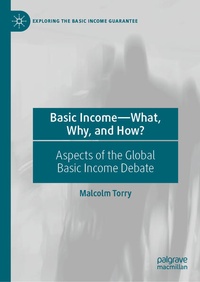
Basic Income-What, Why, and How?
Description

The global Basic Income debate is now widespread, diverse, and relatively well resourced by academic and more popular literature: but that does not mean that there is universal agreement about every topic of discussion. In fact, there is still a quite heated debate about some of the most basic questions, such as 'What is a Basic Income?' 'What's the point?', and 'Is it feasible?'
This book is not yet another general introduction to Basic Income. There are already plenty of those. It is entirely about those aspects of the debate about which there is most discussion and sometimes the most conflict. It is based on conference papers, previously published chapters, and other previously published articles, working papers, and reports: material that has already benefited from consultation and debate, as is appropriate for a book about aspects of a debate that are the subject of frequent consultation and discussion.
Reviews / Votes
"A clear and systematic exploration of a wide range of issues in the evaluation of the idea of Basic Income and of various Basic Income implementation schemes. Torry's essays bring admirable clarity and precision to the discussion of the terms and concepts necessary to understanding the nuances of different perspectives on unconditional, universal, and individual cash transfers. The book manages to be simultaneously useful to experts and accessible to newcomers to the topic"
-- Almaz Zelleke , Professor of Practice in Political Science, New York University Shanghai
"In an atmosphere where there is so much confusion about what a genuine basic income is, this collection of essays by Dr Malcolm Torry is welcome and much needed. He masterfully and elegantly separates the grain from the chaff. It is timely and answers the critical questions that the idea of basic income evokes. Having been invested in this radical idea for several decades, DrTorry brings authority, conviction, and simplicity into these essays. This is a 'must read' as much to scholars and policymakers as to lay people."
-- Dr. Sarath Davala is an Indian sociologist and currently the chair of the Basic Income Earth Network (BIEN).
More details
Other editions
Additional editions
Person
Malcolm Torry is a visiting fellow at the Institute for Policy Research at the University of Bath and a trustee and treasurer of the Basic Income Earth Network (BIEN). He was previously the director of the Citizen's Basic Income Trust and a senior visiting fellow at the London School of Economics.
Content
1.Basic Income: What, why, and how? Introductory chapter.- 2.Defining Basic Income.- 3. 'Unconditional' and 'universal'.- 4. Basic Income and Basic Income schemes.- 5.Basic Income as the preserver and transformation of capitalism.- 6.The mode of delivery is important.- 7.Only for children?.- 8.Basic Income is feasible.- 9.Speenhamland is irrelevant.- 10.Testing different routes to a Basic Income.- 11.A Basic Income at the level of Minimum Income Standards?.- 12.What (if anything) can justify Basic Income pilot projects?.- 13.Factors influencing political decisions about social security benefits in the UK.- 14.Research and education in the UK debate.- 15.Political feasibility in the UK.- 16.Microsimulation research in the UK.- 17.What a Basic Income is, why it matters, and how it might come about.
