

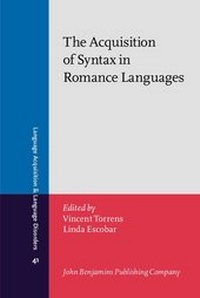
The Acquisition of Syntax in Romance Languages
1st Edition
Published on 26. July 2006
VIII, 422 pages
978-90-272-9349-7 (ISBN)
Description

This volume includes a selection of papers that address a wide range of acquisition phenomena from different Romance languages and all share a common theoretical approach based on the Principles and Parameters theory. They favour, discuss and sometimes challenge traditional explanations of first and second language acquisition in terms of maturation of general principles universal to all languages. They all depart from the view that language acquisition can be explained in terms of learning language specific rules, constraints or structures. The different parts into which this volume is organized reflect different approaches that current research has offered, which deal with issues of development of reflexive pronouns, determiners, clitics, verbs, auxiliaries, inflection, wh-movement, ressumptive pronouns, topic and focus, mood, the syntax/discourse interface, and null arguments.
More details
Other editions
Additional editions
Vincent Torrens | Linda Escobar
The Acquisition of Syntax in Romance Languages
Book
07/2006
John Benjamins Publishing Co
€132.50
Shipment within 10-15 days
Persons
Content
- The Acquisition of Syntax in Romance Languages
- Editorial page
- Title page
- LCC data
- Table of contents
- Contributors
- The acquisition of syntax in Romance languages
- Introduction
- I. Clitics, determiners and pronouns
- The production of SE and SELF anaphors in Spanish and Dutch children
- 1. Introduction
- 2. Reflexivity in and outside narrow syntax
- 3. Experiments
- 3.1. Method
- 3.2. Participants
- 4. Results
- 4.1. Dutch results
- 4.2. Spanish results
- 5. Discussion
- 5.1. Reflexivity and the production of se, zich and zichzelf
- 5.2. Spanish children's production of strong reflexives
- 6. Conclusions
- Acknowledgements
- Notes
- References
- On the acquisition of ambiguous Valency-Marking Morphemes
- 1. Introduction
- 2. Hypotheses on the acquisition of argument structure
- 3. French SE-cliticization and argument structure alternations
- 4. Method
- 4.1. Speech production corpora
- 4.2. Experimental task
- 5. Results
- 5.1. Order of acquisition of SE-constructions
- 5.2. Manifestations of overgeneralizations of ASA
- 5.3. Order of acquisition of SE and be-passive
- 6. Discussion
- Notes
- References
- Definite and bare noun contrasts in child Catalan
- 1. Introduction
- 2. The syntax and semantics of bare nouns
- 2.1. Bare objects
- 2.2. Genericity across languages: the status of bare nouns
- 2.3. Bare nouns in Catalan
- 3. Assumptions on acquisition
- 3.1. The emergence of DP in child grammar
- 4. An experiment on the contrast between bare nouns and definite DPs
- 4.1. Methods
- 4.2. Participants
- 4.3. Results
- 5. Conclusions
- Notes
- References
- Null arguments in monolingual children
- 1. Introduction
- 2. Previous studies comparing the acquisition of object clitics in French and Italian
- 3. The cross-sectional study
- 3.1. The test
- 3.2. Participants
- 3.3. Results
- 4. Discussion
- 5. Conclusion
- Notes
- References
- Prenominal elements in French-Germanic bilingual first language acquisition
- 1. Introduction
- 2. Possibility of cross-linguistic interference
- 2.1. Adult system
- 2.2. Hulk and Müller (2000): Conditions for cross-linguistic influence
- 3. Methodology
- 4. The acquisition of the determiner in adjective-noun combinations
- 4.1. Monolingual acquisition
- 4.2. Bilingual acquisition
- 4.3. Discussion
- 5. The acquisition of the attributive adjective
- 5.1. Monolingual acquisition
- 5.2. Bilingual acquisition
- 5.3. Discussion
- 6. Conclusion
- Notes
- References
- Appendix
- Prenominal and postnominal adjectives in Daniel
- II. Verbs, auxiliaries and inflection
- A cross-sectional study on the use of ``be'' in early Italian
- 1. Introduction
- 2. Method
- 2.1. Subjects and linguistic corpora
- 2.2. Group composition
- 2.3. Criteria of analysis
- 3. Results
- 4. Discussion
- Notes
- References
- Patterns of copula omission in Italian child language
- 1. Introduction
- 2. The Truncation hypothesis
- 3. The data
- 3.1. Copula omission
- 3.2. The Wh-constraint
- 3.3. Auxiliary data
- 4. Discussion
- 4.1. Omission as evidence for truncation
- 4.2. Truncation & full competence
- 5. Conclusions
- Notes
- References
- Looking for the universal core of the RI stage
- 1. Introduction
- 2. RIs
- 3. The Imperative Analogue Hypothesis
- 3.1. Italian and German
- 3.2. Dutch and Icelandic
- 3.3. Spanish and Catalan
- 3.4. Hungarian and Slovenian
- 4. Is the RI analogue really an imperative form?
- 4.1. The 3D Hypothesis
- 4.2. The Underspecification (DM) Hypothesis
- 5. Concluding remarks
- Acknowledgements
- Notes
- References
- The acquisition of experiencers in Spanish L1 and the external argument requirement hypothesis
- 1. Introduction
- 2. The structure of Experiencers
- 2.1. Belletti and Rizzi (1988)
- 2.2. Torrego's (1998) object dependencies in Spanish
- 2.3. Phases and Wexler's hypothesis for syntactic development
- 2.4. Psych verbs and left-dislocation structures
- 3. Implications of the ACDH and EARH for child language
- 4. The experiments
- 4.1. Experiment 1
- 4.2. Experiment 2
- 5. Discussion
- Note
- References
- Appendix. Items for experiments
- Experiment 1
- Experiment 2
- Early operators and late topic-drop/pro-drop
- 1. The acquisition of grammatical features
- 1.1. Jakobson's order of acquisition steps
- 1.2. Wexler's Optional Infinitives
- 1.3. Rizzi's Truncations
- 1.4. Conflict of Reduction Principles
- 2. The acquisition of I-marking and D-marking
- 3. Overlap between the Reduction Principles
- 4. Rizzi's Truncations for the three different predicate types
- 4.1. Examples of the predicate types
- 4.2. Characteristics of the predicate types
- 5. Type b and type c predicate types
- 5.1. Type b operator predicates
- 5.2. Type c: Discourse topic-oriented predicates
- 5.3. Rise of type c predicates: Topic-drop (Spec,C ø)
- 6. Conjecture: Type c Pro-Drop/Agreement is late
- 7. Conclusions
- Notes
- References
- Appendix 1: Input for types a-b-c (Dutch/Italian)
- Appendix 2: Input for types a-b (Dutch/Italian)
- Appendix 3: Percentages for imperative type a-b (Dutch/Italian)
- III. Movement and resumptive pronouns
- The acquisition of A- and A'-bound pronouns in Brazilian Portuguese
- 1. Introduction
- 2. Previous studies on the acquisition of pronouns
- 3. Pronouns as elsewhere elements
- 3.1. Brazilian Portuguese
- 3.2. Elsewhere elements and reference-set computation
- 4. The acquisition of pronouns
- 4.1. Method
- 4.2. Results
- 5. Discussion
- 6. Conclusion
- Notes
- References
- Acquiring long-distance wh-questions in L1 Spanish
- 1. Introduction
- 2. Wh-movement options cross-linguistically
- 3. A few remarks about Spanish
- 4. Previous language acquisition findings: Thornton (1990) and van Kampen (1997)
- 4.1. Non-adult questions are not performance errors
- 5. The experiment
- 5.1. Design and procedure
- 5.2. Results
- 5.3. Discussion
- 6. Conclusion
- Notes
- References
- Appendix I: Sample corresponding to the question
- Appendix II: Maider's subject extraction questions
- Evidence from L1 acquisition for the syntax of wh-scope marking in French
- 1. Introduction
- 2. Wh-in-situ in French
- 3. Partial wh-movement in first and second language acquisition of English LD questions
- 3.1. Thornton (1990): L1 English acquisition of LD wh-questions
- 3.2. Gutierrez (forthcoming): L2/L3 English acquisition of LD wh-questions
- 4. The experiment: Long-distance wh-questions in L1 acquisition of French
- 4.1. Participants, method and results
- 4.2. Partial wh-movement questions in L1 acquisition of French
- 5. Direct dependency scope marking strategies: Wh-in-situ in French and partial wh-movement in L1 French
- 6. Indirect dependency wh-scope marking strategies in L1 French
- 6.1. Indirect dependency in Hindi
- 6.2. Indirect dependency in L1 French
- 6.3. Direct or indirect dependency?
- 7. Acquisition stages
- 7.1. Wh-in-situ as the least marked strategy?
- 7.2. Long-distance dependencies
- Notes
- References
- IV. Syntax/discourse interface
- Acquisition of focus marking in European Portuguese
- 1. Introduction
- 2. The debate on the nature of focus
- 3. Contribution from acquisition for the debate on focus
- 4. Experiment on the comprehension of focus marking strategies
- 4.1. Methodology
- 4.2. Expected results
- 4.3. Results
- 4.4. Discussion
- 5. Conclusions
- Notes
- References
- Subject pronouns in bilinguals
- 1. Introduction
- 2. Method
- 3. Results
- 4. Discussion
- 4.1. Separated systems and yet influence
- 4.2. Features opposition and markedness
- 4.3. Syntax, discourse and cognition
- 4.4. Bilinguals and maturation
- 5. Conclusion
- Notes
- References
- V. L2 acquisition
- Is the semantics/syntax interface vulnerable in L2 acquisition?
- 1. Mood selection
- 1.1. Sentential arguments
- 1.2. Relative clauses
- 2. L2 acquisition of modal contrasts
- 3. Method
- 4. Results
- 4.1. Grammaticality judgment task
- 4.2. Truth-Value Judgment task
- 5. Discussion and conclusion
- Notes
- References
- The development of the syntax-discourse interface
- 1. Introduction
- 2. Theoretical background
- 2.1. Word order distribution and the interfaces
- 2.2. L2 acquisition at the syntax-discourse interface: Word order
- 2.3. L2 acquisition at the lexicon-syntax interface: Word order
- 3. Method
- 3.1. Subjects
- 3.2. Experimental design
- 3.3. Instrument
- 3.4. Procedure
- 3.5. Data analysis
- 3.6. Predictions
- 4. Results
- 4.1. Neutral contexts with unaccusative verbs
- 4.2. Neutral contexts with unergative verbs
- 4.3. Presentationally focused-subject contexts with unaccusative verbs
- 4.4. Presentationally focused-subject contexts with unergative verbs
- 5. Discussion
- 6. Conclusion
- Notes
- References
- Appendix
- Beyond the syntax of the Null Subject Parameter
- 1. Introduction
- 2. Theoretical background
- 2.1. Some history
- 2.2. Discourse pragmatic properties of subjects
- 2.3. Previous L2 studies of the Null Subject Parameter in Spanish
- 2.4. The present study
- 3. Method
- 3.1. Participants
- 3.2. Tasks
- 4. Results
- 4.1. Morphosyntax
- 4.2. Discourse-pragmatics
- 5. Discussion
- Notes
- References
- Appendix
- Intermediate
- Advanced
- Near-native
- Native speaker control
- Index
- The series Language Acquisition and Language Disorders
