

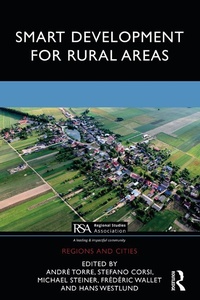
Smart Development for Rural Areas
1st Edition
Published on 11. October 2020
240 pages
978-1-000-06701-9 (ISBN)
Description

This thought-provoking book questions the framework of the Horizon 2020 strategy and the policies of smart development. It aims to answer the following question: Is there any possibility for a policy of smart development and smart specialization in rural and peri-urban areas? Based on detailed analytical studies, empirical and econometric methods, as well as various European case studies, several conclusions are drawn.
Smart development policies are well adapted to the developed or intermediate regions containing at the same time rural and urban areas, but do not really function for the more rural or more peripheral regions. The development policies of rural areas must be adapted to their particular characteristics, to the structure of their economies (agriculture, small firms), as well as in their diversity (distant regions, intermediate regions, rural areas near the urban areas). It appears interesting to exploit natural and cultural amenities, to develop the multifunctional character of the agriculture, to promote territorial innovation under all its forms, to favor the synergies between the various uses of land and space, and to develop the knowledge on the ecological, socioeconomic processes, as well as on the mechanisms of territorial governance.
These results are very important because they question the validity of the H2020 policy and the smart development and smart specialization policies and their applicability to the whole European area, and not only for the most urban and rich areas. It will be valuable reading for students, researchers and policy-makers in regional development, rural studies, spatial planning and economic geography.
Smart development policies are well adapted to the developed or intermediate regions containing at the same time rural and urban areas, but do not really function for the more rural or more peripheral regions. The development policies of rural areas must be adapted to their particular characteristics, to the structure of their economies (agriculture, small firms), as well as in their diversity (distant regions, intermediate regions, rural areas near the urban areas). It appears interesting to exploit natural and cultural amenities, to develop the multifunctional character of the agriculture, to promote territorial innovation under all its forms, to favor the synergies between the various uses of land and space, and to develop the knowledge on the ecological, socioeconomic processes, as well as on the mechanisms of territorial governance.
These results are very important because they question the validity of the H2020 policy and the smart development and smart specialization policies and their applicability to the whole European area, and not only for the most urban and rich areas. It will be valuable reading for students, researchers and policy-makers in regional development, rural studies, spatial planning and economic geography.
More details
Series
Edition
1. Auflage
Language
English
Place of publication
London
United Kingdom
Publishing group
Taylor & Francis Ltd
Target group
College/higher education
Product notice
Reflowable
Illustrations
23 Tables, black and white; 23 Line drawings, black and white; 37 Halftones, black and white; 60 Illustrations, black and white
ISBN-13
978-1-000-06701-9 (9781000067019)
Copyright in bibliographic data and cover images is held by Nielsen Book Services Limited or by the publishers or by their respective licensors: all rights reserved.
Schweitzer Classification
Other editions
Additional editions
Andre Torre | Stefano Corsi | Michael Steiner
Smart Development for Rural Areas
Book
04/2022
1st Edition
Routledge
€65.10
Shipment within 15-20 days
Andre Torre | Stefano Corsi | Michael Steiner
Smart Development for Rural Areas
Book
10/2020
1st Edition
Routledge
€206.40
Shipment within 15-20 days
Book
07/2020
Routledge
Unfortunately, price unknown
Available (delivery time upon request)
Persons
Andre Torre is Professor at the National Institute for Agronomic Research and the University of Paris-Saclay, France.
Stefano Corsi is a researcher in the Department of Economics at the University of Milan, Italy.
Michael Steiner is Professor in the Department of Economics at the University of Graz, Austria.
Frederic Wallet is a researcher at the National Institute for Agronomic Research and the University of Paris-Saclay, France.
Hans Westlund is Professor at KTH Royal Institute of Technology, Stockholm, Sweden, and the Joenkoeping International Business School, Joenkoeping, Sweden.
Stefano Corsi is a researcher in the Department of Economics at the University of Milan, Italy.
Michael Steiner is Professor in the Department of Economics at the University of Graz, Austria.
Frederic Wallet is a researcher at the National Institute for Agronomic Research and the University of Paris-Saclay, France.
Hans Westlund is Professor at KTH Royal Institute of Technology, Stockholm, Sweden, and the Joenkoeping International Business School, Joenkoeping, Sweden.
Content
Foreword Dominique Foray
1. Introduction Andre Torre, Stefano Corsi, Michael Steiner, Fred Wallet and Hans Westlund
Part I: Main Analytical Results on Smart Rural Areas
2. On Smart Business in Rural Areas Hans Westlund, Pia Nilsson, Sofia Wixe, Lucia Naldi
3. Smart Agriculture Stefano Corsi, Frederic Wallet
4. Smart Land Use in Rural Europe Andre Torre, Segolene Darly
5. Participatory Approaches About Smart Development in Rural Areas Sylvie Lardon, Christophe Soulard
Part Ii: Innovations in Rural Areas, Case Studies Results
6. Smart Development in Rural Regions: An Analysis of Two Austrian Case Study Regions Johannes Mossboeck, Michael Steiner, Carla Apschner
7. Case Studies from Sweden: Joenkoeping County and Jaemtland County Hans Westlund, Pia Nilsson, Sofia Wixe, Lucia Naldi
8. Two Case Studies in The Milan Metropolitan Region Stefano Corsi, Rosalia Filippini
9. Case Studies on Metropolitan Agriculture in France Amelie Goncalves, Danielle Galliano, Gael Plumecocq, Pierre Triboulet, Christophe Soulard, Hugo Guggenbuhl, Claire Toque
10. Case Studies from Commodities to Local Agri-Food Planning in France Segolene Darly, Johan Milian, Jean-Baptiste Traversac
11. Case Studies on Sustainable Innovation in Agrofood Chains in France Maryline Filippi, Olivier Frey, Amelie Goncalves
12. Conclusion Andre Torre, Stefano Corsi, Michael Steiner, Fred Wallet and Hans Westlund
1. Introduction Andre Torre, Stefano Corsi, Michael Steiner, Fred Wallet and Hans Westlund
Part I: Main Analytical Results on Smart Rural Areas
2. On Smart Business in Rural Areas Hans Westlund, Pia Nilsson, Sofia Wixe, Lucia Naldi
3. Smart Agriculture Stefano Corsi, Frederic Wallet
4. Smart Land Use in Rural Europe Andre Torre, Segolene Darly
5. Participatory Approaches About Smart Development in Rural Areas Sylvie Lardon, Christophe Soulard
Part Ii: Innovations in Rural Areas, Case Studies Results
6. Smart Development in Rural Regions: An Analysis of Two Austrian Case Study Regions Johannes Mossboeck, Michael Steiner, Carla Apschner
7. Case Studies from Sweden: Joenkoeping County and Jaemtland County Hans Westlund, Pia Nilsson, Sofia Wixe, Lucia Naldi
8. Two Case Studies in The Milan Metropolitan Region Stefano Corsi, Rosalia Filippini
9. Case Studies on Metropolitan Agriculture in France Amelie Goncalves, Danielle Galliano, Gael Plumecocq, Pierre Triboulet, Christophe Soulard, Hugo Guggenbuhl, Claire Toque
10. Case Studies from Commodities to Local Agri-Food Planning in France Segolene Darly, Johan Milian, Jean-Baptiste Traversac
11. Case Studies on Sustainable Innovation in Agrofood Chains in France Maryline Filippi, Olivier Frey, Amelie Goncalves
12. Conclusion Andre Torre, Stefano Corsi, Michael Steiner, Fred Wallet and Hans Westlund
