

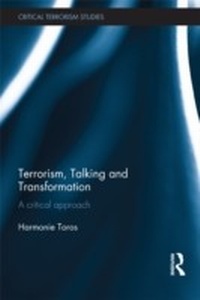
Terrorism, Talking and Transformation
A Critical Approach
1st Edition
Published on 27. February 2012
256 pages
978-1-136-33963-9 (ISBN)
Description

Using rare field research, this book investigates whether and how talking may transform terrorist violence.
Given the failings of today's dominant counterterrorism strategy, is talking a viable policy option to transform conflicts marked by terrorist violence? This book examines the reasons why "negotiating with terrorists" is so often shunned by decision-makers and scholars as a policy response, concluding that such objections are primarily based on a realist and statist understanding of terrorism that has dominated the field so far.
Based on interviews with top rebel and military commanders in the southern Philippine region of Mindanao and interviewing key actors in Northern Ireland, Terrorism, Talking and Transformation investigates how talking may contribute to the transformation of conflicts marked by terrorist violence. The result of this analysis is a theoretically grounded, empirically recognizable and emancipation oriented framework that can be used to investigate the potential of talking in transforming not only terrorist (and counterterrorist) violence, but also the underlying structural violence that often surrounds it.
This book will be of much interest to students in the fields of terrorism studies, security studies, Southeast Asian studies, conflict resolution/transformation and IR in general, and of use to practitioners in the field.
Given the failings of today's dominant counterterrorism strategy, is talking a viable policy option to transform conflicts marked by terrorist violence? This book examines the reasons why "negotiating with terrorists" is so often shunned by decision-makers and scholars as a policy response, concluding that such objections are primarily based on a realist and statist understanding of terrorism that has dominated the field so far.
Based on interviews with top rebel and military commanders in the southern Philippine region of Mindanao and interviewing key actors in Northern Ireland, Terrorism, Talking and Transformation investigates how talking may contribute to the transformation of conflicts marked by terrorist violence. The result of this analysis is a theoretically grounded, empirically recognizable and emancipation oriented framework that can be used to investigate the potential of talking in transforming not only terrorist (and counterterrorist) violence, but also the underlying structural violence that often surrounds it.
This book will be of much interest to students in the fields of terrorism studies, security studies, Southeast Asian studies, conflict resolution/transformation and IR in general, and of use to practitioners in the field.
Reviews / Votes
"This book offers original insights into the idea - counter to much received wisdom - that 'talking' can indeed be positively transformative in conflicts associated with terrorist violence, and has been in a number of cases. This is an important conclusion that breaks new ground. Carefully argued, theoretically knowledgeable, and with excellent fieldwork material from Northern Ireland and Mindanao, Harmonie Toros has done us a valuable service by offering persuasive evidence that talking is not a last resort, but should be considered with other responses from the outset. Let us hope that her book is widely read." - Oliver Ramsbotham, August 2012"Driven by the need to find less harmful methods to engage with terrorism, this book makes a valuable contribution to the literature on the use of dialogue to resolve violent conflict..... its measured approach provides both a strong theoretical grounding and robust evidence for a position that will be shared by many mediators on the ground, and support for a less arrogant approach to dialogue aimed at conflict transformation."- Marie Breen-Smyth, University of Surrey, UK
More details
Series
Language
English
Place of publication
London
United Kingdom
Publishing group
Taylor & Francis Ltd
Target group
College/higher education
Professional and scholarly
File size
1,40 MB
ISBN-13
978-1-136-33963-9 (9781136339639)
Copyright in bibliographic data and cover images is held by Nielsen Book Services Limited or by the publishers or by their respective licensors: all rights reserved.
Schweitzer Classification
Other editions
Additional editions
Book
02/2018
1st Edition
Routledge
€84.36
Shipment within 10-20 days

Book
05/2014
Routledge
Unfortunately, price unknown
Available (delivery time upon request)
Book
02/2012
1st Edition
Routledge
€222.84
Shipment within 15-20 days
Person
Harmonie Toros is lecturer in International Conflict Analysis at the University of Kent. After covering international security and terrorism as a reporter for major international news agencies for nearly ten years, she returned to academia to complete a PhD at the University of Wales, Aberystwyth.
Content
Introduction Part I 1. Terrorism 2. Talking 3. Transformation Part II 4. Talking in Northern Ireland 5. Talking in Mindanao Conclusion
