

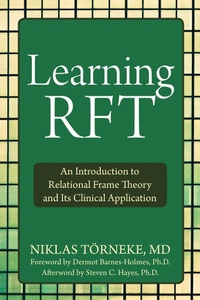
Learning RFT
Description

Relational frame theory, or RFT, is the little-understood behavioral theory behind a recent development in modern psychology: the shift from the cognitive paradigm underpinning cognitive behavioral therapy to a new understanding of language and cognition. Learning RFT presents a basic yet comprehensive introduction to this fascinating theory, which forms the basis of acceptance and commitment therapy. The book also offers practical guidance for directly applying it in clinical work.
In the book, author Niklas Törneke presents the building blocks of RFT: language as a particular kind of relating, derived stimulus relations, and transformation of stimulus functions. He then shows how these concepts are essential to understanding acceptance and commitment therapy and other therapeutic models. Learning RFT shows how to use experiential exercises and metaphors in psychological treatment and explains how they can help your clients. This book...
More details
Other editions
Additional editions
Person
Niklas Törneke, MD, is a psychiatrist, and has worked as a senior psychiatrist in the department of general psychiatry in his hometown of Kalmar, Sweden, from 1991 until he started a private practice in 1998. He earned his license as a psychotherapist in 1996, and was originally trained as a cognitive therapist. Since 1998, he has worked mainly with acceptance and commitment therapy (ACT), both in his own practice and as a teacher and clinical supervisor. His clinical experience ranges from psychiatric disorders such as schizophrenia to common anxiety and mood disorders with high prevalence in the general population.
Content
- Intro
- Contents
- Foreword to the U.S. Edition
- Foreword to the SwedishEdition
- Acknowledgments
- A Personal Word ofIntroduction
- Part 1: Background
- 1. Radical Behaviorism and Fundamental BehaviorAnalytic Principles
- 2. Thinking and HumanLanguage
- 3. Is the Power of Thinking a Clinically Relevant Issue?
- PART 2: Relational Learning
- 4. Derived Relational Responding as the Fundamental Element in Human Language
- 5. Analogies, Metaphors, and Our Experience of Self
- 6. Relational Framing and Rule-Governed Behavior
- 7 The Dark Side of Human Languaging
- PART 3: Clinical Implications
- 8 Learning Theory and Psychological Therapies
- 9 General Guidelines for Clinical Behavior Analysis
- 10 Altering the Context with a Focus on Consequences
- 11 Altering the Context with a Focus on Antecedents
- Afterword
- References
- Index
