

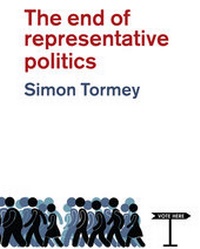
The End of Representative Politics
Description

But different forms of political activity are emerging toreplace representative politics: instant politics, direct action,insurgent politics. We are leaving behind traditionalrepresentation, and moving towards a politics withoutrepresentatives. In this provocative new book, Simon Tormeyexplores the changes that are underway, drawing on a rich range ofexamples from the Arab Spring to the Indignados uprising in Spain,street protests in Brazil and Turkey to the emergence of newinitiatives such as Anonymous and Occupy.
Tormey argues that the easy assumptions that informed our thinkingabout the nature and role of parties, and 'party baseddemocracy' have to be rethought. We are entering a period offast politics, evanescent politics, a politics of the street, ofthe squares, of micro-parties, pop-up parties, and demonstrations.This may well be the end of representative politics as we know it,but an exciting new era of political engagement is justbeginning.
More details
Other editions
Additional editions
Person
Content
Introduction 1
1 Contours of a 'Crisis' 15
2 Locating 'Representative Politics' 37
3 Are We Becoming Unrepresentable? 59
4 Is the Party Over? 83
5 Citizens against Representation 105
6 Democracy after Representation 125
Notes 150
References 152
Index 160
INTRODUCTION
There are not many truisms in the study of politics, but the view that representation is intrinsic to any system of democratic governance is probably one of them. Some people will speak and act on behalf of a group, political cause or identity and thus represent it; others will recognize themselves as being the object of this discourse and be represented by it. Some will hold power as representatives; other people will be represented. 'Speaking for others' and 'being spoken for' is, according to Hanna Pitkin, author of the classic work on the topic, The Concept of Representation, fundamental to understanding the dynamic of politics. As she puts it: 'In modern times, almost everyone wants to be governed by representatives.; every political group or cause wants representation; every government claims to represent' (Pitkin 1972: 2).
Few readers of Pitkin's text would have had grounds for querying such an analysis when it first appeared in 1967. Now it appears increasingly problematic. The claim that almost everyone 'wants to be governed by representatives' is countered by a growing body of evidence that suggests that many of us have become - or are becoming - disillusioned with politics and politicians, with our representatives and with representation (Norris 1999; Dalton 2004; Hay 2007). Compared to the 1960s we vote less - when we vote at all. We are much less likely to join a political party, to be interested in the affairs of the state or the political class (unless it is in the context of a scandal). The citizens of advanced democracies trust politicians less than virtually any other professional grouping, including second-hand car salesmen. In response to such alarming indicators, the Guardian asked in a recent survey whether representative democracy was in 'terminal decline' (Burn-Murdoch 2012).
As for the second half of Pitkin's statement ('every political group or cause wants representation'), many emergent political groups and initiatives explicitly and implicitly disavow the inheritance of representative politics. Occupy, for example, like other recent movements, rejects the idea that it is seeking to represent, even as it proclaims 'We are the 99%.' We can put to one side for a moment the issue of whether and to what extent such responses achieve what they set out to do: avoid, query or move beyond representation. Of interest here is the discourse and repertoire of devices, manoeuvres and gestures groups use to distance themselves from 'representative politics'. In place of a politics based on a practice of speaking and acting for others, we now find a plethora of forms and styles of what might be called immediate or non-mediated politics: direct action, flash protests, Twitter-led mobilizations, pinging, hacking, squatting, boycotting, buy-cotting, occupying and other interventions of a direct, practical kind. Increasingly, politically engaged citizens don't vote, they act. They don't join mass parties contesting power; they create their own initiatives, 'micro-parties', networks, affinity groups, deliberative assemblies, participatory experiments. They don't wait for elections; they seek to make their views, anger, displeasure, known immediately, now. They don't read the media, they (to quote Indymedia) are the media.
Even those who are not particularly active politically share the activists' mistrust of politicians and the political class ('the Pollies', as they are unaffectionately known here in Australia). Many would, it seems, rather listen to the likes of Bono, Slavoj Zizek, Jeremy Clarkson, Zac de La Rocha, System of a Down, Russell Brand, Glenn Beck, Michael Moore - not least because they distance themselves from the world of 'politics' and 'politicians'. The fact that celebrities, some of them millionaires, can appear as authentic voices of a disenfranchised populace whilst living lives further removed from ordinary citizens than many politicians do is a sign of how desperate matters have become. So too is the success of anti-political or protest parties. Indeed, there seems to be an emerging correlation between the 'anti'-ness of a political party, its desire to distance itself from the political mainstream, and its popularity. The Tea Party is the classic example in contemporary politics. But the success of Beppe Grillo's Five Star Movement (5SM) in the Italian general election of 2013 is perhaps even more symptomatic of the self-contradictions of the age: a wealthy celebrity railing at the corruption and decadence of the political class as he lives out a life of relative luxury. Contemporary politics increasingly resounds with the sound of anti-political politics, anti-representational representation.
In view of these developments it should perhaps hardly be surprising that the issue of representation, what it is, how it works, from being a rather dowdy Cinderella topic, has become one of the issues - if not the issue - confronting political commentary today. After a period where representation seemed as a concept to be little discussed (no doubt partly owing to the excellence of Pitkin's work), a number of important texts appeared in swift succession to re-examine the evolving nature of representation: Bernard Manin's The Principles of Representative Democracy (1997), Nadia Urbinati's Representative Democracy: Principles and Geneaology (2006), Mónica Brito Vieira and David Runciman's Representation (2008) and Mike Saward's The Representative Claim (2010), to name but a few.
As well as texts focused on the concept of representation, an academic industry has sprung up examining the crisis of representation, with explanations and recommendations as to how to renew or regenerate representative politics. Many such texts rotate around the theme of tinkering with one or other aspect of the system of representation. Shouldn't electoral systems be more proportionate? Shouldn't we be encouraging more minorities or more women to take part? Shouldn't we have more assemblies, or different kinds of assembly or more opportunities to participate? As many experts have noted, young people are particularly unreceptive to electoral or mainstream politics. Shouldn't we be offering citizenship education in schools? Perhaps the answer is to follow the example of the Australians and the Belgians in making voting compulsory, thereby removing at a stroke one of the symptoms of our declining interest. There's a lively debate about public funding for political parties (Van Biezen 2004). If political parties are the locus of democratic life in representative systems, shouldn't we be doing more and spending more to make sure that they are able to function adequately? Shouldn't we be encouraging new political parties as well as established ones?
For others, however, the horse has already bolted the stable. The worried title of Donatella Della Porta's Can Democracy Be Saved? (2013) speaks for itself, as does Colin Hay's Why We Hate Politics (2007). As emerges in their analyses, we don't like politics and politicians, and wish a plague on their houses. More than this, we blame politicians for most of the ills that confront us, whether it be the impoverishment of public life or the sweeping tides of immigration accompanying globalization. Politicians have messed up our world, and now it's payback time. John Keane's The Life and Death of Democracy (2009), an elephantine history of democracy from Antiquity to the present, foregrounds the matter even more bluntly: democracy appears to be 'dead', a victim of the growing incapacity of politics and politicians to engage with, let alone resolve, the key problems of our age. The best we can hope for is some sort of 'monitory' arrangement where those wielding power are made accountable through various ways and means to those subject to the whims of otherwise far-away politicians and technocrats. The Guardian was on the right lines it seems: terminal decline is a one-way street with the graveyard its final destination. We now live in 'post-democratic' or 'post-political' times. The idea of politics or, more precisely, democracy as a form of governance 'of the people, by the people, for the people' in the manner captured so brilliantly by Abraham Lincoln in the Gettysburg Address has withered in the glare of globalization, denationalization, public choice theory, neoliberalism, apathy and a multitude of other ailments.
What is to be done? Fixing up systems of representation so that they work better, so that they might be renewed, is the obvious place to start, one might think. Another is to rethink the basis of democratic life altogether. The shelves of our bookstores groan with all kinds of recommendations as to how to improve democracy through supplementing representation, or even replacing the representative component with some or other variant of direct or participatory democracy. The sheer variety of models on offer, from...
