

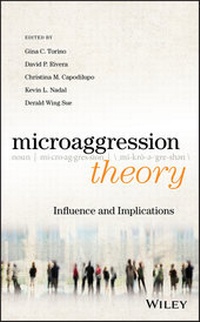
Microaggression Theory
Description

Microaggressions are brief, everyday exchanges that send denigrating messages to certain individuals because of their group membership (e.g., race, gender, culture, religion, social class, sexual orientation, etc.). These daily, common manifestations of aggression leave many people feeling vulnerable, targeted, angry, and afraid. How has this become such a pervasive part of our social and political rhetoric, and what is the psychology behind it?
In Microaggression Theory, the original research team that created the microaggressions taxonomy, Gina Torino, David Rivera, Christina Capodilupo, Kevin Nadal, and Derald Wing Sue, address these issues head-on in a fascinating work that explores the newest findings of microaggressions in their sociopolitical context. It delves into how the often invisible nature of this phenomenon prevents perpetrators from realizing and confronting their own complicity in creating psychological dilemmas for marginalized groups, and discusses how prejudice, privilege, safe spaces, and cultural appropriation have become themes in our contentious social and political discourse.
* Details the psychological effects of microaggressions in separate chapters covering clinical impact, trauma, related stress syndromes, and the effect on perpetrators
* Examines how microaggressions affect education, employment, health care, and the media
* Explores how social policies and practices can minimize the occurrence and impact of microaggressions in a range of environments
* Investigates how microaggressions relate to larger social movements
If you come across the topic of microaggressions in your day-to-day life, you can keep the conversation going in a productive manner--with research to back it up!
More details
Other editions
Additional editions
Persons
Gina C. Torino, Ph.D., is an Associate Professor of Psychology at SUNY Empire State College in New York.
David P. Rivera, Ph.D., is an Associate Professor of Counselor Education at Queens College, City University of New York.
Christina M. Capodilupo, Ph.D., is an Adjunct Associate Professor in the Department of Counseling and Clinical Psychology at Teachers College, Columbia University.
Kevin L. Nadal, Ph.D., is a Professor of Psychology at John Jay College of Criminal Justice and at The Graduate Center, City University of New York.
Derald Wing Sue, Ph.D., is a Professor of Psychology and Education in the Department of Counseling and Clinical Psychology at Teachers College, Columbia University, where he also holds a joint appointment with the School of Social Work.
Content
Acknowledgments xi
About the Editors xiii
About the Authors xv
Part I Microaggression Theory 1
1 Everything YouWanted to Know About Microaggressions but Didn't Get a Chance to Ask 3
Gina C. Torino, David P. Rivera, Christina M. Capodilupo, Kevin L. Nadal, and DeraldWing Sue
2 Aversive Racism, Implicit Bias, and Microaggressions 16
John F. Dovidio, Adam R. Pearson, and Louis A. Penner
3 MultidimensionalModels of Microaggressions and Microaffirmations 32
James M. Jones and Rosalie Rol¿on-Dow
4 Intersectionality Theory and Microaggressions: Implications for Research, Teaching, and Practice 48
Jioni A. Lewis, Marlene G.Williams, Anahvia T. Moody, Erica J. Peppers, and Cecile A. Gadson
Part II Detrimental Impact of Microaggressions 65
5 Microaggressions: Clinical Impact and Psychological Harm 67
Jesse Owen, KarenW. Tao, and Joanna M. Drinane
6 Microaggressions: Considering the Framework of Psychological Trauma 86
Thema Bryant-Davis
7 Factors Contributing to Microaggressions, Racial Battle Fatigue, Stereotype Threat, and Imposter Phenomenon for Nonhegemonic Students: Implications for Urban Education 102
Jennifer L.Martin
8 Microaggressions and Internalized Oppression: Intrapersonal, Interpersonal, and Institutional Impacts of "Internalized Microaggressions" 121
E.J.R. David, Jessica Petalio, and Maria C. Crouch
9 "I Didn't Know ThatWas Racist": Costs of Racial Microaggressions To White People 138
D Anthony Clark and Lisa Spanierman
Part III Manifestation of Microaggressions 157
10 The 360-Degree Experience of Workplace Microaggressions: Who Commits Them? How Do Individuals Respond? What Are the Consequences? 159
Jennifer Young-Jin Kim, Duoc Nguyen, and Caryn Block
11 Microaggressions: Toxic Rain in Health Care 178
Silvia L. Mazzula and Rebecca R. Camp¿on
12 From Racial Microaggressions to Hate Crimes: A Model of Online Racism Based on the Lived Experiences of Adolescents of Color 194
Brendesha M. Tynes, Fantasy T. Lozada, Naila A. Smith, and AshleyM. Stewart
13 EnvironmentalMicroaggressions: Context, Symbols, and Mascots 213
Jesse A. Steinfeldt, Jacqueline Hyman, and M. Clint Steinfeldt
Part IV Microaggressions and Social Policies and Practices 227
14 Microaggressions and Student Activism: Harmless Impact and Victimhood Controversies 229
DeraldWing Sue
15 "Radical by Necessity, Not by Choice": From Microaggressions to Social Activism 244
Michelle Fine,Maria E. Torre, David Frost, and Allison Cabana
Part V Microaggressions: Interventions and Strategies 259
16 Microaggressions:Workplace Interventions 261
Aisha M. B. Holder
17 "Compliments"and "Jokes": Unpacking Racial Microaggressions in the K-12 Classroom 276
Rita Kohli, Nallely Arteaga, and Elexia R. McGovern
18 Microaggressions in Higher Education: Embracing Educative Spaces 291
Kathryn S. Young andMyron R. Anderson
Part VI The Future of Microaggression Theory 307
19 Microaggression Theory:What the Future Holds 309
Gina C. Torino, David P. Rivera, Christina M. Capodilupo, Kevin L. Nadal, and DeraldWing Sue
Author Index 329
Subject Index 343
About the Authors
Dr. Myron R. Anderson serves MSU Denver, as the Chief Diversity Officer, responsible for developing a strategic vision to resolve campus climate issues. Anderson's research focuses on the intersection of microaggressions and workplace bullying, and he copublished the article "Hierarchal Microaggressions in Higher Education" and presented his research on "How to Move Climate Survey Data to Institutional Policy" at the University of Oxford.
Nallely Arteaga is a Ph.D. student in the Graduate School of Education at the University of California, Riverside. Her work examines the racialized processes traditional comprehensive high schools participate in to remove Black and Latinx students into alternative schools. Ms. Arteaga is a former continuation high school teacher.
Caryn Block is a Professor of Psychology and Education in the Social-Organizational Psychology Program at Teachers College, Columbia University. Her work focuses on the effects of stereotypes on individual work experiences and organizational processes. She examines how women and People of Color navigate careers when they are in the demographic minority. She also works with organizations to identify diversity dynamics in systems that may unwittingly impede the advancement of women and People of Color.
Thema Bryant-Davis is a licensed psychologist, Professor of Psychology at Pepperdine University, and Director of the Culture and Trauma research lab. She is a past psychology representative to the United Nations and a past president of the Society for the Psychology of Women. She is author of the book Thriving in the Wake of Trauma: A Multicultural Guide and co-editor of the books, Religion and Spirituality in Diverse Women's Lives and Womanist and Mujerista Psychologies. The California Psychological Association honored Dr. Bryant-Davis as Distinguished Scholar of the Year.
Allison Cabana is a participatory researcher and doctoral candidate in the Critical Social Psychology program at the Graduate Center at the City University of New York. Her work has included What's Your Issue?-a national Participatory Action Research project investigating LGBTQ+ and GNC Youth of Color's experiences with community and identity.
Rebecca R. Campón, Ph.D., is a counseling psychologist who specializes in the areas of multiculturalism, internalized racism, and women's health. She is an Assistant Professor in the Department of Professional Psychology and Family Therapy at Seton Hall University. Dr. Campón has extensive clinical experience working with underrepresented populations in various outreach settings across the country, including Boston, Denver, and New York City areas. Her work focuses on appropriated racial oppression, health, and mental health of underrepresented populations and women's health issues.
D Anthony Clark is Senior Lecturer in the Faculty of Leadership and Interdisciplinary Studies at Arizona State University. His research interests are in modern U.S. culture and law, the sociology of race and indigeneity, and racial justice. He has published 17 articles, 25 essays and reviews, and delivered over 40 presentations. He is past president of the mid-America American Studies Association.
Maria C. Crouch, M.S., is a doctoral candidate in the Clinical-Community Psychology program with a rural and Indigenous emphasis at the University of Alaska Anchorage. She is of Deg Hit'an Athabascan, Mexican, and Scandinavian heritage. Her clinical, research, and community passions are rooted diversity, intersectionality, and Alaska Native mental health.
E.J.R. David, Ph.D., is an Associate Professor of Psychology at the University of Alaska Anchorage where he also directs the Alaska Native Community Advancement in Psychology Program. Dr. David has produced four books, Brown Skin, White Minds: Filipino-/American Postcolonial Psychology; Internalized Oppression: The Psychology of Marginalized Groups; The Psychology of Oppression; and We Have Not Stopped Trembling Yet. He has received national honors and recognitions for his work, including Fellow Status by the AAPA for "Unusual and Outstanding Contributions to Asian American Psychology."
John F. Dovidio is the Carl Iver Hovland Professor of Psychology, as well as Dean of Academic Affairs of the Faculty of Arts and Sciences, at Yale University. His research interests are in stereotyping, prejudice, and discrimination. Much of his scholarship, in collaboration with Dr. Samuel L. Gaertner, has focused on "aversive racism," a subtle form of contemporary racism.
Joanna M. Drinane is a doctoral candidate at the University of Denver and a doctoral intern at the University of Maryland. Her research focuses on psychotherapy process and outcome specifically looking at cultural processes, therapist effects, and within therapist identity-based disparities.
Michelle Fine is a Distinguished Professor of Critical Psychology and Women/Gender Studies at the Graduate Center CUNY. Her new book Just Research in Contentious Times: Widening the Methodological Imagination is available from Teachers College Press.
David Frost, Ph.D., is a Senior Lecturer in Social Psychology at University College London. His research interests sit at the intersections of close relationships, stress, stigma, and health. His work has been recognized by grants and awards from the National Institutes of Health, Society for the Psychological Study of Social Issues, and the New York Academy of Sciences.
Cecile A. Gadson, M.A., is a doctoral candidate in the Counseling Psychology Program at the University of Tennessee, Knoxville. Currently, she is working under the mentorship of Dr. Jioni Lewis. Her research interests are focused on the influence of the intersection of race and gender on the emotional, mental, and physical health of young Black women and girls.
Aisha M. B. Holder is a Staff Psychologist at Columbia University Counseling and Psychological Services. Prior to pursuing a career in counseling psychology, Dr. Holder was a Vice President at JPMorgan Chase working in various business groups in Human Resources. Dr. Holder has coauthored articles on racial microaggressions published in American Psychologist; Professional Psychology; Research and Practice; and Qualitative Psychology journals.
Jacqueline Hyman is a second-year doctoral student in Counseling Psychology at Indiana University, with specialization in Sport and Performance Psychology. Her research interests within Sport Psychology take an identity-based approach by examining the impact of race, masculinity, and sexual orientation on athletes' perceptions of self in sport and society, particularly in times of athletic transition (i.e., athletic advancement, athletic retirement).
Dr. James M. Jones is Trustees Distinguished Professor of Psychological and Brain Sciences and Africana Studies and Director of the Center for the Study of Diversity at the Universality of Delaware. His books on race and diversity include, Prejudice and Racism (1972, 1997), and The Psychology of Diversity: Beyond Prejudice and Racism (2014; with Jack Dovidio and Deborah Vietze).
Jennifer Young-Jin Kim is a doctoral candidate in the Social-Organizational Psychology Program at Teachers College, Columbia University. Her research is focused on diversity and inclusion topics such as the negative effects of workplace microaggressions and ways to reduce their occurrence. She also works with organizations to facilitate conversations and interventions aimed at addressing workplace microaggressions.
Rita Kohli is an Assistant Professor in the Education, Society, and Culture Program in the Graduate School of Education at the University of California, Riverside. A former public school teacher, she is the codirector of the Institute for Teachers of Color Committed to Racial Justice and serves on the editorial board for the international journal Race, Ethnicity and Education.
Jioni A. Lewis, Ph.D., is an Assistant Professor in the Department of Psychology at the University of Tennessee, Knoxville. Her research is focused on the influence of subtle forms of racism and sexism on the health of Women of Color. She developed the Gendered Racial Microaggressions Scale, which is a self-report measure to assess the intersection of gender and racial microaggressions.
Fantasy T. Lozada is an Assistant Professor in the Department of Psychology, Developmental Psychology Area at Virginia Commonwealth University. Her work focuses on the intersections between culture, race, and emotion in predicting ethnic minority youth's socioemotional development in the context of familial, school, and technological constructs.
Jennifer L. Martin is an Assistant Professor of Teacher Education at the University of Illinois at Springfield. She is the editor of Racial Battle Fatigue: Insights from the Front Lines of Social Justice Advocacy (Recipient of the 2016 AERA Division B's Outstanding Book Recognition Award), and coauthor of Teaching for Educational Equity: Case Studies for Professional Development and Principal Preparation, Volumes I and II. Her most recent edited volume is Feminist Pedagogy, Practice, and Activism: Improving Lives for Girls and Women.
Silvia L. Mazzula, Ph.D., is a counseling psychologist with extensive experience on issues of...
