

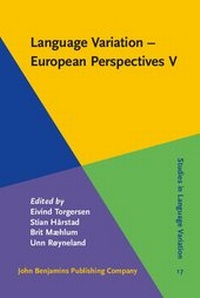
Language Variation - European Perspectives V
Selected papers from the Seventh International Conference on Language Variation in Europe (ICLaVE 7), Trondheim, June 2013
1st Edition
Published on 15. April 2015
XIII, 237 pages
978-90-272-6881-5 (ISBN)
Description

Language Variation - European Perspectives V is based on papers presented at the Seventh International Conference on Language Variation in Europe (ICLaVE 7), which was held in Trondheim, Norway from 26 to 28 June 2013. The 17 papers included in the book explore phonetic and phonological variation (Bitenc and Kenda-Jez; Hildenbrandt and Moosmüller; Jansen; Schaufuß; Schleef, Flynn and Ramsammy; Stuart-Smith, Rathcke, Sonderegger and Macdonald), morphology (Padilla-Moyano), syntax (Christensen and Juel Jensen; Jónsson, Brynjólfsdóttir and Sverrisdóttir), morphosyntax (Auger and Wykoff; Cerruti and Regis), language ideology, linguistic practices and language attitudes (Strand; Hall-Lew, Fairs and Lew; Dunmore and Smith-Christmas), code-switching (Amadou; Bucher) and language documentation (Kühl). The book is essential reading for scholars working on variation and change in European languages. The articles in the present volume investigate Romani, Turkish, Greek, Slovene, Picard, Swiss-German, Basque, Danish, Italian, English, Gaelic, Icelandic Sign Language, Faroe Danish and Norwegian.
More details
Other editions
Additional editions
Eivind Torgersen | Stian Harstad | Brit Maehlum
Language Variation - European Perspectives V
Selected papers from the Seventh International Conference on Language Variation in Europe (ICLaVE 7), Trondheim, June 2013
Book
04/2015
John Benjamins Publishing Co
€111.30
Shipment within 10-15 days
Persons
Content
- Language Variation - European Perspectives V
- Editorial page
- Title page
- LCC data
- Table of contents
- Introduction
- A corpus-driven analysis of Romani in contact with Turkish and Greek
- 1. Introduction
- 2. Data
- 3. Results and discussion
- 3.1 Overall composition of the corpus
- 3.2 The borrowing-code-switching continuum
- 3.3 Degree of composition
- 3.4 Structural integration
- 3.5 Word class
- 3.6 Distribution of tokens per word class and per speaker
- 3.7 Inter-speaker variation
- 3.8 Location
- 3.9 Language shift
- 3.10 Age
- 3.11 Families and peers
- 4. Concluding remarks
- Excerpt
- Abbreviations
- References
- How many ands in Picard?
- 1. Introduction
- 2. How many conjunctions?
- 3. Research questions, corpus, and methodology
- 4. General overview of the data
- 5. Temporal value
- 6. Phonological conditioning
- 7. Syntactic conditioning
- 8. Discussion
- References
- Language variation in Slovene
- 1. Slovene: Between local dialects and the spoken standard
- 2. The Idrija region language situation
- 3. The first steps of Slovene variationist sociolinguistics
- 4. Methodology
- 5. The case study: Two similar but different female informants
- 6. Perception of and reflection on their own speech behaviour
- 7. Language attitudes, language and identity, experiences with language use
- 8. Conclusion
- References
- Code-switching in SMS communication
- 1. Introduction
- 2. Analysis
- 2.1 Types of Codes
- 2.2 Grammatical Properties in CS
- 2.3 CS Functions in SMS
- 3. Discussion
- References
- Online References
- The interplay between dialect and standard
- 1. Introduction
- 2. The Italian continuum
- 3. The Piedmontese dialect continuum
- 4. Between Italian and Piedmontese
- 5. A continuum of continua: The Italian/Piedmontese continuum
- References
- Voicing the 'Other'
- 1. Introduction
- 2. Method
- 3. Code-switching and critiques of language planning
- 4. Irony and code-switching in language ideologies
- 5. Some conclusions
- Transcription conventions used
- References
- Tourists' Attitudes towards Linguistic Variation in Scotland
- 1. Sociolinguistics and tourism
- 2. Language attitudes and tourism in Edinburgh, Scotland
- 3. Methodology
- 4. Fieldwork
- 5. Results
- 6. Discussion and Conclusion
- References
- A century of change in prevocalic (r) in Carlisle English
- 1. Introduction: The status of (r) in the north of England and Scotland
- 2. Internal Constraints in dialect contact situations
- 3. Sociolinguistic background Carlisle
- 4. Data collection
- 5. Results
- 6. Discussion
- References
- Faroe Danish
- 1. The linguistic situation in the Faroe Islands
- 2. A structural profile of Faroe Danish
- 2.1 The FADAC and the WriFD Corpus
- 2.2 Specific Faroe Danish features
- FD phonology
- FD lexicon
- FD indirect questions with 'hvem' or 'hvad' as a subject
- Gender in pronominal reference
- FD prepositional patterns
- Unspecific temporal 'da'
- Conditional 'om'
- Analytic possessive constructions with 'hos'
- Reflexive possessive pronouns with plural referents
- FD declarative V1
- 3. Conclusion
- References
- A new view of basque through eighteenth-century correspondence
- 1. Introduction
- 2. On the basque written tradition
- 3. The Le Dauphin Correspondence (1757)
- 4. New linguistic insights
- 5. Epenthesis in Labourdin: The witness of Le Dauphin
- 6. Conclusions
- References
- Standard-dialect variation and its functionalization
- 1. Introduction
- 2. Method and data
- 2.1 Speech material
- 2.2 Data analysis
- 3. Results
- 3.1 D-value measurement
- 3.2 Variable analysis
- Example 1: The sports pub situation
- Example 2: The romantic date
- 4. Discussion
- Acknowledgments
- References
- Production and perception of (ing) in Manchester English
- 1. Introduction
- 2. Methods
- 3. Results: Production
- 4. Results: perception
- 5. Discussion
- 6. Conclusion
- References
- Pro-dialect practices and linguistic commodification in rural Valdres, Norway
- 1. Introduction
- 2. Local and national background
- 3. Dialect enregisterment and commodification in Valdres
- 4. Discussion and conclusions
- References
- A real-time study of plosives in Glaswegian using an automatic measurement algorithm
- 1. Introduction
- 2. The voicing contrast in Scottish English
- 3. Research question for this study
- 4. The Glasgow real-time project
- 4.1 Sample
- 4.2 Linguistic variable: /p t k/ and /b d g/
- 4.3 An automatic algorithm for measuring VOT
- 4.3.1 Algorithm description
- 4.3.2 Previous results
- 4.4 Procedure for this study
- 5. Algorithm performance
- 5.1 Coding predictions
- 5.2 Overall results
- 6. VOT results
- 6.1 VOT and phonetic factors
- 6.2 VOT in voiced plosives in real and apparent time
- 6.3 VOT in voiceless plosives in real and apparent time
- 7. Discussion
- 7.1 Semi-automatic measurement of VOT in sociolinguistic data
- 7.2 Age-grading or real-time change in Glaswegian stops?
- 8. Future directions
- References
- Index
