

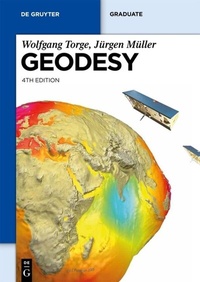
Geodesy
Description

The fourth edition of this textbook has been thoroughly revised in order to reflect the central role which geodesy has achieved in the past ten years.
The Global Geodetic Observing System established by the IAG utilizes a variety of techniques to determine the geometric shape of the earth and its kinematics, the variations of earth rotation, and the earth's gravity field. Space techniques play a fundamental role, with recent space missions also including gravity field recovery. Terrestrial techniques are important for regional and local applications, and for validating the results of the space missions. Global and regional reference systems are now well established and widely used. They also serve as a basis for geo-information systems. The analysis of the time variation of the geodetic products provides the link to other geosciences and contributes to proper modelling of geodynamic processes.
The book follows the principal directions of geodesy, providing the theoretical background as well as the principles of measurement and evaluation methods. Selected examples of instruments illustrate the geodetic work. An extensive reference list supports further studies.
The book is intended to serve as an introductory textbook for graduate students as well as a reference for scientists and engineers in the fields of geodesy, geophysics, surveying engineering and geomatics.
Reviews / Votes
"The book is thoroughly revised and extended with the important results achieved in the years since the last edition (2001). The section on Satellite Observations has been extended with descriptions of the current missions like GRACE and GOCE. Geodynamics is well treated in an extended chapter on "Structure and Dynamics of the Earth". The book contains an extensive bibliography with 500 references added since the edition of 2001. [..] But what is extremely important is the index, which makes the book useful as a handbook for everyone. The book also includes many fine figures and illustrations, now also in color. [..] It is a wonderful book with so much important information covering all of modern geodesy."Carl Christian Tscherning in: Journal of Geodesy, 86, p.786 (2012)More details
Other editions
Additional editions
Persons
Content
2 - 1 Introduction [Seite 11]
2.1 - 1.1 Definition of geodesy [Seite 11]
2.2 - 1.2 The objective of geodesy [Seite 12]
2.3 - 1.3 Historical development of geodesy [Seite 14]
2.3.1 - 1.3.1 The spherical Earth model [Seite 14]
2.3.2 - 1.3.2 The ellipsoidal Earth model [Seite 17]
2.3.3 - 1.3.3 The geoid, arc measurements and national geodetic surveys [Seite 19]
2.3.4 - 1.3.4 Three-dimensional geodesy [Seite 21]
2.3.5 - 1.3.5 Four-dimensional geodesy [Seite 22]
2.4 - 1.4 Organization of geodesy, literature [Seite 22]
2.4.1 - 1.4.1 National organizations [Seite 22]
2.4.2 - 1.4.2 International collaboration [Seite 23]
2.4.3 - 1.4.3 Literature [Seite 25]
3 - 2 Reference Systems and Reference Frames [Seite 27]
3.1 - 2.1 Basic units and constants [Seite 27]
3.2 - 2.2 Time systems [Seite 29]
3.2.1 - 2.2.1 Atomic time, dynamical time systems [Seite 30]
3.2.2 - 2.2.2 Sidereal and Universal Time [Seite 31]
3.3 - 2.3 Reference coordinate systems: fundamentals [Seite 34]
3.3.1 - 2.3.1 Celestial Reference System [Seite 35]
3.3.2 - 2.3.2 Precession, nutation [Seite 37]
3.3.3 - 2.3.3 Terrestrial Reference System [Seite 38]
3.3.4 - 2.3.4 Polar motion, Earth rotation [Seite 40]
3.4 - 2.4 International reference systems and reference frames [Seite 44]
3.4.1 - 2.4.1 International Celestial Reference System and Frame [Seite 44]
3.4.2 - 2.4.2 International Terrestrial Reference System and Frame [Seite 49]
3.4.3 - 2.4.3 Transformation between celestial and terrestrial reference systems, Earth orientation parameters [Seite 52]
3.4.4 - 2.4.4 International Earth Rotation and Reference Systems Service [Seite 55]
3.5 - 2.5 Local level systems [Seite 56]
4 - 3 The Gravity Field of the Earth [Seite 63]
4.1 - 3.1 Fundamentals of gravity field theory [Seite 63]
4.1.1 - 3.1.1 Gravitation, gravitational potential [Seite 63]
4.1.2 - 3.1.2 Gravitation of a spherically symmetric Earth [Seite 65]
4.1.3 - 3.1.3 Properties of the gravitational potential [Seite 67]
4.1.4 - 3.1.4 Centrifugal acceleration, centrifugal potential [Seite 70]
4.1.5 - 3.1.5 Gravity acceleration, gravity potential [Seite 71]
4.2 - 3.2 Geometry of the gravity field [Seite 72]
4.2.1 - 3.2.1 Level surfaces and plumb lines [Seite 73]
4.2.2 - 3.2.2 Local gravity field representation [Seite 74]
4.2.3 - 3.2.3 Natural coordinates [Seite 77]
4.3 - 3.3 Spherical harmonic expansion of the gravitational potential [Seite 79]
4.3.1 - 3.3.1 Expansion of the reciprocal distance [Seite 79]
4.3.2 - 3.3.2 Expansion of the gravitational potential [Seite 81]
4.3.3 - 3.3.3 Geometrical interpretation of the surface spherical harmonics [Seite 83]
4.3.4 - 3.3.4 Physical interpretation of the spherical harmonic coefficients [Seite 84]
4.4 - 3.4 The geoid [Seite 86]
4.4.1 - 3.4.1 Definition [Seite 86]
4.4.2 - 3.4.2 Mean sea level [Seite 88]
4.4.3 - 3.4.3 The geoid as height reference surface [Seite 91]
4.5 - 3.5 Temporal gravity variations [Seite 94]
4.5.1 - 3.5.1 Gravitational constant, Earth rotation [Seite 95]
4.5.2 - 3.5.2 Tidal acceleration, tidal potential [Seite 95]
4.5.3 - 3.5.3 Non-tidal temporal gravity variations [Seite 99]
5 - 4 The Geodetic Earth Model [Seite 101]
5.1 - 4.1 The rotational ellipsoid [Seite 101]
5.1.1 - 4.1.1 Parameters and coordinate systems [Seite 101]
5.1.2 - 4.1.2 Curvature [Seite 104]
5.1.3 - 4.1.3 Spatial geodetic coordinates [Seite 106]
5.2 - 4.2 The normal gravity field [Seite 109]
5.2.1 - 4.2.1 The level ellipsoid, level spheroids [Seite 109]
5.2.2 - 4.2.2 The normal gravity field of the level ellipsoid [Seite 111]
5.2.3 - 4.2.3 Geometry of the normal gravity field [Seite 115]
5.3 - 4.3 Geodetic reference systems, optimum Earth model [Seite 118]
6 - 5 Methods of Measurement [Seite 123]
6.1 - 5.1 Atmospheric refraction [Seite 123]
6.1.1 - 5.1.1 Fundamentals [Seite 124]
6.1.2 - 5.1.2 Tropospheric refraction [Seite 127]
6.1.3 - 5.1.3 Ionospheric refraction [Seite 131]
6.2 - 5.2 Satellite observations [Seite 133]
6.2.1 - 5.2.1 Undisturbed satellite motion [Seite 134]
6.2.2 - 5.2.2 Perturbed satellite motion [Seite 136]
6.2.3 - 5.2.3 Artificial Earth satellites [Seite 138]
6.2.4 - 5.2.4 Direction, range and range rate (Doppler, DORIS) measurements [Seite 141]
6.2.5 - 5.2.5 Global Navigation Satellite Systems GNSS (GPS, GLONASS, Galileo and others) [Seite 145]
6.2.6 - 5.2.6 Laser distance measurements [Seite 160]
6.2.7 - 5.2.7 Satellite altimetry [Seite 164]
6.2.8 - 5.2.8 Satellite-to-satellite tracking, satellite gravity gradiometry [Seite 168]
6.3 - 5.3 Geodetic astronomy [Seite 172]
6.3.1 - 5.3.1 Optical observation instruments [Seite 173]
6.3.2 - 5.3.2 Astronomic positioning and azimuth determination [Seite 176]
6.3.3 - 5.3.3 Reductions [Seite 178]
6.3.4 - 5.3.4 Very Long Baseline Interferometry [Seite 180]
6.4 - 5.4 Gravimetry [Seite 185]
6.4.1 - 5.4.1 Absolute gravity measurements [Seite 185]
6.4.2 - 5.4.2 Relative gravity measurements [Seite 193]
6.4.3 - 5.4.3 Gravity reference systems and gravity standard [Seite 199]
6.4.4 - 5.4.4 Gravity measurements on moving platforms [Seite 200]
6.4.5 - 5.4.5 Gravity gradiometry [Seite 207]
6.4.6 - 5.4.6 Continuous gravity measurements [Seite 209]
6.5 - 5.5 Terrestrial geodetic measurements [Seite 213]
6.5.1 - 5.5.1 Horizontal and vertical angle measurements [Seite 214]
6.5.2 - 5.5.2 Distance measurements, total stations [Seite 216]
6.5.3 - 5.5.3 Inertial surveying, underwater acoustic positioning [Seite 222]
6.5.4 - 5.5.4 Leveling [Seite 225]
6.5.5 - 5.5.5 Tilt and strain measurements [Seite 229]
7 - 6 Methods of Positioning and Gravity Field Modeling [Seite 233]
7.1 - 6.1 Residual gravity field [Seite 234]
7.1.1 - 6.1.1 Disturbing potential, height anomaly, geoid height [Seite 234]
7.1.2 - 6.1.2 Gravity disturbance, gravity anomaly, deflection of the vertical [Seite 236]
7.1.3 - 6.1.3 Statistical description of the gravity field, interpolation [Seite 239]
7.2 - 6.2 Three-dimensional positioning [Seite 243]
7.2.1 - 6.2.1 Observation equations [Seite 244]
7.2.2 - 6.2.2 Geodetic datum [Seite 250]
7.3 - 6.3 Horizontal positioning [Seite 255]
7.3.1 - 6.3.1 Ellipsoidal trigonometry [Seite 255]
7.3.2 - 6.3.2 Reductions to the ellipsoid [Seite 257]
7.3.3 - 6.3.3 Computations on the ellipsoid [Seite 259]
7.4 - 6.4 Height determination [Seite 262]
7.4.1 - 6.4.1 Heights from geometric leveling [Seite 263]
7.4.2 - 6.4.2 Trigonometrical heights [Seite 265]
7.4.3 - 6.4.3 Heights from GNSS (GPS) [Seite 266]
7.5 - 6.5 Fundamentals of gravity field modeling [Seite 268]
7.5.1 - 6.5.1 The geodetic boundary-value problem [Seite 268]
7.5.2 - 6.5.2 Gravitation of topography, digital elevation models [Seite 272]
7.5.3 - 6.5.3 Gravity reductions to the geoid [Seite 274]
7.5.4 - 6.5.4 Orientation and scale of gravity field models [Seite 279]
7.6 - 6.6 Global gravity field modeling [Seite 281]
7.6.1 - 6.6.1 Spherical harmonic expansion [Seite 281]
7.6.2 - 6.6.2 "Satellite-only" gravity field models [Seite 285]
7.6.3 - 6.6.3 Combined (high resolution) gravity field models [Seite 288]
7.7 - 6.7 Local gravity field modeling [Seite 293]
7.7.1 - 6.7.1 Gravimetric geoid heights and deflections of the vertical: integral formulas [Seite 293]
7.7.2 - 6.7.2 Gravimetric height anomalies and surface deflections of the vertical [Seite 300]
7.7.3 - 6.7.3 The external gravity field [Seite 303]
7.7.4 - 6.7.4 Astrogeodetic geoid and quasigeoid determination [Seite 306]
7.8 - 6.8 Least-squares collocation [Seite 311]
8 - 7 Geodetic and Gravimetric Networks [Seite 315]
8.1 - 7.1 Horizontal control networks [Seite 315]
8.2 - 7.2 Vertical control networks [Seite 326]
8.3 - 7.3 Three-dimensional networks [Seite 331]
8.4 - 7.4 Gravity networks [Seite 340]
9 - 8 Structure and Dynamics of the Earth [Seite 343]
9.1 - 8.1 The geophysical Earth model [Seite 343]
9.2 - 8.2 The upper layers of the Earth [Seite 347]
9.2.1 - 8.2.1 Structure of the Earth's crust and upper mantle [Seite 347]
9.2.2 - 8.2.2 Isostasy [Seite 348]
9.2.3 - 8.2.3 Plate tectonics [Seite 352]
9.2.4 - 8.2.4 Interpretation of the gravity field [Seite 354]
9.3 - 8.3 Geodesy and recent geodynamics [Seite 359]
9.3.1 - 8.3.1 Geophysical processes and effects on geodetic products [Seite 360]
9.3.2 - 8.3.2 Changes in Earth rotation [Seite 363]
9.3.3 - 8.3.3 Sea level variations [Seite 365]
9.3.4 - 8.3.4 Crustal deformations [Seite 369]
9.3.5 - 8.3.5 Gravity field variations with time [Seite 377]
9.3.6 - 8.3.6 Earth tides and tidal loading [Seite 385]
10 - References [Seite 393]
11 - Index [Seite 431]
