

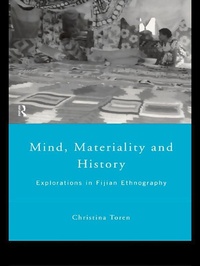
Mind, Materiality and History
Explorations in Fijian Ethnography
Published on 15. August 2005
222 pages
978-1-134-64516-9 (ISBN)
Description

How do we become who we are? How is it that people are so similar in the ways they differ from one another, and so different in the ways they are the same?
Christina Toren's theory of mind as not only a physical phenomenon, but an historical one, sets out to answer these questions by examining how the material world of objects and other people informs the constitution of mind in persons over time.
This theory of embodied mind as a microhistorical process is set out in the first chapter, providing a context for the nine papers that follow. Questions explored include the way meaning-making processes reference an historically specific world and are responsible at once for continuity and change, how ritual informs children's constitution of the categories adults use to describe the world, and how people represent their relationships with one another and in so doing come to embody history.
Mind, Materiality and History has direct relevance to current debates on the nature of mind and consciousness, and demonstrates the centrality of the study of children to social analysis. It will be a valuable resource for students and scholars with an interest in anthropological theory and methodology, as well as those engaged in material culture studies.
Christina Toren's theory of mind as not only a physical phenomenon, but an historical one, sets out to answer these questions by examining how the material world of objects and other people informs the constitution of mind in persons over time.
This theory of embodied mind as a microhistorical process is set out in the first chapter, providing a context for the nine papers that follow. Questions explored include the way meaning-making processes reference an historically specific world and are responsible at once for continuity and change, how ritual informs children's constitution of the categories adults use to describe the world, and how people represent their relationships with one another and in so doing come to embody history.
Mind, Materiality and History has direct relevance to current debates on the nature of mind and consciousness, and demonstrates the centrality of the study of children to social analysis. It will be a valuable resource for students and scholars with an interest in anthropological theory and methodology, as well as those engaged in material culture studies.
Reviews / Votes
'Toren's perception, craft and theoretical articulation can only be admired.' - Vicki Lukere, Australia National UniversityMore details
Series
Language
English
Place of publication
London
United Kingdom
Publishing group
Taylor & Francis Ltd
Target group
College/higher education
File size
2,40 MB
ISBN-13
978-1-134-64516-9 (9781134645169)
Copyright in bibliographic data and cover images is held by Nielsen Book Services Limited or by the publishers or by their respective licensors: all rights reserved.
Schweitzer Classification
Other editions
Additional editions
Book
07/1999
1st Edition
Routledge
€79.30
Shipment within 15-20 days
Book
07/1999
1st Edition
Routledge
€206.20
Shipment within 15-20 days
Content
List of illustrations, Acknowledgements, Introduction: mind, materiality and history, PART I Objectifying history, material mind, PART II The material basis of meaning, PART III Living history, material mind and the stuff of the world, Notes, References
