

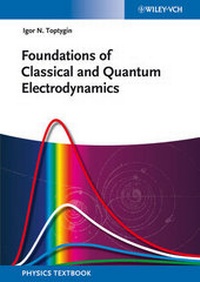
Foundations of Classical and Quantum Electrodynamics
Description

The book introduces the material at different levels, oriented towards 3rd-4th year bachelor, master, and PhD students. This is so as to describe the whole complexity of physical phenomena, instead of a mosaic of disconnected data. The required mathematical background is collated in Chapter 1, while the necessary physical background is included in the main text of the corresponding chapters and also given in appendices.
The content is based on teaching material tested on students over many years, and their training to apply general theory for solving scientific and engineering problems. To this aim, the book contains approximately 800 examples and problems, many of which are described in detail. Some of these problems are designed for students to work on their own with only the answers and descriptions of results, and may be solved selectively. The examples are key ingredients to the theoretical course; the user should study all of them while reading the corresponding chapters.
Equally suitable as a reference for researchers specialized in science and engineering.
More details
Other editions
Additional editions
Person
Content
Chapter 2. Basic Concepts of Electrodynamics: The Maxwell Equations
Chapter 3. The Special Theory of Relativity and Relativistic Kinematics
Chapter 4. Fundamentals of Relativistic Mechanics and Field Theory
Chapter 5. Emission and Scattering of Electromagnetic Waves
Chapter 6. Quantum Theory of Radiation Processes. Photon Emission and Scattering
Chapter 7. Fundamentals of Quantum Theory of the Electron?Positron Field
Appendix A Conversion of Electric and Magnetic Quantities between the
International System of Units and the Gaussian System
Appendix B Variation Principle for Continuous Systems
Appendix C General Outline of Quantum Theory
1
The Mathematical Methods of Electrodynamics
1.1 Vector and Tensor Algebra
1.1.1 The Definition of a Tensor and Tensor Operations
In three-dimensional space, select a rectangular and rectilinear (Cartesian1)) system of coordinates x1, x2, x3. Regard the space as Euclidean. This means that all axioms of Euclidean geometry2) and their consequences considered in school courses on mathematics are valid in it. For instance, the square of the distance between two close points is given by the following expression:
Along with the original system of coordinates, consider some other systems of common origin yet rotated with respect to the original one (Figure 1.1).
Figure 1.1 The rotation of the Cartesian system of coordinates.
A scalar or invariant is a quantity that does not change when the system of coordinates is rotated, that is, it is the same in either the original or the rotated system of coordinates
(1.1)
For instance, dl2 = dl′2 = inv.
In three-dimensional space, a vector is the titality of three quantities Vα(α = 1, 2, 3) defined in all coordinate systems and transformed according to the following rule:
(1.2)
(summing of elements over the repeated symbol β, from 1 to 3 is assumed). Here Vβ are the projections of the vector on an axis of the original system of coordinates, V′α are the projections of the vector on an axis of the rotated system, and aαβ are the coefficients of the transformation, which are the cosines of the angles between the β axis of the original system and the α axis of the rotated system. They may be written through the single vectors (orts) of the coordinate axes:
(1.3)
In three-dimensional space, a tensor of rank 2 is a nine-component quantity Tαβ (each index varies independently assuming three values: 1, 2, 3) which is defined in every system of coordinates and, when a coordinate system is rotated, is transformed as the products of the components of the two vectors Aα Vβ, in the following way:
(1.4)
In three-dimensional space, a tensor of rank s is a 3s-component quantity Tλ…v that is transformed as the product of s components of vectors:
(1.5)
Scalars and vectors may be regarded as tensors of rank 0 and 1, respectively.
Rotation matrix has the following properties:
1. Orthogonality(1.6)
where(1.7)
is Kronecker symbol3); 2. The determinant of a rotation matrix equals 1:(1.8)
3. The product of two rotation matrices(1.9)
describes the evolution of a system resulting from two consecutive rotations, first with matrix and then with matrix .4) In the general case, rotation matrices are noncommutative, that is,(1.10)
As follows from property 1, a reverse matrix defined by the relation(1.11)
results from the original matrix when the latter is transposed, that is, its columns are substituted for lines and vice versa:(1.12)
The reverse transformation (1.2) looks like this:(1.13)
All vectors are transformed identically according to rule (1.2) when a coordinate system is rotated. But they may behave in one of two ways if a system of coordinates is inverted, that is,
(1.14)
Here the transformation matrix is aαβ = –δαβ. Vectors whose components, just like coordinates xa, change their signs during inversions are called polar (regular, real) vectors. Vectors whose components do not change sign as the result of inversions of coordinate systems are called axial vectors or pseudovectors (an angular velocity, a cross-product of two polar vectors A × B, etc.) This definition also includes tensors of arbitrary rank s: when the inversion of coordinates occurs, the components of polar (regular) tensors acquire a factor of (–1)s and the components of pseudotensors acquire a factor of (–1)s+1.
The sum of two tensors of the same rank produces a third tensor of the same rank with components
(1.15)
The direct products of the components of two tensors (without summing) constitute a tensor whose rank equals the sum of the ranks of the factors, for instance,
(1.16)
where Qαβγ is a tensor of rank 3.
The contraction of a tensor means the formation of a new tensor whose components are produced by the selection of components with two identical symbols and, further, their summing. For instance, Qαβγ = Aα is a vector and Qαβγ = Bβ is another vector. Contraction decreases the rank of the tensor by 2, for instance,
(1.17)
is a scalar.
When an equality between tensors is written, the rule of the same tensor dimensionality must be observed: only tensors of the same rank may be equated. This means that the number of free symbols (over which no summation is done) must be the same in the first and second members of an equality. The number of pairs of “mute” symbols (those over which summing is done) may be any on the right and on the left.
Tensors may be symmetric (antisymmetric) with respect to a pair of indices α and β if their components satisfy the conditions
(1.18)
Tensor components may be either real or complex numbers. In the latter case, the concepts of Hermitian5) and anti-Hermitian tensors play an important role. The definition of a Hermitian tensor is as follows:
(1.19)
where the asterisk indicates complex conjugation. The definition of an anti-Hermitian tensor is as follows:
(1.20)
In applications, invariant unit tensors δαβ and eαβγ are very important. The former is a symmetric polar tensor whose components coincide with the Kronecker symbol (1.7), whereas the latter is antisymmetric over any pair of indices, and its components are determined by the following conditions:
(1.21)
It is called the Levi-Civita tensor.6) Both tensors, transforming during rotations according to rule (1.7), are peculiar in that their components have the same values in all coordinate systems:
(1.22)
Problems
1.1. Prove equality (1.8). What is the determinant of the transformation matrix if rotation is accompanied by the inversion of the coordinate axes?
1.2. Prove the equalities δ′αβ = δαβ and e′αμv = eαμv for an arbitrary rotation of a coordinate system.
1.3. Write down the rule of transformation for the components of a pseudotensor of rank s that would be valid not just for the rotation but also for the mirror reflections of the coordinate axes.
1.4. Represent an arbitrary tensor of rank 2 Tαβ as the sum of a symmetric tensor (Sαβ = Sβα) and an antisymmetric tensor (Aαβ = –Aβα). Make sure that this representation is unique.
1.5. Represent an arbitrary complex tensor of rank 2 Tαβ as the sum of a Hermitian tensor and an anti-Hermitian tensor . Make sure that this representation is unique.
1.6. Show that
1. the contraction of a symmetric tensor and an antisymmetric tensor equals zero: SαβAαβ = 0 2. the contraction of two Hermitian tensors or two anti-Hermitian tensors of rank 2 is a real number. 3. the contraction of a Hermitian tensor and an anti-Hermitian tensor of rank 2 is a purely imaginary number.1.7. Show that the symmetry of a tensor is a property that is invariant with respect to rotations, that is, a tensor that is symmetric (antisymmetric) over a pair of indices in a certain system of reference remains symmetric (antisymmetric) over these indices in every system rotated with respect to the original one.
1.8. Using rules (1.2)–(1.6) of tensor transformation, show that
1. Aα is a vector (pseudovector) if AαBα = inv and Bα is a vector (pseudovector). 2. Aα isavectorif Aα = TαβBβ in any system of coordinates and...