

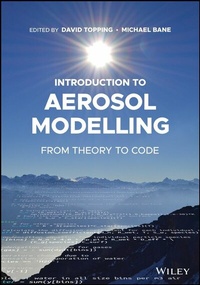
Introduction to Aerosol Modelling
Description

Introduction to Aerosol Modelling: From Theory to Code
An aerosol particle is defined as a solid or liquid particle suspended in a carrier gas. Whilst we often treat scientific challenges in a siloed way, aerosol particles are of interest across many disciplines. For example, atmospheric aerosol particles are key determinants of air quality and climate change. Knowledge of aerosol physics and generation mechanisms is key to efficient fuel delivery and drug delivery to the lungs. Likewise, various manufacturing processes require optimal generation, delivery and removal of aerosol particles in a range of conditions.
There is a natural tendency for the aerosol scientist to therefore work at the interface of the traditional academic subjects of physics, chemistry, biology, mathematics and computing. The impacts that aerosol particles have are linked to their evolving chemical and physical characteristics. Likewise, the chemical and physical characteristic of aerosol particles reflect their sources and subsequent processes they have been subject to. Computational models are not only essential for constructing evidence-based understanding of important aerosol processes, but also to predict change and impact. Whilst existing textbooks provide an overview of theoretical frameworks on which aerosol models are based, there is a significant gap in reference material that provide training in translating theory into code.
The purpose of this book is to provide readers with exactly that. In following the content provided in this book, you will be able to reproduce models of key processes that can either be used in isolation or brought together to construct a demonstrator 0D box-model of a coupled gaseous-particulate system. You may be reading this book as an undergraduate, postgraduate, seasoned researcher in the private/public sector or as someone who wishes to better understand the pathways to aerosol model development. Wherever you position yourself, it is hoped that the tools you will learn through this book will provide you with the basis to develop your own platforms and to ensure the next generation of aerosol modellers are equipped with foundational skills to address future challenges in aerosol science.
About the Editors
David Topping is Professor of the Digital Environment in the department of Earth and Environmental Science, University of Manchester.
Michael Bane is a Lecturer in the Department of Computing and Mathematics at the Manchester Metropolitan University, UK, and Director of High End Compute LTD
More details
Other editions
Additional editions
Persons
About the Editors
David Topping is Professor of the Digital Environment in the department of Earth and Environmental Science, University of Manchester.
Michael Bane is a Lecturer in the Department of Computing and Mathematics at the Manchester Metropolitan University, UK, and Director of High End Compute LTD
Content
1. Introduction and the purpose of this book
2. Gas to particle partitioning
3. Thermodynamics, non-ideal mixing and phase separation
4. Chemical mechanisms and pure component particles
5. Coagulation
6. Nucleation: Formation of new particles from gases by molecular clustering
7. Box-models
8. Software optimisation
Appendix: Exercises, code availability, physical constants
