

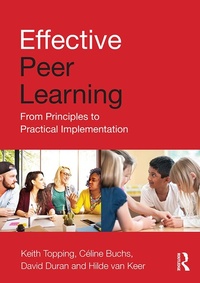
Effective Peer Learning
From Principles to Practical Implementation
Published on 31. March 2017
192 pages
978-1-317-44306-3 (ISBN)
Description

Peer learning allows a positive use of differences between pupils, turning them into learning opportunities. Yet education professionals often remain unfamiliar with the principles necessary to guarantee its effectiveness.
The aim of this book is to help practitioners establish well-structured and effective peer learning projects using a variety of methods. It introduces and defines cooperative learning (mutual peer interaction) and peer tutoring (directional peer interaction) - outlining general organisational principles that will help practitioners implement peer learning in either of these forms. The authors consider how to prepare and train learners to undertake their roles effectively, and how to organise and monitor the process of interaction as it is happening. They then look at how these systems actually operate in the classroom, exploring how the organisational principles work in practice and giving many practical examples. Subsequently three successive chapters consider how to structure peer interactions in cooperative learning, same-age peer tutoring and cross-age peer tutoring. Finally, the advantages and problems, and the potential and challenges, of peer learning are examined.
The book should be read in stages, with each part being able to be read on its own - thus providing time for reflection. Within each part, readers can choose to focus on cooperative learning or peer tutoring. The successive focuses on definitions, general principles of implementation and practical issues of implementation should help practitioners build their skills and confidence. Many choices between methods are described, and when teachers are confident in one method they may then consider trying a new method. It is the authors' hope that the book will become a model for peer learning by sharing with readers the skills of other practitioners, and thereby helping all children to develop to their full potential.
The aim of this book is to help practitioners establish well-structured and effective peer learning projects using a variety of methods. It introduces and defines cooperative learning (mutual peer interaction) and peer tutoring (directional peer interaction) - outlining general organisational principles that will help practitioners implement peer learning in either of these forms. The authors consider how to prepare and train learners to undertake their roles effectively, and how to organise and monitor the process of interaction as it is happening. They then look at how these systems actually operate in the classroom, exploring how the organisational principles work in practice and giving many practical examples. Subsequently three successive chapters consider how to structure peer interactions in cooperative learning, same-age peer tutoring and cross-age peer tutoring. Finally, the advantages and problems, and the potential and challenges, of peer learning are examined.
The book should be read in stages, with each part being able to be read on its own - thus providing time for reflection. Within each part, readers can choose to focus on cooperative learning or peer tutoring. The successive focuses on definitions, general principles of implementation and practical issues of implementation should help practitioners build their skills and confidence. Many choices between methods are described, and when teachers are confident in one method they may then consider trying a new method. It is the authors' hope that the book will become a model for peer learning by sharing with readers the skills of other practitioners, and thereby helping all children to develop to their full potential.
Reviews / Votes
A guide that aims to help practitioners establish well-structured and effective peer learning projects using a variety of methods...Highly recommended for a wide variety of audiences: from those educational professionals who want to start using cooperative learning at any educational stage, to those who already use it and want to improve their practices, and even for those who are not convinced about is application in the classroom yet. - Revista de Educacion 379, Jan-March 2018More details
Language
English
Place of publication
London
United Kingdom
Publishing group
Taylor & Francis Ltd
Target group
College/higher education
Professional and scholarly
Illustrations
4 s/w Abbildungen, 32 s/w Tabellen
32 Tables, black and white; 4 Illustrations, black and white
File size
3,40 MB
ISBN-13
978-1-317-44306-3 (9781317443063)
Copyright in bibliographic data and cover images is held by Nielsen Book Services Limited or by the publishers or by their respective licensors: all rights reserved.
Schweitzer Classification
Other editions
Additional editions
Keith Topping | Celine Buchs | David Duran
Effective Peer Learning
From Principles to Practical Implementation
Book
03/2017
1st Edition
Routledge
€193.13
Shipment within 10-20 days

Keith Topping | Celine Buchs | David Duran
Effective Peer Learning
From Principles to Practical Implementation
Book
03/2017
1st Edition
Routledge
€67.00
Shipment within 10-20 days
Persons
Keith Topping, School of Education, University of Dundee, UK.
Celine Buchs, University of Geneva, Switzerland.
David Duran, Department of Psychology of Education, Universitat Autonoma de Barcelona, Spain.
Hilde van Keer, Department of Educational Studies, Ghent University, Belgium.
Celine Buchs, University of Geneva, Switzerland.
David Duran, Department of Psychology of Education, Universitat Autonoma de Barcelona, Spain.
Hilde van Keer, Department of Educational Studies, Ghent University, Belgium.
Content
Part I. Introducing peer learning
1. Mutual peer interactions
2. Peer learning: directional peer interactions
Part II. General principles for peer learning
3. Preparing learners for constructive interactions
4. Organising peer interactions in academic tasks
Part III. Practical propositions for the classroom
5. Structuring peer interactions in symmetrical relationships (cooperative learning)
6. Structuring directional peer interactions in same-age tutoring
7. Structuring directional peer interactions in cross-age tutoring
Part IV. Conclusions and onward directions
8. Advantages, problems, potential and challenges of peer learning
References
1. Mutual peer interactions
2. Peer learning: directional peer interactions
Part II. General principles for peer learning
3. Preparing learners for constructive interactions
4. Organising peer interactions in academic tasks
Part III. Practical propositions for the classroom
5. Structuring peer interactions in symmetrical relationships (cooperative learning)
6. Structuring directional peer interactions in same-age tutoring
7. Structuring directional peer interactions in cross-age tutoring
Part IV. Conclusions and onward directions
8. Advantages, problems, potential and challenges of peer learning
References
