

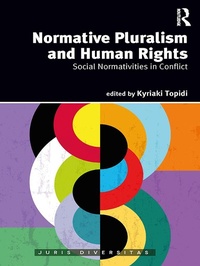
Normative Pluralism and Human Rights
Social Normativities in Conflict
1st Edition
Published on 13. June 2018
306 pages
978-1-351-67649-6 (ISBN)
Description

The complex legal situations arising from the coexistence of international law, state law, and social and religious norms in different parts of the world often include scenarios of conflict between them. These conflicting norms issued from different categories of 'laws' result in difficulties in describing, identifying and analysing human rights in plural environments.
This volume studies how normative conflicts unfold when trapped in the aspirations of human rights and their local realizations. It reflects on how such tensions can be eased, while observing how and why they occur. The authors examine how obedience or resistance to the official law is generated through the interaction of a multiplicity of conflicting norms, interpretations and practices. Emphasis is placed on the actors involved in raising or decreasing the tension surrounding the conflict and the implications that the conflict carries, whether resolved or not, in conditions of asymmetric power movements. It is argued that legal responsiveness to state law depends on how people with different identities deal with it, narrate it and build expectations from it, bearing in mind that normative pluralism may also operate as an instrument towards the exclusion of certain communities from the public sphere. The chapters look particularly to expose the dialogue between parallel normative spheres in order for law to become more effective, while investigating the types of socio-legal variables that affect the functioning of law, leading to conflicts between rights, values and entire cultural frames.
This volume studies how normative conflicts unfold when trapped in the aspirations of human rights and their local realizations. It reflects on how such tensions can be eased, while observing how and why they occur. The authors examine how obedience or resistance to the official law is generated through the interaction of a multiplicity of conflicting norms, interpretations and practices. Emphasis is placed on the actors involved in raising or decreasing the tension surrounding the conflict and the implications that the conflict carries, whether resolved or not, in conditions of asymmetric power movements. It is argued that legal responsiveness to state law depends on how people with different identities deal with it, narrate it and build expectations from it, bearing in mind that normative pluralism may also operate as an instrument towards the exclusion of certain communities from the public sphere. The chapters look particularly to expose the dialogue between parallel normative spheres in order for law to become more effective, while investigating the types of socio-legal variables that affect the functioning of law, leading to conflicts between rights, values and entire cultural frames.
Reviews / Votes
'The world remains plagued with conflict and violence. The contributors illustrate that conflict is not always avoidable but that there are different ways, some more successful than others, to deal with these conflicts through the lenses of agency, socio-economic conditions, culture and human rights. I am personally delighted with the legal pluralistic and interdisciplinary focus of the book.'Christa Rautenbach, North-West University, South Africa
'This volume is a must read for anyone interested in the relations between culture and human rights and why positivistic international law does not provide the answers to mediating conflicts in societies populated by hybrid social realities. It brings together a remarkable variety of case studies from Europe, the Middle East and Asia that interrogate conflicts and clashes of values of various kinds that seem unavoidable but not intractable. We learn that in managing pluralities, we must pay attention to alternative social approaches to human rights.'
Tove Malloy, Director of the European Centre for Minority Issues, Flensburg, Germany and Member of the Advisory Committee to the FCNM at the Council of Europe
'In the inherently plural world of the law, universalising human rights norms meet new challenges. These are brilliantly explored in this rich and carefully presented collection of essays by authors who engage with conflicts and disputes in various contexts, and in different places, from India to Austria, from Italy to Israel. The book is an excellent resource for understanding how hybrid normativies work to transform morality, religion, and the law in the contemporary world.'
Michele Graziadei, the University of Torino, Italy
More details
Series
Edition
1. Auflage
Language
English
Place of publication
London
United Kingdom
Publishing group
Taylor & Francis Ltd
Target group
College/higher education
Product notice
Reflowable
Illustrations
2 Line drawings, black and white
ISBN-13
978-1-351-67649-6 (9781351676496)
Copyright in bibliographic data and cover images is held by Nielsen Book Services Limited or by the publishers or by their respective licensors: all rights reserved.
Schweitzer Classification
Other editions
Additional editions
Book
08/2020
1st Edition
Routledge
€65.80
Shipment within 15-20 days
Book
06/2018
1st Edition
Routledge
€208.10
Shipment within 10-20 days
Person
Kyriaki Topidi is Senior Lecturer and Associate Director of the Centre for Comparative Constitutional Law and Religion at the Faculty of Law of the University of Lucerne in Switzerland. She has undertaken extensive research in the areas of minority rights, human rights law, comparative constitutional law and law and religion issues. Her current research interests focus on religious diversity in public school systems. She is the author and editor of a number of volumes and articles that problematize the use of human rights in plural settings.
Content
1. Introduction: Conflicts over Justice and Hybrid Social Actors as Legal Agents;
PART I: Preventing Conflict;
2. Beyond the Pedagogical Beauty of Dichotomy: Comparative Law Methodology in Liquid Times;
3. Managing Language in Multicultural Societies: Learning from the Indian Experience;
PART II: Articulating Conflict;
4. De-Religionising Religion: The European Court of Human Rights and the Conflict of Definition;
5. Immigrants or New Religious Minorities? Conflicting European and International Perspectives;
6. Conscientious objection in Swedish and Italian health care: Paradoxical Secularizations and Unbalanced Pluralisms;
7. The Unfinished Education: Religion, Education and Power Struggles in Multicultural Israel;
PART III: Processing Conflict;
8. Feminist Dilemmas: The Challenges in Accommodating Women's Rights within Religion-based Family Law in India;
9. Tamasha: The Theatrics of Disputing and Non-State Dispute Processing;
10. Can Law 'Sustain' Cultural Diversity? The Inheritance Laws of Indian Minority Communities and the Italian Legal System;
PART IV: Resolving Conflict;
11. Multiculturalist Conflicts and Intercultural Law;
12. Addressing the Possibility of Normative Conflicts around Human Rights: The Concept of Adaptation;
13. Adjudication in a Pluralized Legal Field: Proposing Communication as an Analytical Device;
14. Two Legal Orders And One Cause-Or a Way to Simultaneous Decision Making;
PART I: Preventing Conflict;
2. Beyond the Pedagogical Beauty of Dichotomy: Comparative Law Methodology in Liquid Times;
3. Managing Language in Multicultural Societies: Learning from the Indian Experience;
PART II: Articulating Conflict;
4. De-Religionising Religion: The European Court of Human Rights and the Conflict of Definition;
5. Immigrants or New Religious Minorities? Conflicting European and International Perspectives;
6. Conscientious objection in Swedish and Italian health care: Paradoxical Secularizations and Unbalanced Pluralisms;
7. The Unfinished Education: Religion, Education and Power Struggles in Multicultural Israel;
PART III: Processing Conflict;
8. Feminist Dilemmas: The Challenges in Accommodating Women's Rights within Religion-based Family Law in India;
9. Tamasha: The Theatrics of Disputing and Non-State Dispute Processing;
10. Can Law 'Sustain' Cultural Diversity? The Inheritance Laws of Indian Minority Communities and the Italian Legal System;
PART IV: Resolving Conflict;
11. Multiculturalist Conflicts and Intercultural Law;
12. Addressing the Possibility of Normative Conflicts around Human Rights: The Concept of Adaptation;
13. Adjudication in a Pluralized Legal Field: Proposing Communication as an Analytical Device;
14. Two Legal Orders And One Cause-Or a Way to Simultaneous Decision Making;
