

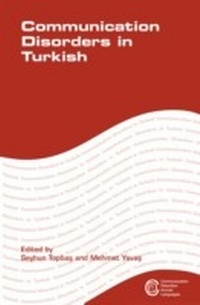
Communication Disorders in Turkish
1st Edition
Published on 30. April 2010
384 pages
978-1-84769-247-4 (ISBN)
Description

This volume is the first to deal with Turkish communicative development and disorders, reflecting the use of Turkish by a sizeable population in multilingual settings in Europe, USA, and Australia. In addition to Speech-language Pathologists, the book will be of interest to professionals from related fields such as clinical linguistics, psychology, psycholinguistics, neurolinguistics, audiology, and special education. This book presents a compendium of information about the profession of speech-language pathology, cultural differences, assessment materials and research done in communication disorders in Turkey. It also covers acquisition and disorders in multilingual contexts where there is significant Turkish immigration.
Reviews / Votes
Communication Disorders in Turkish is the most comprehensive overview of this topic ever written. Each chapter author has skillfully translated research to guide clinical practice. Speech-language pathologists and audiologists within Turkey, and in the many countries where Turkish people live, will find the breadth and depth of information to be impressive. -- Professor Sharynne McLeod, Research Institute for Professional Practice, Learning and Education (RIPPLE), Charles Sturt University, Australia Communication Disorders in Turkish elevates the field of speech-language pathology for Turkish-speaking individuals to a new level. The book will certainly become a mainstay resource for speech-language pathologists, educational audiologists, and even deaf educators who care for Turkish-speaking children and adults with speech or language disorders and differences. It will also appeal to clinical and scientific professionals across the international community, especially those in Europe, Australia, and North America, where millions of bilingual Turkish families have made their homes. -- Professor Kenneth O. St. Louis, Dept of Speech Pathology and Audiology, West Virginia University, USAMore details
Series
Language
English
Place of publication
Bristol
United Kingdom
Publishing group
Channel View Publications Ltd
Target group
Professional and scholarly
Edition type
Digital original
ISBN-13
978-1-84769-247-4 (9781847692474)
Copyright in bibliographic data and cover images is held by Nielsen Book Services Limited or by the publishers or by their respective licensors: all rights reserved.
Schweitzer Classification
Other editions
Additional editions
Seyhun Topbas | Mehmet Yavas
Communication Disorders in Turkish
Book
04/2010
Multilingual Matters
€180.80
Shipment within 10-20 days
Seyhun Topbas | Mehmet Yavas
Communication Disorders in Turkish
E-Book
04/2010
Multilingual Matters
€24.49
Available for download
Persons
Seyhun Topbas? is professor of Speech & Language Pathology at Anadolu University, Turkey. She is one of the pioneers of Speech and Language Pathology profession in Turkey; the founder of the graduate programs in Speech and Language Therapy and DILKOM (Education, Research and Training Centre for Speech and Language Pathology) at Anadolu University. Dr. Topbas has developed the first standardized Turkish Articulation and Phonology Test and published on phonological disorders in a variety of books and journals. She is currently on the editorial board of Clinical Linguistics and Phonetics.
Mehmet YavaA? is professor of Linguistics at Florida International University, Miami, Florida. His main area is phonology and its application to language acquisition and to speech and language disorders. His articles on Applied Phonology have appeared in numerous journals. He is the principal author of AvaliaA?ao Fonologica da CrianA?a (a phonological assessment procedure for Brazilian Portuguese). His other publications are Phonological Disorders in Children (Routledge, 1991), First and Second Language Phonology (Singular, 1994), Phonology: Development and Disorders (Singular 1998), Applied English Phonology (Blackwell, 2006).
Mehmet YavaA? is professor of Linguistics at Florida International University, Miami, Florida. His main area is phonology and its application to language acquisition and to speech and language disorders. His articles on Applied Phonology have appeared in numerous journals. He is the principal author of AvaliaA?ao Fonologica da CrianA?a (a phonological assessment procedure for Brazilian Portuguese). His other publications are Phonological Disorders in Children (Routledge, 1991), First and Second Language Phonology (Singular, 1994), Phonology: Development and Disorders (Singular 1998), Applied English Phonology (Blackwell, 2006).
Content
PART I Prologue
Chapter 1: A Closer Look at the Developing Profession of Speech and Language Pathology - Seyhun Topbas
Chapter 2: The Sound Inventory of Turkish: Consonants and Vowels - Handan Kopkalli-Yavuz
Chapter 3: Some Structural Characteristics of Turkish - Mehmet Yavas
PART II Communication Development and Disorders in Monolingual Settings
Chapter 4: Normal Language Development in Turkish - Ayhan Aksu-Koc
Chapter 5: MLU as a Tool for Morphological Assessment in Turkish Children - Pinar Ege
Chapter 6: Turkish SALT: Computer Assisted Language Sample Analysis - Funda Acarlar and Judith Johnston
Chapter 7: Specific Language Impairment in Turkish: Adapting the TELD-3 as a First Step in Measuring Language Impairments - Seyhun Topbas
Chapter 8: Speech Characteristics of Hearing Impaired Turkish Children - UEmran Tuefekcioglu
Chapter 9: Language Characteristics of Hearing Impaired Turkish Children - UEmran Tuefekcioglu
Chapter 10: Characteristics of Aphasia in Turkish - Ilknur Mavis
Chapter 11: Semantic Relatedness Judgments in Normal Turkish-English Bilinguals - Ilknur Mavis and Swathi Kiran
PART III Communication Disorders in Multilingual Settings
Chapter 12: Aspects of Acquisition and Disorders in Turkish-Dutch Bilingual Children - Kutlay Yagmur and Elma Nap-Koff
Chapter 13: Language Impairment in Turkish-Dutch Bilingual Children - Jan de Jong, Nazife Cavus and Anne Baker
Chapter 14: Measuring the Language Abilities of Turkish-English Bilingual Children Using TELD-3-T - Theodoros Marinis and Duygu OEzge
Chapter 15: Aspects of Language Acquisition and Disorders in Turkish-French Bilingual Children - Mehmet Ali Akinci and Nathalie Decool-Mercier
Chapter 16: Specific Language Impairment in Turkish-German Bilingual Children: Aspects of Assessment and Outcome - Solveig Chilla and Ezel Babuer
Chapter 1: A Closer Look at the Developing Profession of Speech and Language Pathology - Seyhun Topbas
Chapter 2: The Sound Inventory of Turkish: Consonants and Vowels - Handan Kopkalli-Yavuz
Chapter 3: Some Structural Characteristics of Turkish - Mehmet Yavas
PART II Communication Development and Disorders in Monolingual Settings
Chapter 4: Normal Language Development in Turkish - Ayhan Aksu-Koc
Chapter 5: MLU as a Tool for Morphological Assessment in Turkish Children - Pinar Ege
Chapter 6: Turkish SALT: Computer Assisted Language Sample Analysis - Funda Acarlar and Judith Johnston
Chapter 7: Specific Language Impairment in Turkish: Adapting the TELD-3 as a First Step in Measuring Language Impairments - Seyhun Topbas
Chapter 8: Speech Characteristics of Hearing Impaired Turkish Children - UEmran Tuefekcioglu
Chapter 9: Language Characteristics of Hearing Impaired Turkish Children - UEmran Tuefekcioglu
Chapter 10: Characteristics of Aphasia in Turkish - Ilknur Mavis
Chapter 11: Semantic Relatedness Judgments in Normal Turkish-English Bilinguals - Ilknur Mavis and Swathi Kiran
PART III Communication Disorders in Multilingual Settings
Chapter 12: Aspects of Acquisition and Disorders in Turkish-Dutch Bilingual Children - Kutlay Yagmur and Elma Nap-Koff
Chapter 13: Language Impairment in Turkish-Dutch Bilingual Children - Jan de Jong, Nazife Cavus and Anne Baker
Chapter 14: Measuring the Language Abilities of Turkish-English Bilingual Children Using TELD-3-T - Theodoros Marinis and Duygu OEzge
Chapter 15: Aspects of Language Acquisition and Disorders in Turkish-French Bilingual Children - Mehmet Ali Akinci and Nathalie Decool-Mercier
Chapter 16: Specific Language Impairment in Turkish-German Bilingual Children: Aspects of Assessment and Outcome - Solveig Chilla and Ezel Babuer
