

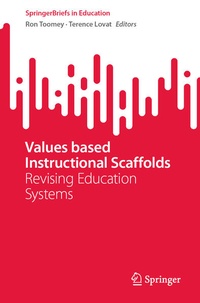
Values based Instructional Scaffolds
Description

This work fleshes out the assertion about the need for a revisioning of education to address the circumstances in which we now find ourselves. It draws attention to the ways education systems typically take a short-sighted view of the purposes of education by focussing on their parochial interests and having the education system strongly linked to national identity and the national economy. It argues that we now require a more long-term view of the purposes of education: one that better fits students for an uncertain future and for dealing with the unprecedented challenges that confront humankind. These include, amongst many others, that much more emphasis needs to be given to nurturing appropriate skills, within a framework of lifelong learning, as people's jobs are reimagined, enriched or facilitated by the technology they work alongside; the unprecedented environmental destruction through global warming and natural resource depletion; population and consumption trends predicting that we shall overshoot the earth's carrying capacity within the century; humanity being at war with itself in escalating numbers of regional, ethnic, and religious conflicts; and domestic violence, youth suicide as well as child abuse and neglect being of epidemic proportions.
The work identifies a conception of curriculum and an approach to teaching and learning that have been shown to have the effects that successfully address such challenges. The authors label them as values based instructional scaffolds. The volume provides a total of eight case studies of best practice values based instructional scaffolding drawn from the UK, USA, Africa and Australia.
More details
Other editions
Additional editions
Persons
Ron Toomey, a former Secondary School teacher, is an Emeritus Professor at Victoria University in Australia. He managed the research program for the Australian Government's Values Education Program.
Terence Lovat, a former Secondary School teacher, is an Emeritus Professor at the University of Newcastle in Australia, Honorary Research Fellow at the University of Oxford, UK, and Distinguished Visiting Professor at the University of Johannesburg, South Africa, where he is attached to the UNESCO Chair in Values Education. From 2003-2010, he was Principal Investigator for the Australian Government's Values Education Program.
Content
Introduction.- Reasons for Rethinking the Purpose of Education.- The Beginnings of a Rethink about Learning.- Values based Education.- Learning Perspectives from the Learning Sciences and Educational Neuroscience.- A Practical Example.- Rethinking Curriculum.- Values Based Instructional Scaffolds.- Case Study Number 1 The Ritual of Acknowledgements as a Values Based Instructional Scaffold at the Embodiment of Love Academy Enugu Nigeria by Michael Ezenwa Ngozi Agu and Patrick Alor.- Case Study Number 2 Unconditional Positive Regard as a Values Based Instructional Scaffold at Toogoolawa School by Ron Toomey and Ron Farmer.- Case Study Number 3 Socratic Circles as a Values based Instructional Scaffold by Catherine Devine.- Case Study Number 4 Student Action Teams as a Values based Instructional Scaffold by Roger Holdsworth.- Case Study Number 5 Courageous Advocacy as a Values based Instructional Scaffold by Neil Hawkes and Cory Bateman.- Case Study Number 6 Service Learning at Horace Mann School as a Values based Instructional Scaffold by Jeremy Leeds.- Case Study Number 7 Values Education Quality Teaching and Service Learning A Troika as a Values based Instructional Scaffold by Ron Toomey.- Case Study Number 8 Student Voice Deep Learning and Student Agency as a Values based Instructional Scaffold by Sophie Cartelli.- Conclusion What are the Case Studies Saying about Values Based Instructional Scaffolding.
