

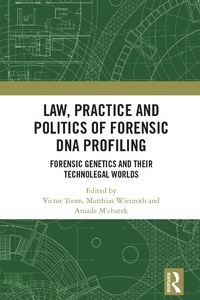
Law, Practice and Politics of Forensic DNA Profiling
Forensic Genetics and their Technolegal Worlds
1st Edition
Published on 30. December 2022
272 pages
978-1-000-81857-4 (ISBN)
Description

This collection reviews developments in DNA profiling across jurisdictions with a focus on scientific and technological developments as well as their political, ethical, and socio-legal aspects. Written by leading scholars in the fields of social studies of forensic science, science and technology studies and socio-legal studies, the book provides state-of-the-art analyses of forensic DNA practices in a diverse range of jurisdictions, new and emerging forensic genetics technologies and issues of legitimacy.
The work articulates the various forms of technolegal politics involved in the everyday, standardised and emerging practices of forensic genetics and engages with the most recent scholarly and policy literature. In analyses of empirical cases, and by taking into account the most recent technolegal developments, the book explores what it means to live in a world that is increasingly governed through anticipatory crime control and its related risk management and bio-surveillance mechanisms, which intervene with and produce political and legal subjectivities through human bodies in their DNA.
This volume is an invaluable resource for those working in the areas of social studies of forensic science, science and technology studies, socio-legal studies, sociology, anthropology, ethics, law, politics and international relations.
The work articulates the various forms of technolegal politics involved in the everyday, standardised and emerging practices of forensic genetics and engages with the most recent scholarly and policy literature. In analyses of empirical cases, and by taking into account the most recent technolegal developments, the book explores what it means to live in a world that is increasingly governed through anticipatory crime control and its related risk management and bio-surveillance mechanisms, which intervene with and produce political and legal subjectivities through human bodies in their DNA.
This volume is an invaluable resource for those working in the areas of social studies of forensic science, science and technology studies, socio-legal studies, sociology, anthropology, ethics, law, politics and international relations.
More details
Edition
1. Auflage
Language
English
Place of publication
London
United Kingdom
Publishing group
Taylor & Francis Ltd
Target group
Professional and scholarly
Product notice
Reflowable
Illustrations
2 Tables, black and white; 1 Line drawings, black and white; 2 Halftones, black and white; 3 Illustrations, black and white
ISBN-13
978-1-000-81857-4 (9781000818574)
Copyright in bibliographic data and cover images is held by Nielsen Book Services Limited or by the publishers or by their respective licensors: all rights reserved.
Schweitzer Classification
Other editions
Additional editions
Victor Toom | Matthias Wienroth | Amade M'charek
Law, Practice and Politics of Forensic DNA Profiling
Forensic Genetics and their Technolegal Worlds
Book
12/2022
1st Edition
Routledge
€60.30
Shipment within 10-20 days
Victor Toom | Matthias Wienroth | Amade M'charek
Law, Practice and Politics of Forensic DNA Profiling
Forensic Genetics and their Technolegal Worlds
Book
12/2022
1st Edition
Routledge
€186.30
Shipment within 15-20 days
Persons
Dr Victor Toom is scientific staff at the Netherlands Scientific Council for Government Policy, The Hague, the Netherlands.
Dr Matthias Wienroth, Centre for Crime and Policing, Department of Social Sciences, University of Northumbria, Newcastle upon Tyne, UK.
Amade M'charek is Professor of Anthropology of Science at the Department of Anthropology, University of Amsterdam, the Netherlands.
Dr Matthias Wienroth, Centre for Crime and Policing, Department of Social Sciences, University of Northumbria, Newcastle upon Tyne, UK.
Amade M'charek is Professor of Anthropology of Science at the Department of Anthropology, University of Amsterdam, the Netherlands.
Content
Contents
Acknowledgements
Notes on contributors
Introduction
1 Forensic genetics and their technolegal worlds: The law, practices and politics of forensic DNA profiling: Introduction
Victor Toom, Matthias Wienroth and Amade M'charek
Part I DNA profiling and database governance
2 Technolegal worlds in an armed conflict: The forensic making of victims in Colombia
Maria Fernanda Olarte-Sierra and Jaime Enrique Castro Bermudez
3 Travelling promises: Forensic DNA databases in Brazil's technolegal setting
Vitor Richter and Luiza Louzada
4 Forensic DNA analysis and database governance in Ghana
Aaron Opoku Amankwaa and Judith Amankwa Addo
5 Legislating forensic genetics in South Africa: Science, justice and the occlusion of race in postapartheid DNA databasing
Noah Tamarkin
Part II New and emerging innovations and applications
6 From promise to practice: Anticipatory work and the adoption of massive parallel sequencing in forensics
Roos Hopman, Irene van Oorschot and Amade M'charek
7 Deliberating forensic genetics innovations: The case of rapid DNA technologies in England and Wales
Dana Wilson-Kovacs
8 Emerging forensic genetic technologies: Contested anticipations of legitimation, caution and social situatedness
Christopher James Lawless
Part III Issues of legitimacy
9 Systemic (mis)trust in technolegal worlds: Three key trust relationships in forensic genetics
Matthias Wienroth
10 Why is DNA not enough? The multiple temporalities of family reunification in Finland
Anna-Maria Tapaninen and Ilpo Helen
11 Evaluating forensic DNA databases
Carole McCartney and Aaron Amankwaa
12 The stakes of forensic phenotypic profiling: Can solidarity help?
Barbara Prainsack and Gabrielle Samuel
13 Conceptions of consent, family and jurisdiction in forensic genetic genealogical searches
Erin Murphy
Epilogue
14 Technolegal policies and practices: Studying the past, present and future of forensic genetics
David Skinner
Acknowledgements
Notes on contributors
Introduction
1 Forensic genetics and their technolegal worlds: The law, practices and politics of forensic DNA profiling: Introduction
Victor Toom, Matthias Wienroth and Amade M'charek
Part I DNA profiling and database governance
2 Technolegal worlds in an armed conflict: The forensic making of victims in Colombia
Maria Fernanda Olarte-Sierra and Jaime Enrique Castro Bermudez
3 Travelling promises: Forensic DNA databases in Brazil's technolegal setting
Vitor Richter and Luiza Louzada
4 Forensic DNA analysis and database governance in Ghana
Aaron Opoku Amankwaa and Judith Amankwa Addo
5 Legislating forensic genetics in South Africa: Science, justice and the occlusion of race in postapartheid DNA databasing
Noah Tamarkin
Part II New and emerging innovations and applications
6 From promise to practice: Anticipatory work and the adoption of massive parallel sequencing in forensics
Roos Hopman, Irene van Oorschot and Amade M'charek
7 Deliberating forensic genetics innovations: The case of rapid DNA technologies in England and Wales
Dana Wilson-Kovacs
8 Emerging forensic genetic technologies: Contested anticipations of legitimation, caution and social situatedness
Christopher James Lawless
Part III Issues of legitimacy
9 Systemic (mis)trust in technolegal worlds: Three key trust relationships in forensic genetics
Matthias Wienroth
10 Why is DNA not enough? The multiple temporalities of family reunification in Finland
Anna-Maria Tapaninen and Ilpo Helen
11 Evaluating forensic DNA databases
Carole McCartney and Aaron Amankwaa
12 The stakes of forensic phenotypic profiling: Can solidarity help?
Barbara Prainsack and Gabrielle Samuel
13 Conceptions of consent, family and jurisdiction in forensic genetic genealogical searches
Erin Murphy
Epilogue
14 Technolegal policies and practices: Studying the past, present and future of forensic genetics
David Skinner
