

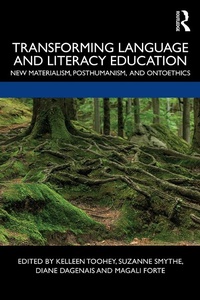
Transforming Language and Literacy Education
New Materialism, Posthumanism, and Ontoethics
1st Edition
Published on 3. June 2020
214 pages
978-0-429-95870-0 (ISBN)
Description

The field of languages and literacies education is undergoing rapid transformation. Scholarship that draws upon feminist, post-colonial, new material and posthuman ontologies is transcending disciplinary boundaries and disrupting traditional binaries between human and nonhuman, the natural and the cultural, the material and the discursive.
In Transforming Language and Literacy Education, editors Kelleen Toohey, Suzanne Smythe, Diane Dagenais and Magali Forte bring together accessible, conceptually rich stories from internationally diverse authors to guide new practices, new conversations and new thinking among scholars and educators at the forefront of languages and literacies learning. The book addresses these concepts for diverse groups of learners including young children, youth and adults in formal educational and community-based settings. Challenging and disruptive, this is a unique and important contribution to language and literacy education.
In Transforming Language and Literacy Education, editors Kelleen Toohey, Suzanne Smythe, Diane Dagenais and Magali Forte bring together accessible, conceptually rich stories from internationally diverse authors to guide new practices, new conversations and new thinking among scholars and educators at the forefront of languages and literacies learning. The book addresses these concepts for diverse groups of learners including young children, youth and adults in formal educational and community-based settings. Challenging and disruptive, this is a unique and important contribution to language and literacy education.
Reviews / Votes
"This book unsettles the reader through stories, questions, wonderings, and wanderings; it takes us through a series of encounters into the not-yet-known. The authors invite us to explore, as educators, the emergence of our own capacity to affect and be affected by others-where those others are both human and more-than-human. The multiple and emergent educational encounters that the authors offer us are embodied, and they are grounded in place; and they take us, through new materialist and posthumanist experimentation, into inspiring new ways of knowing-in-being. Together these papers engage in a Baradian ethico-onto-epistemological exploration of pedagogical becomings. They are beautifully written and make a vital and timely contribution to educational thought and practice."Bronwyn Davies Emeritus Professor Western Sydney University
"Calling for radical hope, this volume opens potentials for language and literacies research that reaches beyond critique alone and into more just, speculative futures. Toward such futures, the authors develop orientations to language and literacies research that value the 'more than' of experience that affects this sense of radical hope."
Christian Ehret, McGill University
More details
Edition
1. Auflage
Language
English
Place of publication
London
United Kingdom
Publishing group
Taylor & Francis Ltd
Target group
College/higher education
Illustrations
31 Halftones, black and white; 31 Illustrations, black and white
ISBN-13
978-0-429-95870-0 (9780429958700)
Copyright in bibliographic data and cover images is held by Nielsen Book Services Limited or by the publishers or by their respective licensors: all rights reserved.
Schweitzer Classification
Other editions
Additional editions
Kelleen Toohey | Suzanne Smythe | Diane Dagenais
Transforming Language and Literacy Education
New Materialism, Posthumanism, and Ontoethics
Book
06/2020
1st Edition
Routledge
€62.90
Shipment within 10-20 days
Kelleen Toohey | Suzanne Smythe | Diane Dagenais
Transforming Language and Literacy Education
New Materialism, Posthumanism, and Ontoethics
Book
06/2020
1st Edition
Routledge
€207.50
Shipment within 10-20 days
Persons
Kelleen Toohey, Professor Emerita, Simon Fraser University, Vancouver, BC has been teaching and writing about the education of children whose languages have been minoritized in Canada, especially English language learners. Her book, Learning English at school: Identity, socio-material relations and classroom practice (2nd edition) is in press with Multilingual Matters. Her recent work has explored the affordances of digital making for language and literacy learning.
Suzanne Smythe, Associate Professor, Faculty of Education, Simon Fraser University is an adult literacy researcher and educator who works closely with community-based agencies and educators to understand the implications of new technologies for literacies and learning. She is particularly interested in the potential of technologies to inscribe old and new modes of control and exploitation. She is currently exploring the potential of participatory technology design to intervene in such assemblages and to forge new ways to think and do techno-literacies.
Diane Dagenais, Professor, Simon Fraser University, works in French second language and minority language education. Her research has documented the literacy practices of multilingual children in families, communities and schools. Her recent studies examine encounters between multilingual youth and digital tools for video and story production. Her work is published in a range of French and English language education journals.
Magali Forte is a PhD student in the Faculty of Education at Simon Fraser University (Vancouver, BC, CANADA) and a K-12 teacher in Vancouver. She adopts a sociomaterial perspective to examine the ways in which multilingual and multimodal processes of identity construction unfold through entanglements of humans and nonhumans in second language education settings.
Suzanne Smythe, Associate Professor, Faculty of Education, Simon Fraser University is an adult literacy researcher and educator who works closely with community-based agencies and educators to understand the implications of new technologies for literacies and learning. She is particularly interested in the potential of technologies to inscribe old and new modes of control and exploitation. She is currently exploring the potential of participatory technology design to intervene in such assemblages and to forge new ways to think and do techno-literacies.
Diane Dagenais, Professor, Simon Fraser University, works in French second language and minority language education. Her research has documented the literacy practices of multilingual children in families, communities and schools. Her recent studies examine encounters between multilingual youth and digital tools for video and story production. Her work is published in a range of French and English language education journals.
Magali Forte is a PhD student in the Faculty of Education at Simon Fraser University (Vancouver, BC, CANADA) and a K-12 teacher in Vancouver. She adopts a sociomaterial perspective to examine the ways in which multilingual and multimodal processes of identity construction unfold through entanglements of humans and nonhumans in second language education settings.
Content
Introduction by Kelleen Toohey, Suzanne Smythe, Diane Dagenais and Magali Forte (co-editors)
Chapter 1: Making and unmaking literacy desirings: Pedagogical matters of concern from Writers' Studio by Tara Gutshall Rucker and Candace R. Kuby
Chapter 2: Practising place-thought and engaging in critical place inquiry in a public park: Listening, letting go, and unsettling our writing pedagogies by Michelle A. Honeyford and Jennifer Watt
Chapter 3: Becoming posthuman - Bodies, affect, earth at the school garden by Saskia Van Viegen
Chapter 4: Lekta and literacy in early childhood education - Entwinements of idealism and materialism by Liselott Mariett Olsson
Chapter 5: Rethinking causality through children's literacies by Jacqueline Barreiro
Chapter 6: A rhizomatic case analysis of instructional coaching as becoming by Brandon Sherman, Mari Haneda and Annela Teemant
Chapter 7: 'This documentary actually makes Welland look good': Exploring posthumanism in a high school documentary film project by Amelie Lemieux and Jennifer Rowsell
Chapter 8: Affect theory as a lens on teacher thinking in adult language classrooms by Monica Waterhouse
Chapter 9: The problem and potential of representation: Being and becoming by Margaret MacDonald, Cher Hill and Nathalie Sinclair
Chapter 10: Exploring affect in stop frame animation by Gabriele Budach, Dimitri Efremov, Daniela Loghin and Gohar Sharoyan
Chapter 1: Making and unmaking literacy desirings: Pedagogical matters of concern from Writers' Studio by Tara Gutshall Rucker and Candace R. Kuby
Chapter 2: Practising place-thought and engaging in critical place inquiry in a public park: Listening, letting go, and unsettling our writing pedagogies by Michelle A. Honeyford and Jennifer Watt
Chapter 3: Becoming posthuman - Bodies, affect, earth at the school garden by Saskia Van Viegen
Chapter 4: Lekta and literacy in early childhood education - Entwinements of idealism and materialism by Liselott Mariett Olsson
Chapter 5: Rethinking causality through children's literacies by Jacqueline Barreiro
Chapter 6: A rhizomatic case analysis of instructional coaching as becoming by Brandon Sherman, Mari Haneda and Annela Teemant
Chapter 7: 'This documentary actually makes Welland look good': Exploring posthumanism in a high school documentary film project by Amelie Lemieux and Jennifer Rowsell
Chapter 8: Affect theory as a lens on teacher thinking in adult language classrooms by Monica Waterhouse
Chapter 9: The problem and potential of representation: Being and becoming by Margaret MacDonald, Cher Hill and Nathalie Sinclair
Chapter 10: Exploring affect in stop frame animation by Gabriele Budach, Dimitri Efremov, Daniela Loghin and Gohar Sharoyan
