

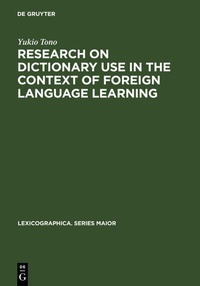
Research on Dictionary Use in the Context of Foreign Language Learning
Description

The purpose of this book is to conceptualise the research on dictionary use within a more general overview of language learning. It brings together some of the findings of studies on dictionary users and uses and shows how research into dictionary use can contribute to the improvement of dictionary design and the clarification of issues in language learning. The book also provides reports on a series of empirical studies on dictionary use in decoding activities (reading comprehension and L2/L1 translation) , which will shed some light on the nature of the issues discussed throughout the book. The book falls into two parts. Part I, »Research on Dictionary Use - State of the Art« is, as its title suggests, a summary of previous studies to tease out relevant issues in each area of inquiry. Part 2, »Empirical Studies« reports on a series of studies the author has conducted in the past 15 years. The first three studies (Chapter 5, 6, and 7) investigate dictionary use in the broader context of language learning. The next four studies (Chapter 8, 9, 10 and 11) report on a series of controlled experiments on the relationship between the macro- and microstructure of the dictionary and reference skills. Finally, the last two chapters (Chapter 12 and 13) report the use of learner language data for a better lexicographical output.
More details
Other editions
Additional editions
Content
- Intro
- Acknowledgements
- Introduction
- Part 1: Research on Dictionary Use: State of the Art
- 1. User-oriented Dictionary Research: a Brief History
- 1.1. Lexicography: theory and practice
- 1.2. The user perspective: innovation
- 1.3. The growing awareness of user needs
- 1.4. Advances in user-oriented research
- 2. Research on Dictionary Use in Language Learning
- 2.1. Dictionary use in vocabulary learning
- 2.2. Dictionary use in decoding activities
- 2.3. Dictionary use in encoding activities
- 2.4. Summary
- 3. Needs and Skills Analysis of L2 Dictionary Users
- 3.1. The development of needs analysis in dictionary research
- 3.2. A framework for needs analysis
- 3.3. Needs analysis of native speakers as dictionary users
- 3.4. Needs analysis of ESL/EFL learners
- 3.5. Skills analysis
- 3.6. A new framework for needs and skills analysis
- 3.7. Summary
- 4. Research on Dictionary Use: Methodological Considerations
- 4.1. Areas and hypotheses concerning research into dictionary use
- 4.2. Towards a more comprehensive framework for the research on dictionary use
- 4.3. Methods for research into dictionary use
- 4.4. Summary
- Part 2: Empirical Studies
- 5. The Effect of Long-term Dictionary Use on Reading Comprehension
- 5.1. Purpose
- 5.2. Method
- 5.3. Results
- 5.4. Discussion
- 5.5. Summary
- 6. How to Assess Dictionary Using Skills for Language Learning
- 6.1. Two major studies on the assessment of dictionary using skills
- 6.2. The components of a test of dictionary using skills
- 6.3. A comparative study of the dictionary skills test
- 6.4. Summary
- 7. A Good Dictionary User: What Makes the Difference?
- 7.1. Background
- 7.2. Method
- 7.3. Results and discussion
- 7.4. Summary
- 8. Macrostructure Skills: Idiom Look-up Operations
- 8.1. The treatment of idioms in dictionaries
- 8.2. Idiom patterns in the Oxford Dictionary of Current Idiomatic English (1985)
- 8.3. Idiom look-up strategies: Béjoint (1981)
- 8.4. Method
- 8.5. Results
- 8.6. Discussion
- 8.7. Summary
- 9. Microstructure Skills: Process of Dictionary Look-up in L2/L1 Translation
- 9.1. Background
- 9.2. Method
- 9.3. Results
- 9.4. Discussion
- 9.5. Summary
- 10. Microstructure Skills: the Effect of Menu on the Look-up Process
- 10.1. Purpose
- 10.2. Method
- 10.3. Results and discussion
- 10.4. Summary
- 11. Macrostructure Revisited: the Effect of Signposts/Guidewords
- 11.1. Background
- 11.2. Method
- 11.3. Results and discussion
- 11.4. Summary
- 12. Using Learners' Error Information for L2 Lexicography
- 12.1. Background
- 12.2. JEFLL corpus project
- 12.3. Collocation errors of English basic verbs
- 12.4. Corpus analysis procedure
- 12.5. Results of verb collocation analysis
- 12.6. Integrating error information into lexicographical description
- 12.7. Summary
- 13. L2 Learner Corpora for Pedagogical Dictionaries: The Case of Make
- 13.1. Background
- 13.2. Method
- 13.3. Results
- 13.4. Summary
- Conclusion
- Appendices
- Bibliography
