

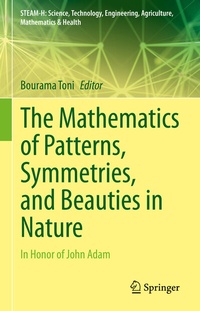
The Mathematics of Patterns, Symmetries, and Beauties in Nature
In Honor of John Adam
1st Edition
Published on 6. December 2021
XIV, 142 pages
978-3-030-84596-4 (ISBN)
Description

This unique book gathers various scientific and mathematical approaches to and descriptions of the natural and physical world stemming from a broad range of mathematical areas - from model systems, differential equations, statistics, and probability - all of which scientifically and mathematically reveal the inherent beauty of natural and physical phenomena. Topics include Archimedean and Non-Archimedean approaches to mathematical modeling; thermography model with application to tungiasis inflammation of the skin; modeling of a tick-Killing Robot; various aspects of the mathematics for Covid-19, from simulation of social distancing scenarios to the evolution dynamics of the coronavirus in some given tropical country to the spatiotemporal modeling of the progression of the pandemic. Given its scope and approach, the book will benefit researchers and students of mathematics, the sciences and engineering, and everyone else with an appreciation for the beauty of nature. The outcome is a mathematical enrichment of nature's beauty in its various manifestations.
This volume honors Dr. John Adam, a Professor at Old Dominion University, USA, for his lifetime achievements in the fields of mathematical modeling and applied mathematics. Dr. Adam has published over 110 papers and authored several books.
This volume honors Dr. John Adam, a Professor at Old Dominion University, USA, for his lifetime achievements in the fields of mathematical modeling and applied mathematics. Dr. Adam has published over 110 papers and authored several books.
More details
Series
Language
English
Place of publication
Cham
Switzerland
Publishing group
Springer International Publishing
Target group
Professional and scholarly
Product notice
Reflowable
Illustrations
XIV, 142 p. 18 illus., 8 illus. in color.
File size
4,87 MB
ISBN-13
978-3-030-84596-4 (9783030845964)
DOI
10.1007/978-3-030-84596-4
Schweitzer Classification
Other editions
Additional editions
Book
12/2021
Springer
€139.09
Shipment within 7-9 days
Person
Bourama Toni
is a Full Professor of Mathematics and Chair of the Department of Mathematics at Howard University, Washington, DC, USA. As the Founder and Editor of the Springer-published STEAM-H series, with a truly interdisciplinary profile, Dr. Toni's research interests are primarily in Differential and Nonlinear Analysis and related topics such as Dynamical Systems, Non-Archimedean Analysis, Game Theory, Feedback Loops Analysis, and their applications to the biosciences, behavioral sciences and naval engineering, with an excellent track record of high-quality published research papers including contributed volumes with Springer.
Content
- Intro
- Preface
- Acknowledgments
- Contents
- Contributors
- Introduction: Nature and Its Mathematics
- A Mathematical Model of Thermography with Application to Tungiasis Inflammation of the Skin
- 1 Introduction
- 2 Mathematical Model
- 3 Results and Discussion
- 4 Conclusion
- References
- Mathematics of COVID-19
- 1 Introduction
- 2 Development of the Vaccine
- 2.1 Structure of the Virus and How It Enters Human Cells
- 2.2 Immuno-Response to the Virus
- 2.3 The Vaccine
- 3 The Basic SIR Model
- 4 R0 and Herd Immunity
- 4.1 Numerical Solution with Euler's Method
- 5 Modifications of the Basic Model
- 5.1 Susceptible-Exposed-Infectious-Recovered-Deceased (SEIRD) Model
- 5.2 SEIRD Model with Vaccination
- 5.3 SEIRDv Model with Reinfection
- References
- Application and Modeling of a Tick-Killing Robot, TickBot
- 1 Introduction
- 2 Parameter Estimation Studies
- 2.1 Permethrin Potency
- 2.2 TickBot 2016
- 2.3 Dry Ice Attraction Study
- 2.4 TickBot 2017
- 3 The Model
- 3.1 Purpose
- 3.2 Entities, State Variables, and Scales
- 3.2.1 Agents/Individuals
- 3.2.2 Spatial Units
- 3.2.3 Environment
- 3.3 Process Overview and Scheduling
- 3.4 Design Concepts
- 3.4.1 Basic Principles
- 3.4.2 Sensing
- 3.4.3 Interaction
- 3.4.4 Stochasticity
- 3.4.5 Observation
- 3.5 Initialization
- 3.6 Input Data
- 3.7 Submodels
- 3.7.1 Process Passage of Time
- 3.7.2 Process Tick Life Cycle
- 3.7.3 Process Host Mortality and Movement
- 3.7.4 Process TickBot
- 3.8 Scenarios
- 4 Results
- 4.1 Number of Ticks Killed
- 4.2 Maximum Density of Questing Ticks
- 4.3 Sum of Questing Ticks
- 4.4 Sum of All Ticks
- 4.5 Cost of Effort
- 5 Conclusions
- References
- Simulations of Social Distancing Scenarios and Analysis of Strategies to Predict the Spread of COVID-19
- 1 Introduction
- 2 Materials and Methods
- 2.1 Data
- 2.2 Models Description
- 2.2.1 Discrete-Time SIR Model
- 2.2.2 Continuous SEIR Model
- 2.3 Parameter Estimation Framework
- 2.4 Model and Parameter Setups
- 2.4.1 Model Parameters
- 2.4.2 Delay Scheme
- 2.4.3 Social Distancing Scheme
- 2.4.4 Parameter Setting
- 3 Results and Discussion
- 3.1 Analysis on the Effect of Social Distancing
- 3.2 Comparison of Strategies to Simulate the Effect of Latency
- 4 Conclusions
- References
- Mathematical Modelling of the Evolution Dynamics of the Coronavirus Disease 2019 (COVID-19) in Burkina Faso
- 1 Introduction
- 2 Mathematical Model
- 3 Basic Properties
- 4 Data
- 5 Numerical Simulations
- 5.1 Situation Without Public Policies
- 5.2 Situation with Public Policies
- 6 Conclusion
- Appendix A. Tables of Data
- References
- Spatio-Temporal Modelling of Progression of the COVID-19Pandemic
- 1 Introduction
- 2 The Dataset
- 2.1 Preliminary Analyses
- 3 Statistical Models and Results
- 3.1 Conditional Autoregressive Bayesian Disease Mapping Models for Full Data
- 3.2 Output and Results
- 4 Discussion: Conclusion
- 5 Data Availability Statement
- References
- Archimedean and Non-Archimedean Approaches to Mathematical Modeling
- 1 Introduction
- 1.1 Cultural Approaches to Mathematics
- 1.2 Artificial Mathematics
- 1.3 Qualitative Mathematics
- 2 The Non-Archimedean or Ultrametric/p-adic Approach
- 2.1 p-adic Mathematical Physics
- 2.2 Mathematically Thinking p-adically
- 2.3 p-adic Mental Spaces
- 3 The Archimedean or Euclidean Approach
- 3.1 Signed Qualitative Modeling: An Example
- 3.2 Jacobian Feedback Loops
- 3.3 Loops and Jacobian Spectrum
- 3.4 Qualitative existence of Multiple Equilibria
- 3.5 Applications and Examples
- 3.5.1 Thomas Conjectures
- 3.5.2 Eisenfeld Qualitative Stability
- 3.5.3 Loop Analysis in the Plane
- 3.5.4 Biochemical Application: Two-Component Oscillators
- 3.5.5 Two-dimensional Model for Electrochemical Corrosion
- 3.5.6 A Loop Analysis of the Lorenz System
- 3.5.7 A Loop Analysis of the Rossler System
- 3.6 Summary
- 3.6.1 Research Directions
- References
