

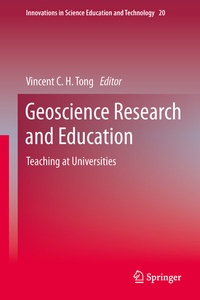
Geoscience Research and Education
Description

More details
Other editions
Additional editions
Content
PART I: INTRODUCTION.- 1. The context.- From research-implicit to research-enhanced teaching: A geoscience perspective, Vincent C. H. Tong.- Teaching and research in the contemporary university, Simon Marginson.- PART II: RESEARCH-TEACHING NEXUS IN GEOSCIENCE.- 2. Perspectives.- The challenge of combining research and teaching: A young geoscientist's perspective, Laura J. Cobden.- Incorporating research into teaching geosciences: the Masters student's perspective, Barbara McNutt.- Teaching on the High Seas: How Field Research Enhances Teaching at All Levels, Ken C. Macdonald.- 3. Promoting research-enhanced teaching.- Curricula and departmental strategies to link teaching and geoscience research, Alan Jenkins.- The Role of scholarly publication in geocognition and discipline-based geoscience education research, Julie Libarkin.- Geologic Displays as Science and Art, Marjorie A. Chan.- Teaching Geoscience Research to Adult Undergraduates and Distance Learners, Hilary Downes.- Geoscience Internships in the Oil and Gas Industry: A Winning Proposition for both Students and Employers, Rolf V. Ackermann and Lucy MacGregor.- PART III: PEDAGOGICAL EXAMPLES.- 4. Use of technology.- Integration of Enquiry Fossil Research Approaches and Students' Local Environments within Online Geoscience Classrooms, Renee M. Clary and James H. Wandersee.- Embedding Research Practice Activities into Earth and Planetary Sciences Courses Through the Use of Remotely Operable Analytical Instrumentation, Jeffrey G. Ryan.- Using Interactive Virtual Field Guides and Linked Data in Geoscience Teaching and Learning, Tim Stott, Kate Litherland, Patrick Carmichael and Anne-Marie Nuttall.- GEOverse - An undergraduate research journal: ResearchDissemination within and beyond the Curriculum, Helen Walkington.- Towards technology- and research-enhanced education (TREE): Electronic feedback as a teaching tool in geoscience, Vincent C. H. Tong.- 5. Programme design.- Introducing university students to authentic, hands-on undergraduate geoscience research in entry-level coursework, Laura Guertin.- Engaging first-year students in team-oriented research: The Terrascope learning community, S. A. Bowring, A. W. Epstein and C. F. Harvey.- Students' final projects: an opportunity to link research and teaching, Dolores Pereira and Luis Neves.- Teaching Environmental Sciences in an International and Interdisciplinary Framework: from Arid to Alpine Ecosystems in NE Spain, D. Badía, N. Bayfield, A. Cernusca, F. Fillat and D. Gómez.- The Role of concept inventories in course assessment, Julie Libarkin, Sarah E. Jardeleza and Teresa L. McElhinny.
