

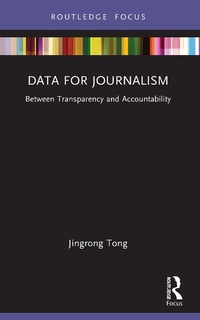
Data for Journalism
Between Transparency and Accountability
1st Edition
Published on 21. July 2022
140 pages
978-1-000-65574-2 (ISBN)
Description

Considering the interactions between developments in open data and data journalism, Data for Journalism: Between Transparency and Accountability offers an interdisciplinary account of this complex and uncertain relationship in a context of tightening the control over data and weighing transparency against privacy.
As data has brought both promise and disruptive changes to societies, the relationship between transparency and accountability has become complicated, and data journalism is practised alongside the contradictory needs of opening up and protecting data. In addition to exploring the benefits of data for journalism, this book addresses the uncertain nature of data and the obstacles preventing data from being fluently accessed and properly used for data reporting. Because of these obstacles, it argues individual data journalists play a decisive role in using data for journalism and facilitating the circulation of data. Frictions in data access, newsrooms' resources and cultures and data journalists' skill and data literacy levels determine the degree to which journalism can benefit from data, and these factors potentially exacerbate digital inequalities between newsrooms in different countries and with different resources. As such, the author takes an international perspective, drawing on empirical research and cases from around the world, including countries such as the UK, the US, Germany, Sweden, Australia, India, China and Japan.
Introducing a new dimension to the study of developments in journalism and the role of journalism in society, Data for Journalism will be of interest to academics and researchers in the fields of journalism and the sociology of (big and open) data.
As data has brought both promise and disruptive changes to societies, the relationship between transparency and accountability has become complicated, and data journalism is practised alongside the contradictory needs of opening up and protecting data. In addition to exploring the benefits of data for journalism, this book addresses the uncertain nature of data and the obstacles preventing data from being fluently accessed and properly used for data reporting. Because of these obstacles, it argues individual data journalists play a decisive role in using data for journalism and facilitating the circulation of data. Frictions in data access, newsrooms' resources and cultures and data journalists' skill and data literacy levels determine the degree to which journalism can benefit from data, and these factors potentially exacerbate digital inequalities between newsrooms in different countries and with different resources. As such, the author takes an international perspective, drawing on empirical research and cases from around the world, including countries such as the UK, the US, Germany, Sweden, Australia, India, China and Japan.
Introducing a new dimension to the study of developments in journalism and the role of journalism in society, Data for Journalism will be of interest to academics and researchers in the fields of journalism and the sociology of (big and open) data.
More details
Series
Edition
1. Auflage
Language
English
Place of publication
London
United Kingdom
Publishing group
Taylor & Francis Ltd
Target group
College/higher education
Professional and scholarly
Illustrations
5 Tables, black and white; 3 Line drawings, black and white; 3 Illustrations, black and white
ISBN-13
978-1-000-65574-2 (9781000655742)
Copyright in bibliographic data and cover images is held by Nielsen Book Services Limited or by the publishers or by their respective licensors: all rights reserved.
Schweitzer Classification
Other editions
Additional editions
Book
10/2024
1st Edition
Routledge
€32.80
Shipment within 10-20 days
Book
07/2022
1st Edition
Routledge
€76.80
Shipment within 15-20 days
Person
Jingrong Tong is Senior Lecturer in Digital News Cultures at the University of Sheffield. Her research focuses on the impact of digital technology on journalism, social media analysis and environmental communication.
Content
Introduction
1 Data as a source of information
2 Access to data
3 Using data in journalism
4 Opening up data from news reporting
Conclusion: The four roles of data journalists in the circulation of data
1 Data as a source of information
2 Access to data
3 Using data in journalism
4 Opening up data from news reporting
Conclusion: The four roles of data journalists in the circulation of data
