

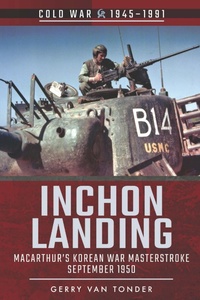
Inchon Landing
MacArthur's Korean War Masterstroke, September 1950
Published on 12. November 2020
136 pages
978-1-5267-5697-8 (ISBN)
Description

A history of this dramatic and risky amphibious invasion, with photos included.
In the previous two volumes in the author's series on battles of the Korean War, North Korean ground forces, armor and artillery cross the 38th Parallel into South Korea, inflicting successive ignominious defeats on the ill-prepared US-led UN troops, pushing them ever southward into a tiny defensive enclave-the Pusan Perimeter-on the tip of the Korean Peninsula.
The story continues as General Douglas MacArthur, Second World War veteran of the South East Asia and Pacific theaters, meets with considerable resistance to his plans for a counteroffensive, from both Washington and his staff in South Korea and Japan: it is typhoon season, the approaches to the South Korean port city of Inch'on are not conducive to amphibious assault, and it will leave the besieged Pusan Perimeter in great danger of being overrun. However, the controversial MacArthur's obstinate persistence prevails and, with a mere three weeks to go, the US X Corps is activated to execute the invasion on D-Day, September 15, 1950.
Elements of the US Marine Corps land successfully on the scheduled day, and with the element of surprise on their side, immediately strike east to Seoul, only fifteen miles away. The next day, General Walker's Eighth US Army breaks out of Pusan to complete the southerly envelopment of the North Korean forces. Seoul falls on the 25th. MacArthur's impulsive gamble has paid off, and the South Korean government moves back to their capital. The North Koreans have been driven north of the 38th Parallel, effectively bringing to an end their invasion of the south that started on June 25, 1950. With a timeline and photos included, this book tells the compelling story.
In the previous two volumes in the author's series on battles of the Korean War, North Korean ground forces, armor and artillery cross the 38th Parallel into South Korea, inflicting successive ignominious defeats on the ill-prepared US-led UN troops, pushing them ever southward into a tiny defensive enclave-the Pusan Perimeter-on the tip of the Korean Peninsula.
The story continues as General Douglas MacArthur, Second World War veteran of the South East Asia and Pacific theaters, meets with considerable resistance to his plans for a counteroffensive, from both Washington and his staff in South Korea and Japan: it is typhoon season, the approaches to the South Korean port city of Inch'on are not conducive to amphibious assault, and it will leave the besieged Pusan Perimeter in great danger of being overrun. However, the controversial MacArthur's obstinate persistence prevails and, with a mere three weeks to go, the US X Corps is activated to execute the invasion on D-Day, September 15, 1950.
Elements of the US Marine Corps land successfully on the scheduled day, and with the element of surprise on their side, immediately strike east to Seoul, only fifteen miles away. The next day, General Walker's Eighth US Army breaks out of Pusan to complete the southerly envelopment of the North Korean forces. Seoul falls on the 25th. MacArthur's impulsive gamble has paid off, and the South Korean government moves back to their capital. The North Koreans have been driven north of the 38th Parallel, effectively bringing to an end their invasion of the south that started on June 25, 1950. With a timeline and photos included, this book tells the compelling story.
More details
Other editions
Additional editions
Book
05/2019
Pen & Sword Military
€24.00
Shipment within 10-20 days
Person
Born in Southern Rhodesia, now Zimbabwe, historian and author Gerry van Tonder came to Britain in 1999. Specializing in military history, Gerry has authored multiple books on Rhodesia and the co-authored definitive Rhodesia Regiment 1899-1981. Gerry presented a copy to the regiment's former colonel-in-chief, Her Majesty the Queen.
